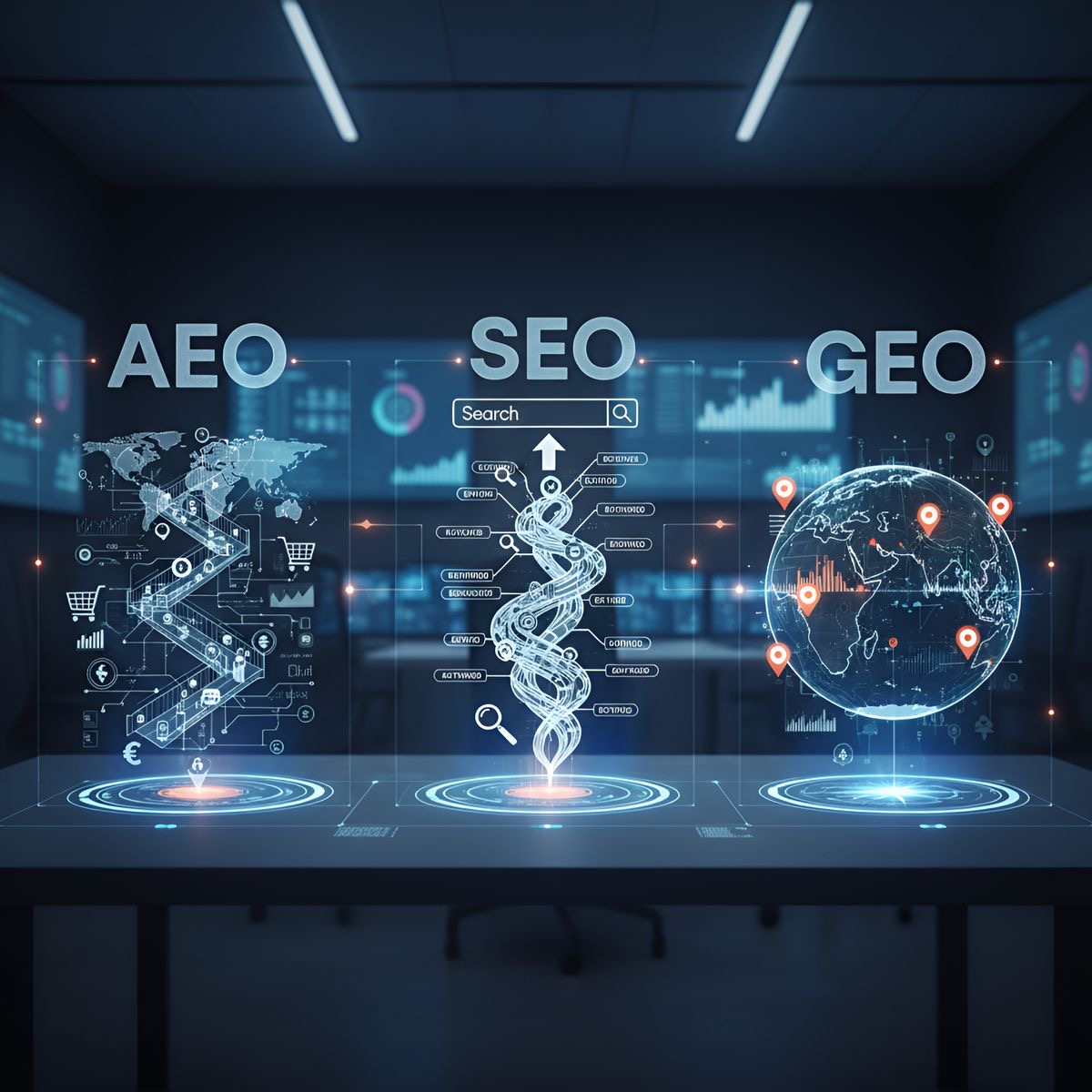
The transition from SEO to GEO (Generative Engine Optimization) marks a fundamental shift from optimizing for blue links to optimizing for AI-generated syntheses. In 2026, search is no longer about “finding” a website; it is about “being cited” by Large Language Models (LLMs) like Gemini, ChatGPT, and Perplexity. Success in this new landscape requires a focus on information gain, brand authority, and technical structures that AI can easily parse.
What is GEO and Why is Traditional SEO Not Enough?
Generative Engine Optimization (GEO) is the practice of optimizing digital content to be selected, synthesized, and cited by generative AI engines. While traditional SEO focuses on keywords and backlinks to rank in a Search Engine Results Page (SERP), GEO prioritizes the “citation probability” of a brand within an AI’s conversational response. As AI search engines move toward providing a single, comprehensive answer rather than a list of websites, the goal shifts from “ranking #1” to “becoming the primary source” of the AI’s knowledge.
The traditional “link-based” economy is under pressure. Recent industry data suggests that “Zero-Click” searches—where the user gets the answer directly from the AI—have risen to nearly 65% for informational queries. As Jensen Huang, CEO of NVIDIA, famously remarked: “We are entering an era where the computer is no longer a tool, but an agent that reasons.” For marketers, this means the technological innovation of search requires a move toward semantic density and E-E-A-T (Experience, Expertise, Authoritativeness, and Trustworthiness).
In the GEO framework, search engines behave like sophisticated researchers. They don’t just look for keywords; they look for unique insights and expert perspectives. If your content merely summarizes what is already on the internet, an AI engine has no reason to cite you. To survive this urban transformation of the digital landscape, content must provide “Information Gain”—data or perspectives that are not found in the AI’s training set.
How Does AI-Driven Search Change Content Strategy?
AI-driven search changes content strategy by rewarding contextual relevance and structured data over keyword density. To succeed in Generative Engine Optimization, creators must adopt an Answer-First model, where the core solution to a user’s problem is presented clearly at the beginning of the text, followed by supporting evidence. This allows AI “crawlers” to identify the “truth-claim” of your content instantly and use it as a snippet in a generated response.
Statistics from Gartner predict that by 2028, organic search traffic for brands will decrease by 25% due to generative AI’s dominance. However, the quality of the remaining traffic is expected to be significantly higher. Users who click through from an AI citation are often deeper in the “Awareness” or “Consideration” phase, meaning your content must act as a professional advisor rather than a sales pitch. This is the future of search, where the authority of the source outweighs the technical tricks of the past.
Why is Structured Data the Secret to GEO Success?
Structured data, such as Schema.org, provides the “map” that generative engines use to verify facts and entities. In the GEO era, Schema markup is not just an add-on; it is the primary languagethrough which you communicate your brand’s EEAT to the model. By clearly defining “Who,” “What,” and “Why” through JSON-LD, you increase the likelihood that the AI will trust your data enough to present it as a factual answer.
- Entity Linking: Connect your brand to known authoritative entities in your niche.
- Fact-Checking Nodes: Ensure your data is consistent across multiple platforms (LinkedIn, Wikipedia, Official Site).
- Source Transparency: Use citations within your own content to show the AI that your research is grounded in reality.
Can Small Brands Compete with Giants in a GEO World?
Small brands can compete in a GEO world by focusing on hyper-niche expertise and unique data sets that large, generic corporations often overlook. Generative engines prize “Experience”—the first ‘E’ in E-E-A-T. By providing original case studies, raw data, or unconventional (but proven) advice, a small brand can become a “Primary Citation” for specific queries, bypassing the traditional domain authority barrier of old-school SEO.
Recent studies on Generative Engine Optimization show that LLMs are surprisingly democratic. They tend to cite the most relevant and logically sound answer, regardless of whether it comes from a Fortune 500 company or an independent SEO expert. This technological innovation levels the playing field for those who can provide genuine informational value.
What Role Does Brand Mention and Sentiment Play in GEO?
In the world of Generative Engine Optimization, your brand’s presence is measured by “Share of Model”—the frequency and sentiment with which an AI mentions your brand. Generative engines do not just read your website; they read reviews, social media discussions, and news articles to form a “concept” of your brand. If the general consensus online is that your service is unreliable, the AI will hesitate to cite you as a recommendation.
Managing your digital footprint now requires a visionary approach to PR. It is about ensuring that the data the AI “feeds” on is accurate and positive. As search evolves into a dialogue, your brand must exist as a reliable entity within that conversation. This is the urban transformation of public relations: from chasing headlines to managing the knowledge graph of your industry.
How to Audit Your Content for Generative Engine Compatibility?
Auditing for GEO compatibility involves testing how AI models interpret and summarize your pages. You can do this by feeding your URLs into LLMs and asking them to “Summarize the unique value of this page.” If the AI misses your core message, your content structure is failing. A successful GEO strategy ensures that your “Key Takeaways” are highlighted and that your LSI (Latent Semantic Indexing) keywords support a coherent narrative rather than a disjointed list of terms.
- Directness: Does the H2 answer the question immediately?
- Uniqueness: Is there a statistic or quote that isn’t on the first page of Google?
- Clarity: Is the language professional and free of “fluff”?
Adapting to the New Search Paradigm
The shift from SEO to GEO is not a trend; it is the structural reorganization of human knowledge. To remain visible in 2026, you must stop treating search engines as filing cabinets and start treating them as intelligent curators. By focusing on Generative Engine Optimization, providing Information Gain, and maintaining high EEAT standards, you ensure that your brand remains a vital part of the global conversation. The era of the blue link is fading, but the era of the authoritative answer has just begun.