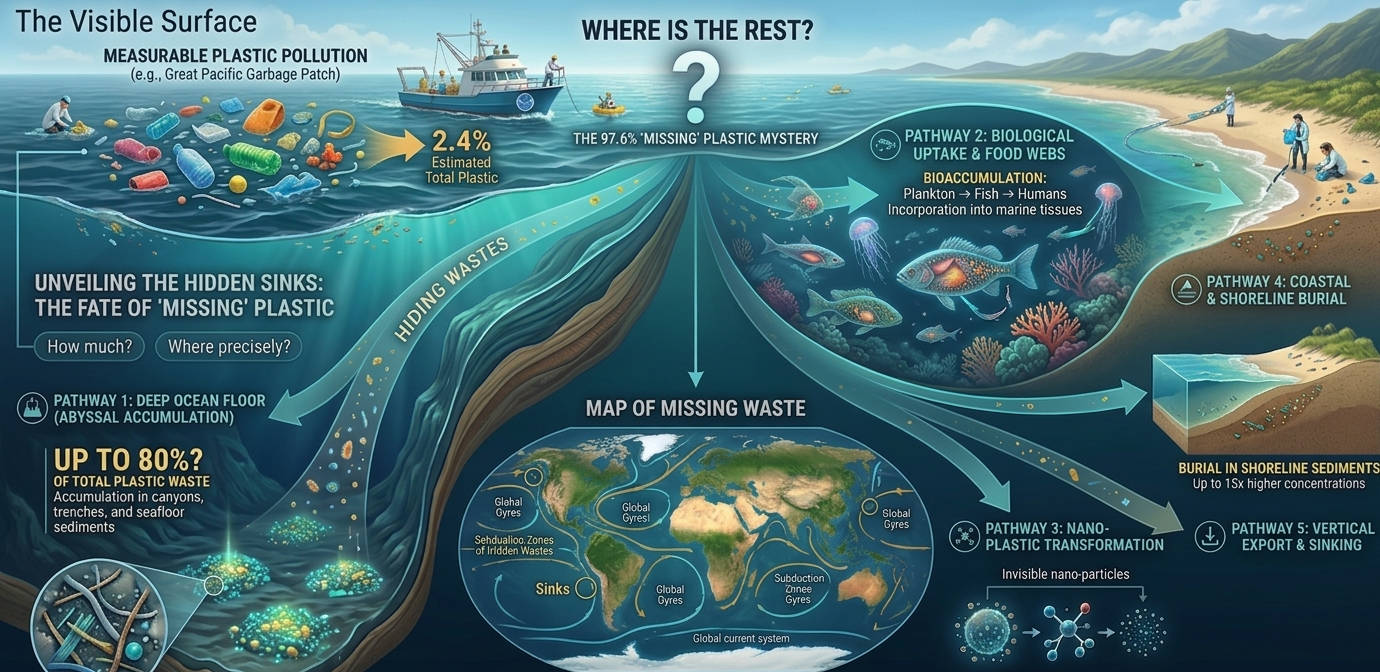
For decades, oceanographers have faced a disturbing mathematical discrepancy: we produce millions of tons of plastic annually, yet only a fraction is visible on the ocean surface. This “missing” plastic represents nearly 99% of the waste entering the marine environment. Recent evidence suggests this debris isn’t gone; it has fragmented into microplastics, sunk to the deep-sea floor, or been sequestered within biological cycles, creating a complex environmental puzzle.
Why is 99% of Ocean Plastic Missing from the Surface?
The vast majority of marine plastic is missing because environmental forces—such as UV radiation, mechanical wave action, and bacterial colonization—transform large debris into microscopic particles. While early research focused on the Great Pacific Garbage Patch, we now understand that surface buoyant plastic is merely the “tip of the iceberg.” Most waste eventually loses buoyancy through biofouling or is transported by deep-sea currents to remote ocean trenches.
The scale of this discrepancy is staggering. According to a landmark study led by the University of Manchester, the deep-sea floor can act as a “sink” for plastic, with concentrations of up to 1.9 million pieces of microplastics per square meter in certain hotspots. As Dr. Ian Kane, lead author of the study, noted: “We were shocked by the sheer number of microplastics we found on the deep-sea bed. It was much higher than anything we had seen before.” Current estimates suggest that while over 8 million metric tons of plastic enter the ocean every year, only about 250,000 tons are found floating. The “missing” remainder is likely distributed across three main reservoirs:
- The Benthic Zone: Deep-sea sediments where heavy or bio-fouled plastics settle.
- The Cryosphere: Significant amounts of plastic are now being trapped in Arctic sea ice.
- Marine Biota: Ingestion by organisms ranging from plankton to whales, effectively moving plastic into the marine food web.
Understanding these pathways is critical for environmental impact assessments. If we only measure what floats, we are missing 99% of the problem.
What Role Do Microplastics Play in the Disappearing Act?
Microplastics act as the primary vehicle for the “disappearance” of plastic by breaking down into sizes that are difficult to track with standard satellite or visual surveys. These particles, often smaller than 5mm, are created through the weathering of larger items or enter the water directly as microbeads and synthetic fibers. Their high surface-area-to-volume ratio makes them prone to sinking and ingestion.
The transition from “macro” to “micro” is not just a change in size; it is a change in behavior. When plastic enters the ocean, it is immediately colonized by microbes, a process known as “biofouling.” This microscopic community increases the density of the plastic, causing even naturally buoyant polymers like polyethylene to sink into the dark, unreachable depths of the water column.
How Does Plastic Pollution Reach the Deepest Parts of the Ocean?
Plastic reaches the deep sea through “underwater avalanches” called turbidity currents and the slow settling of “marine snow.” Deep-ocean currents act like conveyor belts, transporting microplastics from coastal shelves to deep-sea canyons and trenches. This suggests that the oceanic plastic cycle is far more dynamic than previously thought, with the deep sea acting as a final, permanent graveyard for our waste.
Recent expeditions to the Mariana Trench—the deepest point on Earth—found plastic bags and candy wrappers at depths of nearly 11,000 meters. This proves that no part of our planet remains untouched by anthropogenic waste. The movement is driven by thermohaline circulation, the same global system that moves heat around the planet.
- Current-driven hotspots: Powerful bottom currents concentrate fibers and fragments in specific “drifts.”
- Biological transport: “Marine snow”—falling organic debris—traps plastic particles and carries them to the seafloor.
- Direct Sinking: High-density plastics like PVC and PET sink immediately upon entering the water.
Is the “Missing” Plastic Entering the Global Food Web?
Yes, a significant portion of the missing plastic is being sequestered within the marine food web through ingestion by marine organisms. From tiny zooplankton at the base of the food chain to apex predators, animals are mistaking microplastics for food. This bioaccumulation poses a direct threat to oceanic biodiversity and potentially leads to human exposure through the consumption of seafood.
“The presence of microplastics in the digestive tracts of deep-sea species confirms that our waste is infiltrating the most remote ecosystems on Earth,” states Dr. Jamieson of Newcastle University.
Statistics from the United Nations Environment Programme (UNEP) suggest that by 2050, there could be more plastic than fish in the sea by weight if current trends continue. This isn’t just an ecological crisis; it’s a systemic failure of our circular economy models. When plastic enters the biological cycle, it ceases to be “waste” and becomes a toxic constituent of the environment itself, altering the health of coral reefs and the reproductive success of marine mammals.
Can Technology Help Us Track the Missing Plastic?
Advanced satellite imaging, AI-driven ocean modeling, and autonomous underwater vehicles (AUVs) are the primary tools currently being used to solve the “missing” plastic mystery. By combining “top-down” satellite data with “bottom-up” sensor data from the seafloor, scientists are building a comprehensive map of the oceanic plastic cycle. These technologies allow us to predict “accumulation zones” where plastic is likely to settle.
The integration of machine learning has been a game-changer. By analyzing spectral signatures from space, researchers can now distinguish between patches of seaweed and floating plastic debris. Meanwhile, AUVs equipped with high-resolution cameras are patrolling the seafloor to quantify the density of settled waste.
How Can We Close the Loop and Prevent Plastic Leakage?
The only way to solve the mystery of the missing plastic is to stop it at the source through a robust circular economy and improved waste management systems. We must shift from a “take-make-dispose” model to one where plastic is treated as a valuable resource that never enters the natural environment. This requires global policy intervention, such as the UN Global Plastic Treaty, to limit production and mandate recyclability.
- Redesigning Polymers: Creating materials that are truly biodegradable in marine environments.
- Upstream Intervention: Capturing microplastics in wastewater treatment plants before they reach rivers.
- Global Policy: Implementing Extended Producer Responsibility (EPR) to hold manufacturers accountable for the entire lifecycle of their products.
The environmental impact of plastic is a legacy we are leaving for future generations. While the plastic may be “missing” from our sight, its chemical and physical presence continues to reshape the planet’s ecology.