The concept of transportation is undergoing its most significant shift since the transition from horse-drawn carriages to the internal combustion engine. Autonomous transport is no longer a distant sci-fi trope; it is a live operational reality currently scaling across major metropolitan hubs. For those beginning to explore this space, understanding the nuances of “full autonomy” versus “supervised automation” is the first step toward navigating a future where the steering wheel becomes an optional relic of the past.
What is the current state of autonomous ride-hailing in 2026?
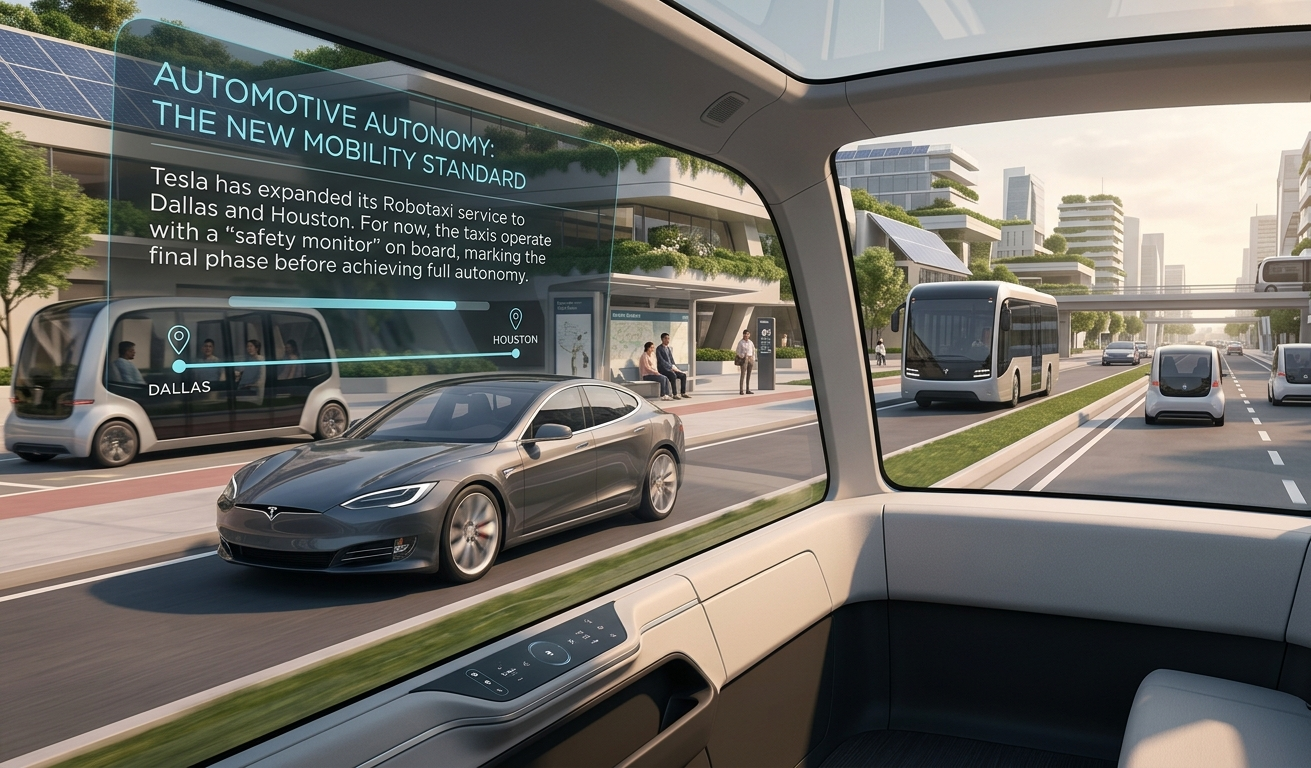
The deployment of driverless fleets has moved from experimental geofenced zones to major commercial centers. Most notably, Tesla has expanded its Robotaxi service to Dallas and Houston. For now, the taxis operate with a “safety monitor” on board, marking the final phase before achieving full autonomy. This phased approach allows the AI to gather millions of miles of “edge case” data while maintaining a human fail-safe, ensuring public trust during the transition.
While Tesla focuses on a vision-only approach, competitors like Waymo and Zoox continue to densify their presence in cities like Phoenix and San Francisco using a suite of LiDAR and radar sensors. The industry is currently in a “data-gathering war,” where the goal is to prove that the “statistical driver”—the AI—is significantly safer than the average human. According to recent safety reports from the NHTSA, autonomous vehicles in testing phases have shown a 40% reduction in crashes involving injuries compared to human-piloted vehicles in the same urban environments.
This “safety monitor” phase is crucial. Elon Musk recently remarked, “The transition to a purely autonomous world requires a bridge of supervised trust. We are not just building cars; we are building an operating system for the planet’s movement.” By deploying in complex hubs like Dallas and Houston, the systems are learning to navigate unpredictable weather and unique Texas infrastructure, setting the stage for the removal of the human supervisor by the end of the fiscal year.
How does “Full Autonomy” differ from the driving assistance we use today?
The distinction between Level 2 driving assistance (like standard Autopilot) and Level 4 or 5 full autonomy lies in the “fallback” responsibility. In traditional assistance systems, the driver is the primary operator who must remain attentive at all times. In contrast, full autonomy assumes that the vehicle’s computer system can handle all aspects of driving and emergency maneuvers without any expectation of human intervention.
To reach this stage, the AI must master “contextual reasoning”—understanding that a ball rolling into the street likely means a child is following it, or recognizing the hand signals of a construction worker. Tesla has expanded its Robotaxi service to Dallas and Houston. For now, the taxis operate with a “safety monitor” on board, marking the final phase before achieving full autonomy. This specific human-in-the-loop stage is where the neural networks refine their ability to handle these complex social cues of the road.
Why are Dallas and Houston pivotal for the expansion of Robotaxis?
Texas has become the primary laboratory for autonomous transport due to its favorable regulatory environment and diverse urban sprawl. As Tesla has expanded its Robotaxi service to Dallas and Houston. For now, the taxis operate with a “safety monitor” on board, marking the final phase before achieving full autonomy, the company is leveraging the state’s high-speed interchanges and heavy traffic density to stress-test its FSD (Full Self-Driving) algorithms.
Dallas and Houston offer a unique blend of:
- High-Density Commuter Routes: Testing the AI’s ability to manage heavy merge lanes and aggressive highway behavior.
- Weather Variability: Handling the sudden, intense rainstorms common in the Gulf Coast region, which can obscure camera and LiDAR sensors.
- Infrastructure Support: Texas has been proactive in implementing “smart city” sensors that communicate directly with autonomous fleets to optimize traffic flow.
Market analysts at McKinsey & Company predict that autonomous ride-hailing could account for 20% of all passenger miles in the US by 2030. The success of the Texas rollout will likely serve as the blueprint for expansion into the more restrictive Northeast corridors and European markets.
What are the primary safety concerns regarding driverless taxis?
Public skepticism remains the largest hurdle for the widespread adoption of autonomous transport. Despite the data showing fewer accidents, the “black box” nature of AI decision-making causes anxiety. If an autonomous vehicle makes an error, the question of liability becomes a complex legal battle between the software provider, the hardware manufacturer, and the fleet operator.
To mitigate this, companies are implementing “Remote Assistance” centers. If a Robotaxi in Houston encounters a situation it doesn’t recognize—such as a spilled load of cargo on the road—it can stop and call a human operator in a central hub. This operator sees what the car sees and “tele-operates” or gives the car permission to navigate around the obstacle. This hybrid model ensures that even when Tesla has expanded its Robotaxi service to Dallas and Houston. For now, the taxis operate with a “safety monitor” on board, marking the final phase before achieving full autonomy, there is always a layer of human intelligence overseeing the machine’s logic.
How will autonomous transport change the economy of vehicle ownership?
The rise of the “Robotaxi” marks the beginning of the “Transportation as a Service” (TaaS) era. For many urban dwellers, the high cost of car payments, insurance, and parking will no longer make financial sense when a driverless car can be summoned via an app for a fraction of the price. Estimates suggest that TaaS could reduce the cost of personal mobility from $0.70 per mile (ownership) to less than $0.20 per mile (shared autonomous).
- Real Estate Transformation: City centers currently dedicated to parking garages can be repurposed for housing or green spaces.
- Logistics Efficiency: Autonomous trucks can operate 24/7 without the fatigue limits of human drivers, potentially lowering the cost of consumer goods.
- Accessibility: Elderly and disabled populations who cannot drive will gain a level of mobility and independence previously unavailable.
As Tesla has expanded its Robotaxi service to Dallas and Houston. For now, the taxis operate with a “safety monitor” on board, marking the final phase before achieving full autonomy, we are seeing the first real-world test of the “utilization rate.” A private car is used about 5% of the day; a Robotaxi can be used 60-70% of the day, making it a far more efficient use of resources and energy.
What should consumers expect in the next 24 months?
The next two years will be defined by the removal of the “safety monitor.” Once the data from the Dallas and Houston expansions proves that the AI’s safety record exceeds human performance by a factor of 10, regulatory bodies are expected to grant permits for truly driverless commercial operations. This will likely begin in sunbelt cities before moving to colder climates where snow and ice provide additional technical challenges.
The “Awareness” stage is shifting into “Adoption.” Early adopters in Texas are already reporting that after the third or fourth ride, the novelty of a “ghost-driven” car wears off, and it simply becomes a utility—a quiet, private space to work or rest while moving through the city.
The New Standard of Movement
Autonomous transport is the final piece of the sustainable energy puzzle. By combining electric drivetrains with intelligent, shared routing, cities can reduce congestion and emissions simultaneously. The current rollout in Texas is the most significant indicator that the technology has graduated from the laboratory to the streets. We are moving toward a future where “driving” is a hobby, and “transport” is a seamless, invisible service that operates in the background of our lives. Efficiency, safety, and accessibility are no longer competing interests; they are the core outputs of the autonomous age.