Professional growth in the modern economic landscape relies less on transactional exchanges and more on the depth of one’s professional ecosystem. A business networking event that prioritizes community over mere lead generation functions as a catalyst for sustainable career trajectory, fostering environments where mutual value creation replaces cold outreach. By integrating into these circles, professionals transition from isolated operators to central nodes within a collaborative network.
Why does a community-driven networking approach outperform traditional sales-focused events?
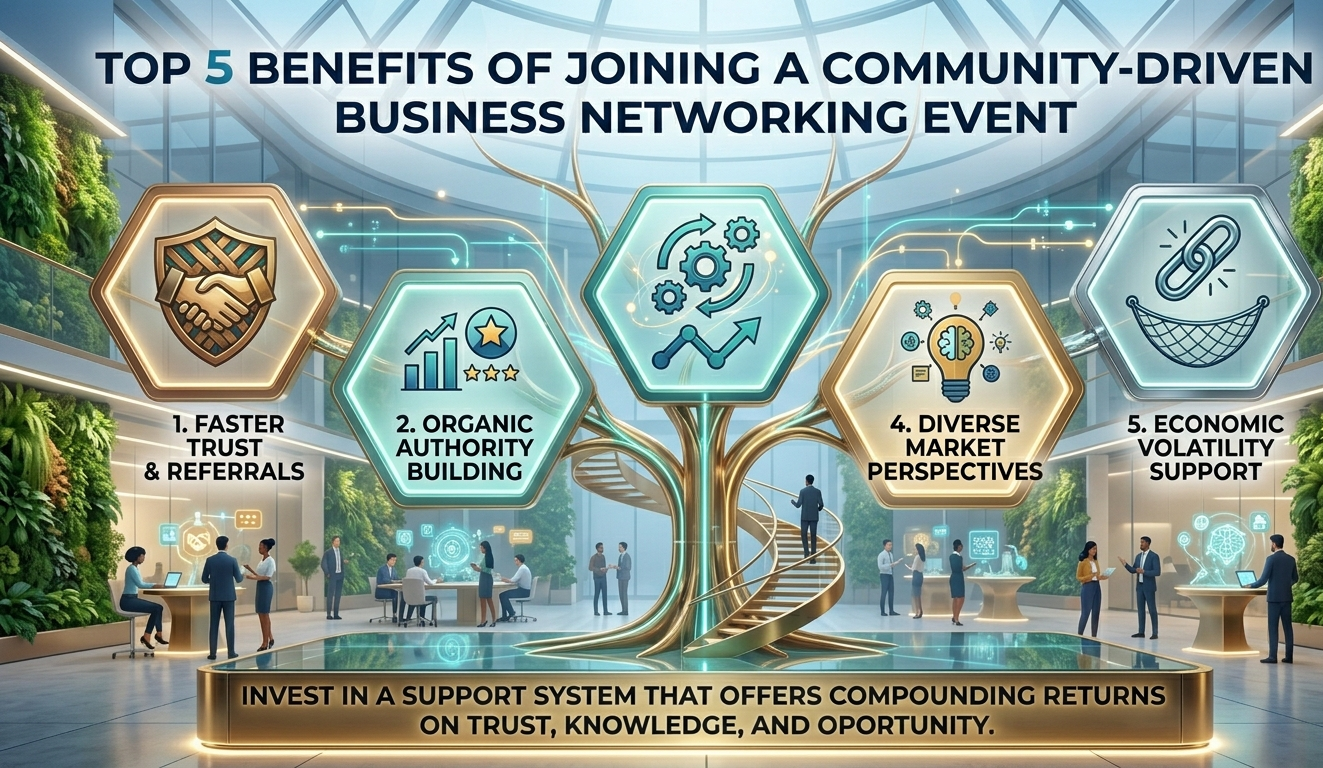
Community-driven events prioritize long-term relational equity over short-term conversion metrics. By focusing on shared challenges and collective problem-solving, these gatherings build trust significantly faster than environments where every interaction is clouded by a hidden sales agenda. This relational depth is the primary driver of high-value business opportunities in a crowded market.
In a traditional setting, the “pitch” is the primary barrier to authentic conversation. Conversely, when the core objective is community support, the interpersonal dynamics shift entirely. Participants engage in active listening, identifying how they can contribute to the success of others rather than simply extracting value. Research indicates that trust-based networks are 30% more efficient at delivering high-quality business leads than competitive, transactional environments.
As networking expert Ivan Misner famously noted: “Networking is more about farming than it is about hunting.” This philosophy is the bedrock of successful community-led initiatives. When professionals stop “hunting” for the next sale and begin “farming” relationships, they cultivate a sustainable pipeline of referrals. In these spaces, your reputation becomes your currency. You are not just a name on a business card; you are a solution-provider, a peer, and a potential collaborator.
The structural advantage here is rooted in psychological safety. When attendees feel that their peers are genuinely invested in their professional hurdles, they are more willing to share “insider” knowledge, nuanced market insights, and strategic warnings that you will never find in an open forum or a whitepaper. This environment transforms networking from a tedious chore into a strategic asset. By removing the pressure to “close” a deal, you open the door to genuine innovation and collaborative potential that can redefine your operational capacity for years to come.
How can targeted networking enhance your professional visibility and authority?
Attending a business networking event with a strong community focus allows you to demonstrate your expertise organically through consistent contribution. Instead of broadcasting your skills, you solve problems, answer complex industry questions, and offer mentorship. This subtle, high-impact display of knowledge solidifies your position as a trusted authority within your specific niche.
When you consistently provide value, your presence becomes synonymous with reliability. Attendees naturally begin to associate your personal brand with specific domains of competence. This is not about being the loudest person in the room; it is about being the most helpful. By consistently facilitating solutions for others, you effectively lower the friction for future partnerships. Your visibility is no longer tied to marketing spend but to the genuine impact you have on the collective growth of the network members. This organic authority building is far more durable than paid advertising.
Can community-centric events actually accelerate your business development cycles?
Yes, they significantly shorten cycles by bypassing the standard “getting to know you” phase through social proof. When a member of your trusted community introduces you to a prospect, the conversion barrier is drastically reduced because the prospect has already “inherited” the trust that the existing member has established with you.
In professional services, this is the gold standard of client acquisition. Statistically, peer-referred leads close at a rate approximately 20% higher than cold leads. By participating in a business networking event that emphasizes community, you are effectively turning every attendee into a potential brand ambassador. The speed of business today demands this level of efficiency; waiting for organic brand recognition is a luxury few growth-oriented businesses can afford.
Furthermore, these environments provide a vital feedback loop. When you discuss a product or service iteration with a group of trusted peers, you receive honest, high-fidelity feedback that you would otherwise have to pay a consultancy to obtain. This accelerated feedback loop allows for rapid pivoting and strategic adjustment, keeping your business development efforts aligned with current market realities rather than outdated assumptions. By leveraging the collective intelligence of your peers, you minimize the risk of costly mistakes and ensure your offerings remain hyper-relevant.
What role does diverse perspective play in long-term strategic planning?
Diversity of thought is the greatest hedge against industry stagnation. Engaging with professionals from adjacent sectors within a community-driven framework provides a bird’s-eye view of broader market trends. This cross-pollination of ideas enables you to identify emerging opportunities or systemic threats long before they reach mainstream awareness, allowing for proactive, rather than reactive, strategic maneuvering.
When your network is homogeneous, your strategic planning often mirrors your existing biases. By integrating into a broader community, you gain access to non-linear thinking. A developer might gain a critical insight into user experience from a marketing director in a completely different industry. This exposure to varied methodologies forces you to sharpen your own internal processes and question long-held assumptions. The objective is to construct a resilient strategy that survives disruptions by learning from the successes and failures of peers across the entire economic spectrum.
How do these networks provide support during challenging market conditions?
Community-driven networks serve as a professional safety net during economic volatility by providing access to shared resources, moral support, and collaborative problem-solving. When market conditions tighten, the inherent trust within these groups acts as a stabilizer, allowing businesses to form strategic alliances that would be deemed too risky in an open market.
It is during downturns that the community aspect becomes most tangible. You might find members pooling marketing budgets, sharing talent, or even collaborating on bundled service offerings to maintain market share. This collective resilience ensures that the survival of the group is prioritized. As data suggests, organizations that maintain strong, collaborative ties to their industry ecosystem are 25% more likely to recover quickly from localized economic downturns compared to isolated competitors. This level of support is invaluable when navigating uncertainty.
Where should you begin when selecting the right networking community?
The most effective way to start is by vetting the community’s “give-to-get” ratio. A high-quality business networking event will have members who are more interested in what they can offer to the group than what they can personally gain. Observe the dynamics of the group: is there a culture of genuine peer-to-peer support, or is it merely a room full of people waiting for their turn to pitch?
Identify groups that curate their membership. Exclusivity, when based on a shared commitment to values and ethical conduct, usually signals a higher quality of interaction. Look for consistency—networks that meet regularly foster deeper bonds than one-off conferences. Your goal is to find a circle where you can show up consistently, offer your expertise, and build the kind of relational depth that becomes a long-term competitive advantage for your professional career.