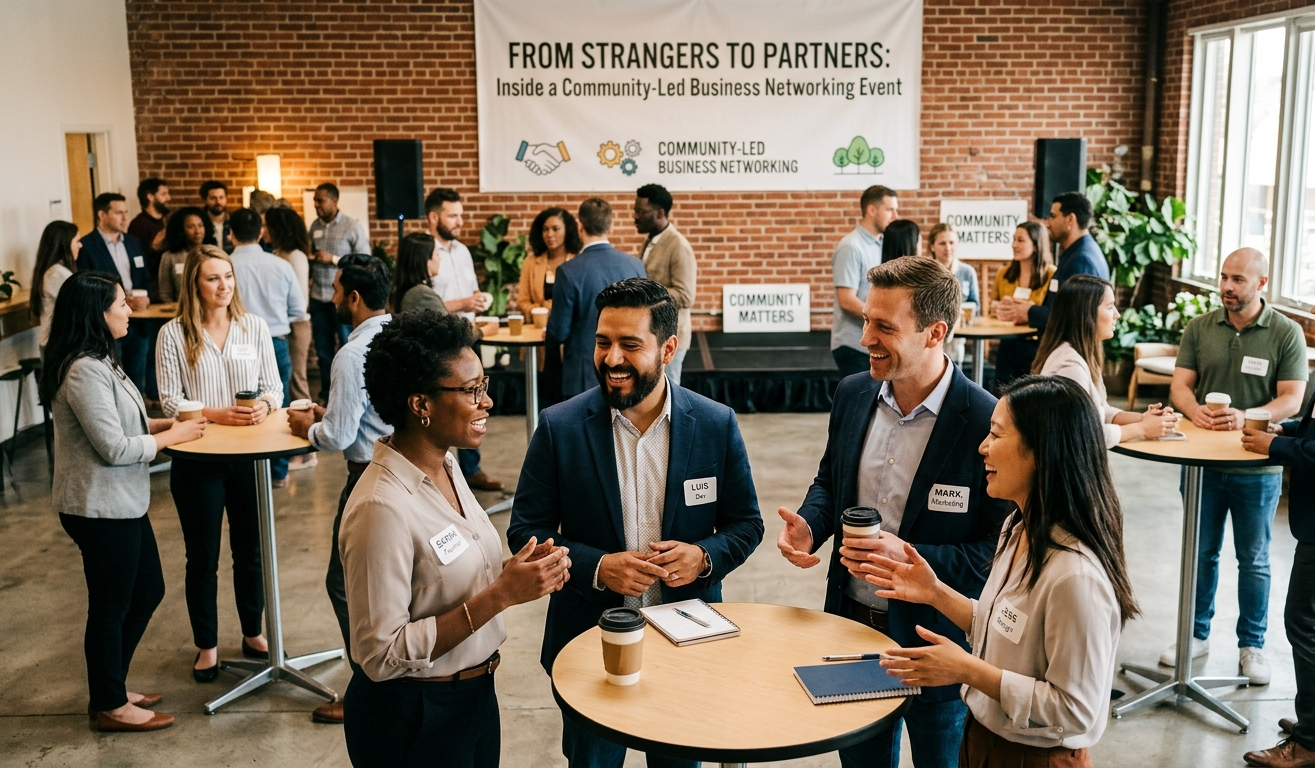
In an era defined by digital saturation, the shift toward organic, connection-first professional environments has fundamentally altered how partnerships are formed. A business networking event anchored in a community mindset moves beyond simple exchange of contact details. It prioritizes long-term value creation, shared goals, and collaborative growth over transactional sales, turning strangers into strategic partners through intentional engagement.
What defines a community-led business networking event?
A community-led business networking event is a structured environment where the primary objective is to foster deep-rooted relationships rather than immediate lead conversion. Unlike traditional events driven by “speed dating” styles of interaction, these gatherings leverage shared values and localized interests to build a community that sustains professional support long after the event concludes.
The architecture of these events rests on three pillars: shared identity, mutual contribution, and sustained interaction. When organizers curate a space based on specific professional interests or industry challenges, they remove the friction inherent in cold outreach. Research indicates that 70% of professional opportunities arise from “weak ties,” but these ties only become actionable when nurtured within a community framework. By focusing on collaborative problem-solving—where attendees are invited to contribute expertise rather than pitch services—the atmosphere shifts from competitive to cooperative. This shift is critical for building the trust required for high-stakes partnerships.
Why are community-led models more effective than traditional networking?
Traditional models often fail because they treat professional relationships as commodities. In contrast, community-led models view them as investments. When individuals meet within a community, they share a baseline of trust. This “pre-vetted” environment lowers the barrier to entry for meaningful conversation, accelerating the cycle from being strangers to becoming partners who understand each other’s vision.
Statistically, networking events that employ “facilitated connection” techniques—such as small group discussions based on common pain points—report a 40% increase in long-term partnership formation compared to open, unmoderated sessions. The psychology is straightforward: when you position yourself as a resource to a community rather than a vendor at a business networking event, you bypass the defensive barriers people naturally erect against sales pitches.
As noted by organizational development expert Dr. Elena Vance:
“The future of business is not in the number of business cards collected, but in the density of the network you serve. True partnership emerges when the motive shifts from ‘what can I get’ to ‘what can we solve together’ within a trusted ecosystem.”
This transition is why modern industry leaders are moving away from massive, anonymous conferences toward curated, smaller-scale events where every participant has a reason to be there and a role to play.
How can you prepare to turn initial meetings into lasting partnerships?
Preparation involves auditing your current objectives and identifying how you can offer value before seeking a return. To transition from a stranger to a partner at a business networking event, you must approach the room with a “contribution-first” mentality, ensuring your expertise is visible, relevant, and aligned with the needs of the community.
Start by researching the cohort attending the event. If the business networking event has a theme, prepare one specific insight or case study that addresses a common challenge in that niche. When you offer a solution or a perspective without a hidden agenda, you demonstrate your value as a peer. Furthermore, preparation requires clarity in your own professional roadmap. If you cannot succinctly articulate the “why” behind your work, potential partners will struggle to see how their goals might align with yours. Active listening, followed by intelligent, context-aware questioning, remains the most potent tool in your arsenal. The goal is to identify common threads—shared struggles, similar target demographics, or complementary service gaps—that transform a polite introduction into a brainstorming session, which is the precursor to any successful professional alliance.
What role does active listening play in the networking process?
Active listening is the cornerstone of building long-term partnerships. It allows you to uncover the nuances of a potential partner’s business model that are never visible on a brochure. By listening to the challenges within a community, you position yourself as someone who understands the landscape, which is essential for earning trust at a business networking event.
Most people at these events spend their time waiting for their turn to speak. By intentionally doing the opposite, you gain a competitive advantage. When you demonstrate that you have synthesized what a contact has said, you validate their professional experience. This validation is a powerful bonding agent. It turns a superficial exchange into a memorable interaction, significantly increasing the probability of a follow-up meeting. In the context of a community, this practice scales; as you listen to multiple people, you begin to act as a “network hub,” connecting others to one another. Being a connector is perhaps the fastest way to become an indispensable partner within a community.
How do you measure the success of these networking interactions?
Success at a business networking event should be measured by the quality and depth of follow-up conversations rather than the volume of connections made. A high-value outcome is the transformation of a “hello” into a “let’s dive deeper,” indicating that the initial interaction was significant enough to warrant further exploration of a partnership.
Key performance indicators for your networking efforts should include:
- Conversion Rate: The number of initial contacts that move to a dedicated one-on-one discovery meeting.
- Collaboration Potential: Identifying at least one project or problem that both parties could tackle together.
- Network Contribution: The number of people you successfully introduced to each other, reinforcing your status in the community.
Looking at the trajectory for professional growth through 2030, analysts suggest that nearly 60% of B2B partnerships will originate through community-integrated channels rather than outbound digital marketing. This underscores the necessity of being present in these spaces. Success is not instant; it is a cumulative effect of showing up, adding value, and maintaining the trust you have built.
Why is follow-up critical in community-led ecosystems?
Follow-up is the bridge between a promising connection and a functional partnership. If the business networking event is the catalyst for the reaction, the follow-up is the stabilization. Within a community, your follow-up must be personalized and value-driven, acknowledging specific points of discussion to maintain the momentum generated during the initial meeting.
Neglecting the follow-up process is the most common reason why promising connections wither. If you promised an introduction, a resource, or a follow-up thought, deliver it within 48 hours. This demonstrates reliability—the most critical attribute of a partner. In a community setting, being seen as a reliable actor elevates your reputation, making it easier for future interactions to turn into partnerships. Your follow-up should not be a sales script; it should be a continuation of the dialogue, reinforcing that you were truly listening and that you are committed to the collaborative potential discussed. By consistently showing up as a partner, you naturally rise to the top of the collective consciousness, ensuring that when opportunities arise, your name is the first one mentioned.
The transition from stranger to partner is not a feat of charisma, but of consistent, value-based interaction. When you engage with integrity, the community responds, and your professional network evolves from a list of contacts into a robust engine for sustained growth and shared success.