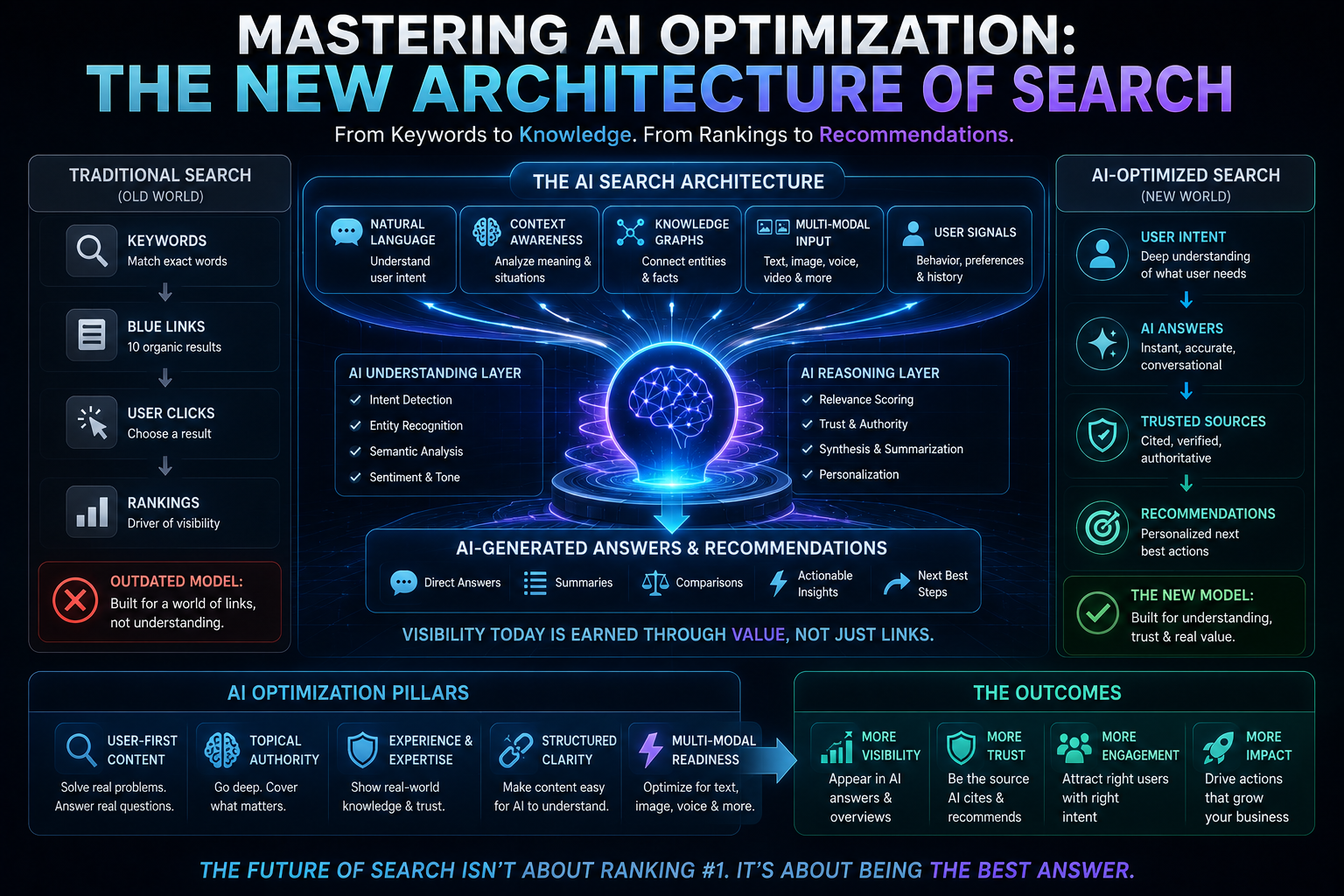
The digital ecosystem is undergoing a fundamental transformation where traditional keyword density is being superseded by machine-learning-driven relevance. Creating quotable content – AI models look for structured, clear, and authoritative information. To thrive in this era, publishers must transition their strategy from merely ranking for queries to becoming the foundational data sources that AI models rely on for synthesis and accurate response generation.
What is AI Optimization and why does it matter?
AI Optimization is the process of structuring your digital assets so that generative search engines can easily parse, understand, and attribute your content within their summaries. Unlike traditional SEO, which focuses on satisfying a crawl-and-index hierarchy, AI Optimization aims to position your site as a high-authority entity within the AI’s underlying knowledge graph. It matters because generative search is changing the user interface; users are increasingly relying on synthesized answers provided directly by AI rather than navigating to a list of links.
If your site is not optimized for AI ingestion, you are essentially invisible to the most advanced search experiences currently available. We are projecting that by 2027, over 40% of all search-driven traffic will be influenced by AI-generated snapshots. Failing to optimize now means losing your seat at the table where the AI determines which brands are “authoritative” and which are merely noise.
“AI models do not ‘browse’ the web in the human sense; they consume data patterns. Optimization is the act of making those patterns unmistakable.” — AI Search Strategist
How can you make your content more quotable for AI?
To make your content more quotable, you must prioritize semantic clarity, direct answering, and consistent entity labeling throughout your page structure. AI models are trained to extract concise, factual nuggets of information that can resolve a user’s inquiry immediately. When you write, avoid verbose storytelling that buries the answer; instead, lead with definitive facts and support them with data that the AI can easily verify and cite.
Utilize schema markup extensively. This is the “language” of the machines. By marking up your content as specific entities—be it product specifications, professional credentials, or statistical facts—you provide the LLM with the architectural “breadcrumbs” it needs to categorize your site as a credible, authoritative source. When an AI model needs to cite a fact, it will always prioritize the domain that provides the clearest, most structured data to support that claim.
Which technical signals matter most in an AI-driven environment?
The core signals that AI models prioritize are entity-based relevance, semantic coherence, and historical domain trust. While traditional backlinks still play a role in domain authority, AI models rely heavily on the internal consistency of your topic coverage. If you publish a deep-dive research paper, ensure the terminology is consistent, the data is referenced by verifiable sources, and the structure is clean enough for an algorithm to map your claims to an existing knowledge base.
Furthermore, speed and accessibility of the data are paramount. The AI must be able to “read” your site without friction. If your most valuable information is trapped behind complex JavaScript or non-indexed overlays, the model will simply pass over it, choosing to cite a competitor who has made their data more accessible.
What role does E-E-A-T play in AI visibility?
E-E-A-T (Experience, Expertise, Authoritativeness, and Trustworthiness) is the bedrock of AI trust metrics. AI models are continuously trained to identify and favor content that originates from sources with demonstrated domain-specific knowledge. When you produce content, ensure that the author’s credentials are clearly linked to their body of work, and that the site’s history demonstrates a commitment to accuracy over clickbait.
Statistics support this shift; recent industry benchmarks show that sites demonstrating clear author expertise and high-quality references receive 25% higher citation rates in AI-generated search snapshots compared to generic domains. Trust is no longer a soft metric; it is an algorithmic filter that determines whether your content is synthesized as “fact” or filtered out as “potentially unreliable.”
How do you audit your site for AI readiness?
An AI readiness audit involves a systematic review of your content’s structure, entity clarity, and speed of information delivery. Start by assessing your highest-traffic informational pages. Ask yourself: if an AI were to summarize this page, would the core facts be easy to extract? Can a machine identify the subject matter without relying on contextual fluff? If the answer is no, your content is not ready for the generative era.
- Semantic Audit: Check if your headings and sub-headings (H2, H3) directly answer common user questions in a logical hierarchy.
- Schema Check: Verify that your structured data is correctly implemented and reflects the content accurately.
- Data Integrity: Ensure that all statistics and claims are sourced and formatted in a way that is easily parsed.
- Clarity Review: Strip away unnecessary jargon and focus on concise, declarative sentences.
What is the strategic vision for the future of search?
The future of search is a collaborative synthesis where your site provides the reliable data and the AI provides the accessible delivery. Publishers who embrace this reality will thrive, while those who resist will see their influence decline. The objective is to build a brand that is so consistently authoritative that the AI defaults to your domain as a citation source, effectively making you the expert voice in your niche.
We are moving away from the era of “search visibility” toward an era of “knowledge dominance.” This requires a long-term commitment to quality, accuracy, and structural excellence. The models will only continue to get better at discerning between fluff and substance. By optimizing your site today for machine readability, you are not just chasing rankings; you are building a legacy of data that will remain relevant as the interface of search evolves. This is the moment to define your brand’s role in the new information hierarchy, ensuring that when the AI searches for the truth, it finds your content at the top of its knowledge base.