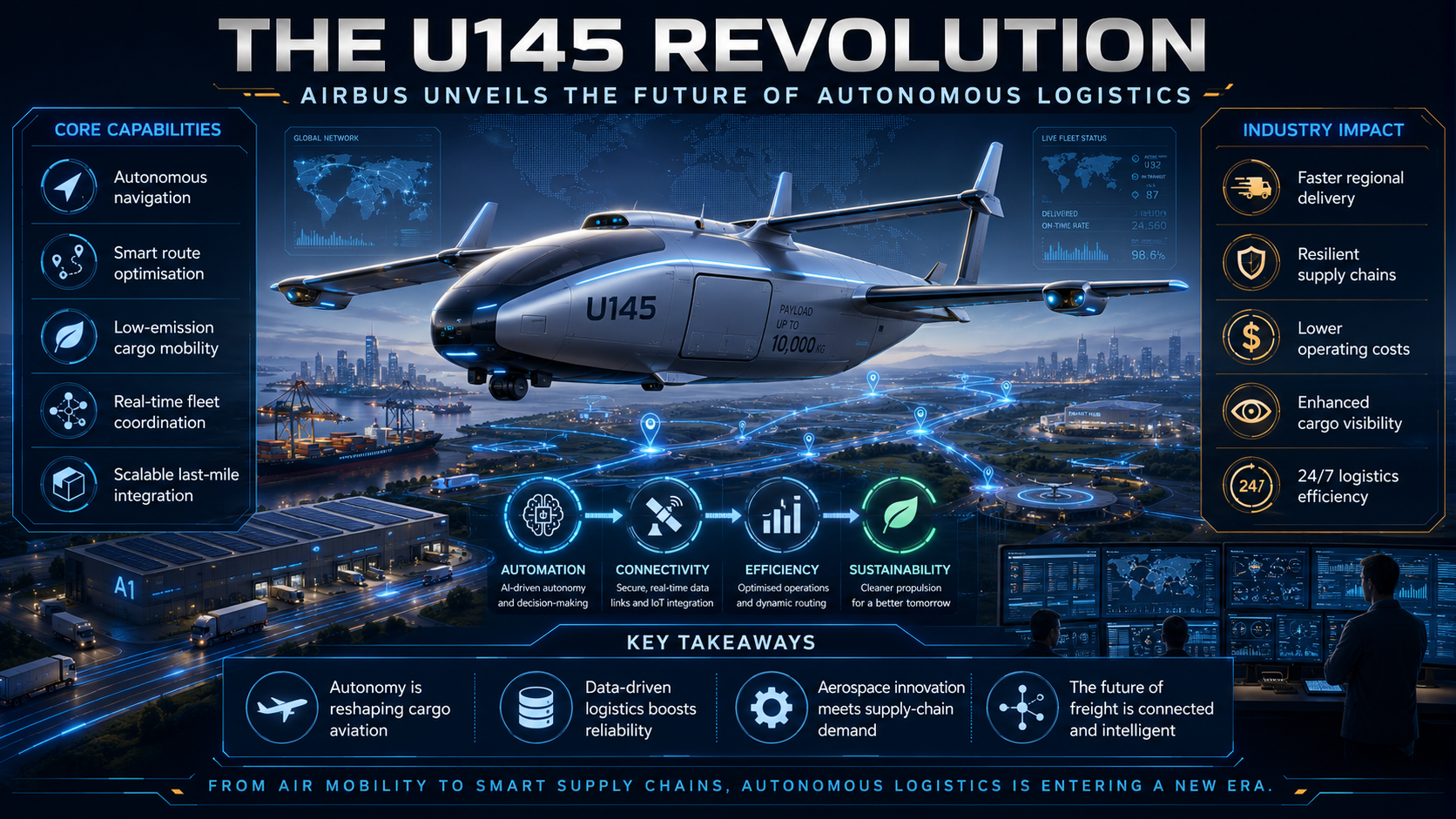
The aviation industry is witnessing a pivotal shift in how we approach aerial transport and logistical support. This is one of the most significant premieres of the month. Unveiled at the ILA Berlin 2026 air show, this machine is an unmanned version of the proven H145 helicopter. The U145 is designed for full autonomy, featuring AI for mission execution and a specialized sensor suite. Its purpose is to serve civil and military logistics needs by eliminating the physical cockpit in favor of increased cargo capacity.
What makes the U145 a game-changer for aerial operations?
The U145 represents a strategic fusion of Airbus’s most reliable airframe technology with the emerging capabilities of autonomous unmanned aerial systems (UAS). By removing the physical cockpit, Airbus has fundamentally reconfigured the aircraft to prioritize utility, effectively maximizing the internal volume for mission-critical cargo.
This helicopter is not merely a drone; it is a heavy-lift platform capable of a maximum take-off weight (MTOW) of 3,800 kg. The transition from a crewed platform to an uncrewed one follows the precedent set by the VSR700, yet the U145 brings the power and payload capacity of the medium-twin H145 class into a fully autonomous format. This allows operators to leverage a combat-proven airframe for tasks that were previously too dangerous or logistically complex for manned flight.
How does the U145 handle complex, multi-mission logistics?
The U145 is engineered as a mission-agnostic platform, utilizing a modular design that allows it to pivot between vastly different operational requirements with minimal downtime. Whether the goal is high-volume cargo delivery in remote regions or tactical support in contested environments, the U145’s specialized sensor suite and AI-driven navigation provide the necessary precision for safe operation.
The aircraft includes significant structural adaptations for cargo, most notably an integrated nose door coupled with a foldable loading table and a dedicated cargo floor. These features are designed to minimize ground time, a critical factor in both disaster relief and military resupply scenarios where speed and efficiency determine mission success.
Can unmanned helicopters actually replace manned assets?
The deployment of autonomous platforms is increasingly viewed not as a total replacement, but as an expansion of capabilities, particularly in “dull, dirty, or dangerous” missions. Uncrewed systems remove the physical risk to pilots in high-threat zones, while AI-driven flight planning ensures consistent performance even in challenging terrain where GPS or traditional communication links might be compromised.
Industry projections indicate that as autonomy technology matures, the “low-altitude economy” will see massive growth, with unmanned platforms serving as the backbone for rapid, frequent cargo movement. The U145 is positioned to lead this transition in Europe, combining the stability of a helicopter with the low manpower footprint required by modern logistics chains.
What is the timeline for the U145 to enter active service?
Airbus has outlined a clear path for the U145, with a maiden flight featuring a safety pilot on board scheduled for the end of 2026. Following this testing phase, the company aims for the model to enter operational service by the beginning of the next decade, setting a standard for the next generation of European UAS ecosystems.
Where will the U145 be deployed first?
The initial focus for the U145 encompasses a wide array of civil and military roles, including disaster management, firefighting, and surveillance. A particularly innovative application is the “drone mothership” function, where the U145 will act as a launch platform for air-launched effects—a project Airbus is currently developing in partnership with MBDA.
This versatility ensures that the U145 will not be tethered to a single industry. Instead, it is being built to integrate into existing European logistics infrastructure, providing a scalable solution for both government-led humanitarian efforts and specialized commercial operations. As the CEO of Airbus Helicopters, Matthieu Louvot, noted, the U145 is about combining the “proven airframe, power and useful load of the H145 with the autonomy of a UAS”.
Summary of the U145 Vision
The introduction of the U145 signifies a major milestone for Airbus, reflecting a deeper commitment to the unmanned systems market. By transforming a proven platform like the H145, Airbus avoids the risks associated with entirely new airframe development while instantly providing a high-capacity, heavy-lift solution to the logistics sector. The future of aviation, as evidenced by this premiere at ILA Berlin, lies in the intelligent, autonomous movement of goods—a future that the U145 is now poised to lead.