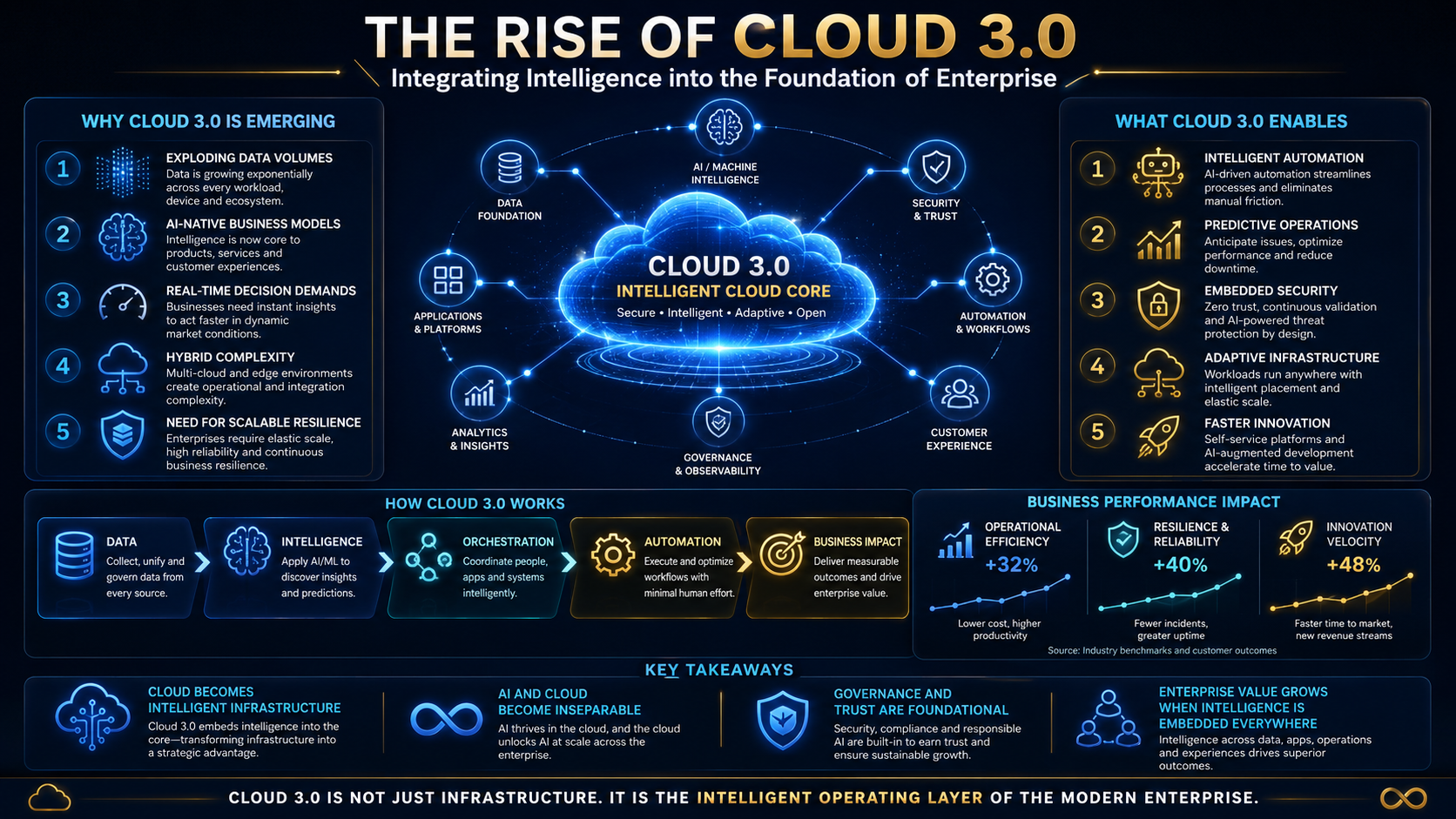
The paradigm of digital infrastructure is undergoing a fundamental evolution, moving from a static storage model to an intelligent, generative ecosystem. Cloud technologies are transforming from passive infrastructure into an active driver for AI. Organizations are massively shifting toward hybrid, private, and “sovereign” cloud models to train their own models on their proprietary data without the risk of leaks. This shift represents the birth of Cloud 3.0, an architectural era where the cloud does not just house data but actively synthesizes it into strategic enterprise value.
Why is Cloud 3.0 fundamentally different from previous iterations?
Cloud 3.0 distinguishes itself by moving intelligence directly to the site of data storage, rather than treating the cloud as a remote repository. By integrating AI compute power into the foundation of the architecture, organizations can now run model training and real-time inference within secure, isolated environments, effectively turning static servers into generative engines.
In the past, the cloud served as a utility—a digital warehouse that companies rented to store and run basic applications. However, the emergence of advanced machine learning has rendered that passive model obsolete. Today, the core challenge for any large-scale enterprise is the tension between leveraging AI for innovation and maintaining absolute control over sensitive, proprietary intelligence. Cloud 3.0 resolves this tension by localized processing. It removes the necessity of migrating massive datasets to public environments where data sovereignty—the control over where data resides and who accesses it—is often compromised. Instead, firms are building private, hybrid architectures that allow them to harness the full power of machine learning algorithms while keeping their “intellectual gold” behind a sovereign firewall. This is not just a technological upgrade; it is a strategic repositioning of the IT department from a cost-center provider to a primary generator of corporate competitive advantage.
What is the strategic importance of “sovereign” cloud models?
Sovereign cloud models ensure that data is stored and processed under the specific legal and regulatory jurisdiction of the host organization, effectively insulating them from external surveillance or international data transfer risks. This provides the compliance assurance necessary for highly regulated sectors, such as banking and healthcare, to adopt AI.
What are the projected trends for cloud adoption in the coming years?
Global analyst projections suggest that by 2028, over 65% of enterprises will have transitioned to hybrid or sovereign cloud infrastructures specifically to support proprietary AI development. This pivot is driven by a 40% projected increase in corporate demand for “clean room” data environments—secure areas where AI can be trained on internal data without leaking insights into broader, public-facing models.
“The true competitive edge in the next decade will be held by organizations that own the entire stack of their data-to-AI journey. Relying on public, multi-tenant models for proprietary strategy is an operational risk that Cloud 3.0 is designed to eliminate.” — Infrastructure and AI Architect
These statistics underscore a massive migration of capital and talent toward internal cloud sovereignty. Businesses are no longer comfortable with the “black box” nature of public AI platforms; they are investing heavily in private infrastructure that allows for “white box” transparency and auditability. The ability to fine-tune foundational models on proprietary, secure data is quickly becoming the ultimate benchmark of enterprise maturity.
How can businesses effectively transition to a hybrid cloud architecture?
The transition to a hybrid model requires a phased integration approach that prioritizes data gravity—moving the compute to the data, rather than the data to the compute. Firms should start by identifying mission-critical, high-sensitivity datasets and deploying sovereign cloud nodes to manage these specific assets, gradually integrating broader services as the hybrid framework matures.
What are the hidden costs of ignoring the transition to Cloud 3.0?
The primary risk of ignoring this transition is the accumulation of “AI technical debt,” where companies become overly reliant on public models that are generic, insecure, and subject to external policy changes. Firms that do not establish their own cloud foundations today will find themselves unable to participate in the “bespoke AI” economy, where specialized models are the standard for high-performance business.
This is a structural problem of dependency. When an organization builds its future on someone else’s public cloud AI, it is essentially renting its innovation potential. If the service provider changes the model, raises the price, or imposes new privacy restrictions, the enterprise is powerless. Furthermore, the risk of data leakage—where proprietary knowledge is inadvertently ingested into the public training data of a third party—is an existential threat to many industries. Cloud 3.0 mitigates this by design. It forces an architectural discipline that protects the firm’s most valuable intellectual property. The costs of not transitioning are therefore not just financial; they are strategic and reputational. Organizations that fail to control their cloud sovereignty will find that their proprietary data, instead of being a source of innovation, becomes a liability that they must hide rather than leverage. Transitioning is no longer an optional upgrade; it is a defensive necessity for long-term survival.
Conclusion: Orchestrating the New Digital Infrastructure
The emergence of Cloud 3.0 marks a pivotal shift in the architecture of the modern firm, where infrastructure is no longer a passive container but an active, intelligent driver of corporate output. By embracing hybrid, private, and sovereign cloud models, enterprises are reclaiming their digital autonomy, ensuring that their proprietary data remains their greatest strategic asset rather than a risky liability.
The move toward sovereign cloud platforms, combined with the power of private AI model training, provides the security and precision required for sustained innovation in a competitive market. As we look toward the remainder of 2026, the success of any large organization will be increasingly tied to how well it manages its digital sovereignty. The organizations that prioritize the construction of these secure, intent-driven cloud environments will be the ones that define the market standards for intelligence, privacy, and performance. By transitioning from the passive infrastructure models of the past to the active, intelligent systems of Cloud 3.0, leaders can guarantee that their technology stack is not just supporting their current operations, but actively building their future. The era of the general-purpose, public utility cloud is coming to an end; the era of the sovereign, intelligent enterprise cloud has begun.