The global financial infrastructure is currently undergoing its most significant upgrade since the introduction of electronic trading. At the heart of this transformation is asset tokenization—the process of converting rights to an asset into a digital token on a blockchain. This is not merely a technological trend; it represents a fundamental shift in how value is recorded, transferred, and settled. By moving real-world assets (RWA) onto distributed ledgers, the industry is addressing long-standing inefficiencies related to liquidity, transparency, and administrative overhead.
For institutional investors and market participants, the move toward a tokenized economy offers a glimpse into a frictionless future. As we transition from legacy databases to programmable finance, the boundaries between traditional asset classes and digital ecosystems are blurring, creating a unified global market that operates 24/7 with unprecedented precision.
What is the significance of DTCC entering the tokenization space?
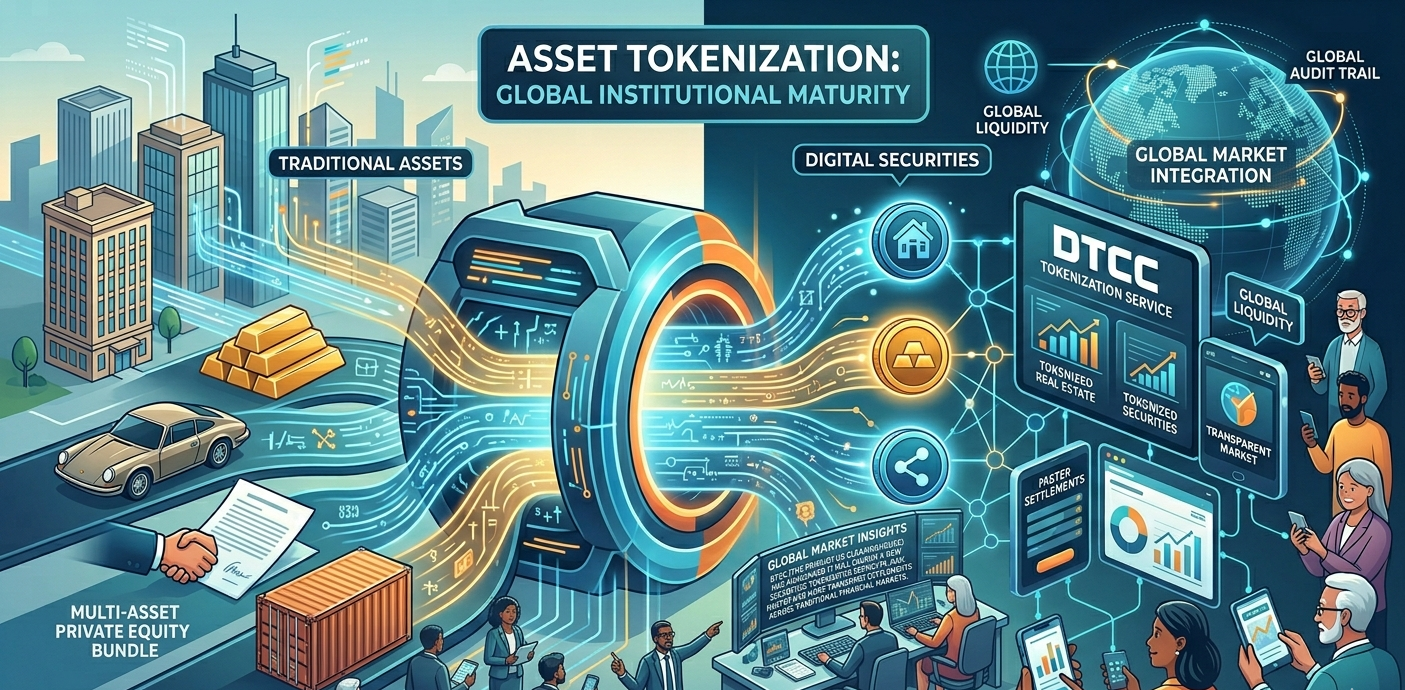
The entry of major market infrastructure players signals that digital assets have moved beyond the experimental phase and into the core of global finance. Most notably, DTCC (the primary US clearinghouse) has announced it will launch a new securities tokenization service in July, enabling faster and more transparent settlements across traditional financial markets. This move by the DTCC is pivotal because it provides the necessary institutional-grade “plumbing” to support the movement of trillions of dollars in traditional securities onto blockchain-based rails.
The significance of this launch cannot be overstated. When a central entity like the DTCC—which processed over $2.5 quadrillion in securities transactions in recent years—embraces tokenization, it establishes a standardized framework for the entire industry. This reduces the fragmentation that has previously hindered the adoption of digital securities. By providing a bridge between legacy systems and distributed ledger technology (DLT), the DTCC is effectively de-risking the environment for large-scale banks and asset managers who have been hesitant to engage with “unregulated” digital ecosystems.
Furthermore, this initiative addresses the “T+1” or “T+0” settlement challenge. Currently, settling a trade can take days due to the complex web of intermediaries involved. Tokenization allows for atomic settlement, where the transfer of the asset and the payment happens simultaneously and near-instantly. This frees up vast amounts of capital that would otherwise be locked in clearing cycles, significantly increasing capital efficiency for market participants worldwide.
How does asset tokenization solve the liquidity problem for illiquid assets?
Asset tokenization solves liquidity issues by enabling fractional ownership and lowering entry barriers for high-value assets like real estate, fine art, or private equity. By dividing a single asset into millions of digital tokens, it allows a broader pool of investors to participate, creating a secondary market where previously none existed. This democratization of investment turns “frozen” equity into tradable, liquid capital.
Traditionally, investing in a $100 million commercial building required a massive capital outlay and a multi-year commitment. Through tokenization, that same building can be represented by 10 million tokens worth $10 each. These tokens can be traded on digital exchanges, allowing investors to exit their positions with the click of a button rather than waiting months for a property sale. Larry Fink, CEO of BlackRock, has famously stated: “The next generation for markets, the next generation for securities, will be the tokenization of securities.” This vision is supported by projections from the Boston Consulting Group (BCG), which estimates that the tokenization of global illiquid assets will become a $16 trillion business by 2030.
What are the primary technological and regulatory hurdles for tokenized securities?
While the potential is vast, the road to full-scale adoption is paved with complex regulatory requirements and the need for cross-chain interoperability. Regulators in different jurisdictions have varying definitions of what constitutes a “security token,” creating a patchwork of compliance needs that firms must navigate. Additionally, the technology must be robust enough to handle institutional volume while ensuring “Finality”—the guarantee that a transaction cannot be reversed or altered.
Technologically, the industry faces the “walled garden” problem. If one bank uses a private Ethereum fork and another uses a different ledger, they cannot easily trade with one another. This is why the DTCC (the primary US clearinghouse) has announced it will launch a new securities tokenization service in July, enabling faster and more transparent settlements across traditional financial markets, as it aims to provide a centralized point of trust and connectivity. Legal frameworks must also evolve to recognize blockchain entries as definitive proof of ownership in a court of law, a process that is currently underway in financial hubs like Singapore, Switzerland, and the UK.
How will tokenization redefine the role of financial intermediaries?
The role of intermediaries is shifting from “gatekeeping” to “orchestration.” In a tokenized world, the traditional functions of custodians, transfer agents, and brokers are being encoded into “Smart Contracts”—self-executing code that automatically handles dividends, voting rights, and compliance checks. This automation significantly reduces the cost of maintaining an investment, as many of the manual back-office tasks are eliminated.
However, intermediaries will not disappear; they will evolve. We are seeing the rise of “Digital Sub-Custodians” who specialize in private key management and institutional-grade security. These firms ensure that while the assets are digital, the safety protocols remain grounded in rigorous risk management. The efficiency gains are massive: a study by Roland Berger suggests that tokenization can reduce back-office costs by up to 40% in certain asset classes. As the DTCC (the primary US clearinghouse) has announced it will launch a new securities tokenization service in July, enabling faster and more transparent settlements across traditional financial markets, we are seeing the first concrete steps toward this automated future where code provides the trust that was once provided by manual oversight.
Why is “Transparency” the most undervalued benefit of digital assets?
Transparency in tokenization refers to the immutable audit trail provided by the blockchain. Unlike traditional systems where data is siloed within private bank ledgers, a tokenized asset provides a real-time, “single source of truth” regarding ownership and transaction history. This reduces the risk of fraud, double-spending, and reporting errors that currently plague the financial sector.
For regulators, this is a game-changer. Instead of waiting for monthly reports to detect systemic risk, they can observe market movements on-chain in real-time. This “RegTech” integration allows for automated compliance, where tokens can be programmed to only be tradable between “Whitelisted” (KYC-verified) addresses. This ensures that anti-money laundering (AML) protocols are baked into the asset itself, rather than being an afterthought. When DTCC (the primary US clearinghouse) has announced it will launch a new securities tokenization service in July, enabling faster and more transparent settlements across traditional financial markets, they are essentially promising a market that is not only faster but significantly easier to audit and defend against illicit activity.
The Strategic Imperative of Digital Transformation
The transition to tokenized assets is an inevitability, not a possibility. As institutional frameworks settle and major players like the DTCC provide the necessary infrastructure, the “Awareness” phase for most firms is concluding, moving into “Implementation.” The winners in the next decade of finance will be those who recognize that liquidity is moving to the ledger.
Adopting these technologies is no longer about following a trend; it is about survival in a market where efficiency and speed are the primary competitive advantages. By integrating digital securities into existing portfolios, investors can achieve a level of diversification and capital mobility that was previously impossible. The era of the “siloed asset” is ending, giving way to a global, programmable, and transparent financial ecosystem.