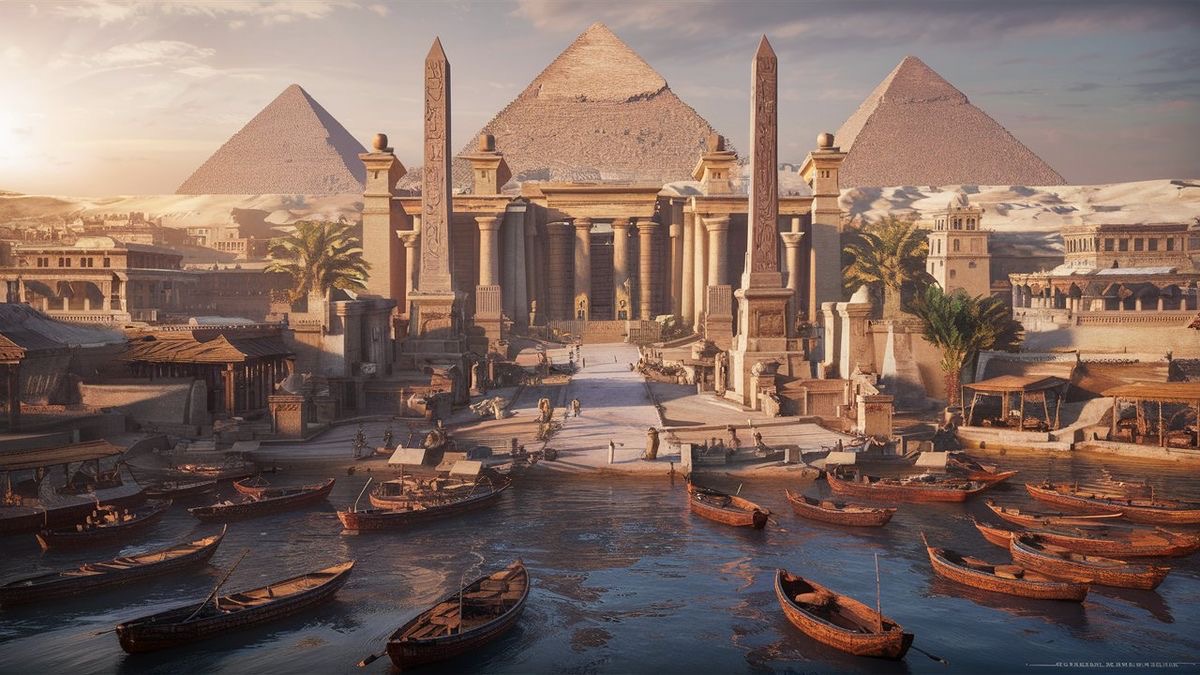
The legacy of Memphis, Egypt, is not merely found in its scattered ruins but in the very foundations of the Egyptian state. As the inaugural capital of a unified kingdom, Memphis served as the administrative, religious, and cultural heartbeat of the Nile Valley for over three millennia. For the modern observer seeking to understand the transition from nomadic tribes to a structured empire, Memphis represents the primary source of the political and theological frameworks that allowed the pyramids of Giza to exist.
Why Was Memphis, Egypt, the Strategic Center of the Ancient World?
Memphis, Egypt, served as the strategic center of the ancient world because of its unique geographic position at the apex of the Nile Delta, effectively controlling the junction between Upper and Lower Egypt. This location allowed the early Pharaohs to monitor trade routes, manage the agricultural surplus of the fertile Delta, and consolidate military power in a single, unassailable hub.
Founded around 3100 BCE by the legendary King Menes (Narmer), the city was originally known as Inbu-Hedj or “The White Walls.” Its placement was a masterstroke of geopolitical engineering. By sitting at the mouth of the Delta, Memphis functioned as a natural tollgate for all commerce moving toward the Mediterranean. Recent archaeological surveys suggest that at its peak during the Old Kingdom, the city housed upwards of 30,000 residents, making it one of the largest metropolitan areas of the Bronze Age.
Beyond its economic utility, Memphis was the theological home of Ptah, the creator god of craftsmen and architects. The Great Temple of Ptah, Hut-ka-Ptah, was so influential that its name eventually evolved through Greek translation into the word “Egypt” itself. To visit Memphis today is to stand at the linguistic and spiritual origin point of an entire nation. While the rising water table and the subsequent construction of Cairo have hidden much of the city’s sprawl, the sheer scale of the historical artifacts recovered—such as the colossal statue of Ramesses II—indicates a city of unimaginable grandeur.
What Can Travelers See at the Memphis Open-Air Museum Today?
The Memphis Open-Air Museum offers a curated encounter with the city’s surviving monuments, most notably the 10-meter-long Colossus of Ramesses II and the Alabaster Sphinx of the 18th Dynasty. These relics provide a tactile connection to the New Kingdom, a period when Memphis remained a vital secondary capital even as the political center shifted south to Thebes.
The experience of the museum is distinct from the verticality of the Giza Plateau. Here, the history is horizontal, resting among palm groves and the modern village of Mit Rahina. The fallen statue of Ramesses II is a masterclass in limestone masonry; even in its prone position, the intricate details of the Pharaoh’s royal cartouche and the anatomical precision of his features are startlingly clear.
- The Alabaster Sphinx: Weighing approximately 80 tons, this monolithic sculpture is the second largest sphinx in Egypt. Its preservation is remarkable, showing few signs of the erosion that has plagued its larger cousin at Giza.
- Embalming Tables: Perhaps the most somber artifacts are the massive travertine tables used for the mummification of the sacred Apis bulls. These bulls were considered earthly incarnations of Ptah and lived lives of extreme luxury before being interred in the Serapeum at Saqqara.
- Stone Sarcophagi: Scattered throughout the gardens are various granite and basalt sarcophagi, many belonging to high-ranking officials and priests who served in the city’s temples.
“Memphis is the shadow beneath the pyramids. Without the bureaucratic and religious engine of this city, the architectural wonders of the Saqqara and Giza necropolises would never have been realized,” states a lead researcher at the Grand Egyptian Museum (GEM).
How Did the Religious Significance of Memphis Shape Egyptian Theology?
The religious significance of Memphis shaped Egyptian theology by establishing Ptah as the supreme craftsman of the universe, who spoke the world into existence through thought and word. This “Memphite Theology,” recorded on the Shabaqo Stone, provided a more intellectual and abstract creation myth compared to the physical models found in other cult centers like Heliopolis.
This theological dominance meant that the High Priest of Ptah was often the second most powerful man in Egypt, overseeing the state’s massive building projects. The city’s necropolis, Saqqara, became the laboratory for the world’s first stone pyramid, the Step Pyramid of Djoser. The proximity of the living city to the city of the dead reinforced the Egyptian belief in the continuity of life, where the Pharaoh could rule in Memphis and be eternalized just a few kilometers away on the desert plateau.
Why Is Memphis, Egypt, Currently Vulnerable to Environmental Threats?
Memphis, Egypt, is currently vulnerable to environmental threats primarily due to a rising water table and soil salinity, which are slowly corroding the buried limestone structures of the city. Unlike the desert-protected sites of Upper Egypt, the ruins of Memphis sit in the moist silt of the Nile Valley, where agricultural runoff and modern urban expansion pose an existential threat to unexcavated layers.
Statistical projections for 2026 suggest that without aggressive dewatering projects, nearly 15% of the remaining unexcavated temple foundations could suffer irreversible structural damage within the next decade. The U.S. government, through various heritage grants, has collaborated with the Egyptian Ministry of Tourism and Antiquities to install sophisticated drainage systems around the Museum, but the vast majority of the ancient city remains buried under private land and active farmland. This creates a complex legal and logistical challenge for future scientific breakthroughs.
What Is the Future of Archaeological Research in Memphis?
The future of archaeological research in Memphis lies in non-invasive sensing technologies, such as Ground-Penetrating Radar (GPR) and satellite imagery, which allow experts to map the buried metropolis without disturbing the modern residents. These tools are essential for locating the fabled “White Walls” and the lost palaces of the Middle Kingdom that are currently hidden beneath layers of Nile silt and modern infrastructure.
In 2026, we are witnessing a surge in “digital archaeology.” New AI models are being trained to recognize subtle topographic anomalies that indicate the presence of buried stone walls. As the global economic crisis pressures research budgets, these efficient, targeted methods are becoming the gold standard. We are moving toward a period where we can “excavate” a city entirely in the digital realm before a single shovel is ever used.
How Does Memphis Connect to the Wider UNESCO World Heritage Site?
Memphis serves as the namesake and anchors the “Memphis and its Necropolis” UNESCO World Heritage site, a 30-kilometer-long archaeological zone that includes the pyramid fields from Giza to Dahshur. This designation recognizes that the tombs on the desert edge cannot be understood in isolation from the city that provided the labor, resources, and religious justification for their construction.
The relationship between Memphis and its burial grounds is a study in ancient urban planning. The city was the “Living Heart,” while the plateau was the “Eternal Horizon.” For an “Awareness” stage traveler, understanding this connection is vital; skipping Memphis and only visiting Giza is like reading the final chapter of a book without ever knowing the characters’ origins.
Reclaiming the Lost Majesty
Memphis, Egypt, remains a city of profound silence and hidden depths. While its temples no longer reach for the sky, their influence remains etched into every granite block and limestone casing of the nearby pyramids. To study Memphis is to witness the birth of a world-view that valued order (Ma’at), craftsmanship, and the eternal nature of the soul.
As we look forward to new sensational discoveries facilitated by modern technology, Memphis continues to guard its secrets. It challenges us to look beyond the obvious monuments and consider the complex, thriving urban life that once sustained an empire. For the modern visitor, a journey to these palm-fringed ruins is not a detour—it is a pilgrimage to the very source of human governance and monumental art.