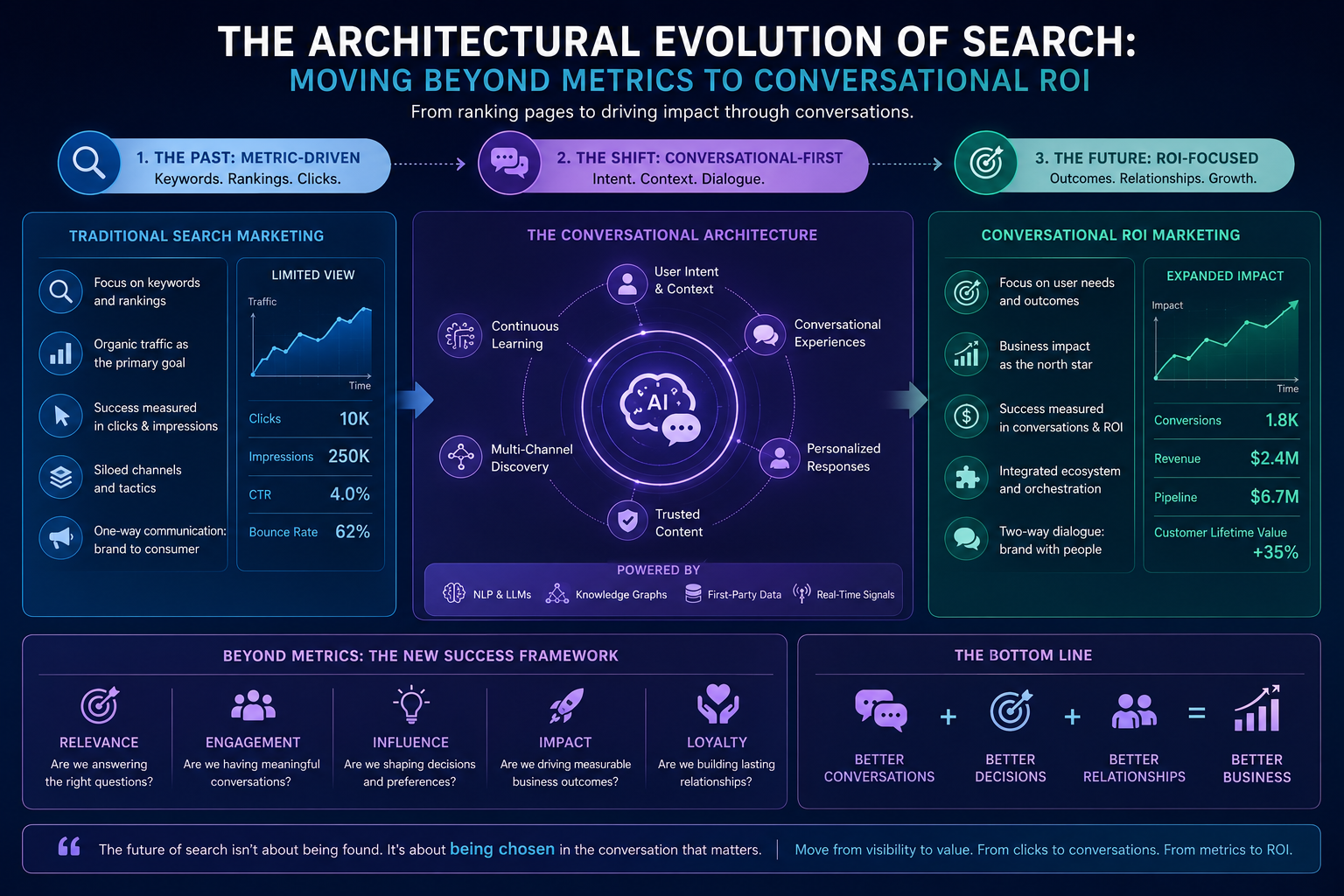
The traditional metrics of the digital advertising era—impressions and clicks—are rapidly becoming secondary indicators of performance as search interfaces evolve into intelligent, goal-oriented assistants. Experts now emphasize that digital strategy should not be limited to impressions and clicks. The focus is shifting toward CRM integration and AI-driven sales enablement. Success is now measured by orchestrating “discovery, personalization, and conversion” within AI-based search channels. This transition marks a fundamental change in how brands must structure their data, their technology, and their customer journey to remain relevant in an environment dominated by intent-driven AI agents.
Why are impressions and clicks no longer sufficient as strategic metrics?
Impressions and clicks measure engagement with a platform, not necessarily the progression of a customer relationship. In an age where AI-driven search interfaces provide direct, synthesized answers, the traditional “click” is becoming increasingly rare because the user receives value directly within the search results page, bypassing the landing page entirely.
Relying on vanity metrics like impressions ignores the fundamental reality of the modern funnel: the intent is now being satisfied by the AI. Therefore, a strategy limited to these metrics is blind to the actual quality of the traffic or the depth of the interaction. Marketing professionals must instead integrate their CRM systems directly with these AI search behaviors to track if a discovery lead actually moves toward a purchase or a loyal customer relationship. This requires shifting from a volume-based mindset—where “more traffic” is the goal—to a value-based mindset where “more intelligence” about the customer’s journey is the primary objective. Metrics are evolving from descriptive analytics (what happened?) to prescriptive ones (how does this interaction influence the next stage of our CRM sequence?).
How does CRM integration transform the efficacy of AI-driven search strategies?
CRM integration allows brands to feed historical customer data back into the AI search model, enabling the system to recognize high-value intent patterns. When an AI agent understands a user’s previous interactions, it can tailor its responses to be more relevant, thereby dramatically increasing the likelihood of conversion.
What are the projected outcomes of AI-driven sales enablement in the search funnel?
Projections indicate that businesses adopting AI-driven sales enablement within their search strategy will see a 20-30% improvement in lead-to-customer conversion rates by 2027. This efficiency gain is realized by removing the “discovery friction” that usually occurs when a user moves from an initial search query to an internal company resource.
“The winning brands will be those that treat every interaction within an AI search channel as a CRM touchpoint. Discovery, personalization, and conversion are no longer sequential; they must occur simultaneously in the AI-synthesized output.” — Search Strategy Architect
By automating the transition from interest to action through personalized AI responses, brands can effectively “pre-sell” the product or service before the human agent even initiates direct contact. This reduces the burden on sales teams, allowing them to focus on high-intent leads who have already been qualified by the AI’s personalization logic. The statistical trajectory suggests that companies failing to integrate these channels will suffer from an escalating cost of acquisition as their competitors capture higher-intent search traffic with greater automated precision.
How does one orchestrate “discovery, personalization, and conversion” in an automated environment?
Orchestration in this context means designing the content and data architecture so that AI models can extract the information necessary to fulfill each stage of the user’s journey. Brands must provide structured, context-rich data that allows AI to facilitate the entire user experience without needing external human-led navigation.
What role does the “AI-based search channel” play in the long-term customer journey?
The AI-based search channel is the modern front door to a brand’s ecosystem. It serves as the initial diagnostic layer that filters out non-qualified traffic while identifying the specific psychological triggers that motivate a prospect to move from exploration to commitment. Because these channels are capable of long-term memory via CRM integration, they function as the ultimate repository for customer intelligence.
To leverage this, companies must move away from static website design and towards “liquid content”—information modules that can be consumed, reformatted, and synthesized by AI models in real-time. The success of this approach is measured by the clarity and relevance of the AI’s output regarding your product or service. If your data architecture is fragmented, the AI will provide diluted, generic responses. If it is robust and tightly integrated with your CRM, the AI will serve as your most effective, scalable sales representative. This strategy requires a total alignment between technical SEO teams, CRM management, and content creation departments, effectively collapsing the silos that have traditionally separated these functions.
Conclusion: Mastering the New Search Paradigm
The strategic imperative for the remainder of 2026 and beyond is clear: stop optimizing for the click and start optimizing for the synthesis. The transition to AI-driven search channels is not a disruption to be feared, but an opportunity to deliver superior, friction-less experiences that align more closely with customer needs. Success in this new paradigm requires a deep commitment to CRM-backed data structures and a vision that treats every AI-orchestrated interaction as a vital component of the sales process.
By focusing on the orchestration of discovery, personalization, and conversion, brands can reclaim control over their narrative in an environment where AI increasingly dictates the answers. This is a shift from passive presence in search results to active participation in the customer’s decision-making flow. Those who master the art of feeding the AI the right intelligence—derived from deep CRM insights—will define the market leaders of the next decade. The era of the click is ending; the era of intelligent discovery has begun, and the competitive advantage will lie solely with those who can most effectively integrate their internal data intelligence with the evolving intelligence of global search models.