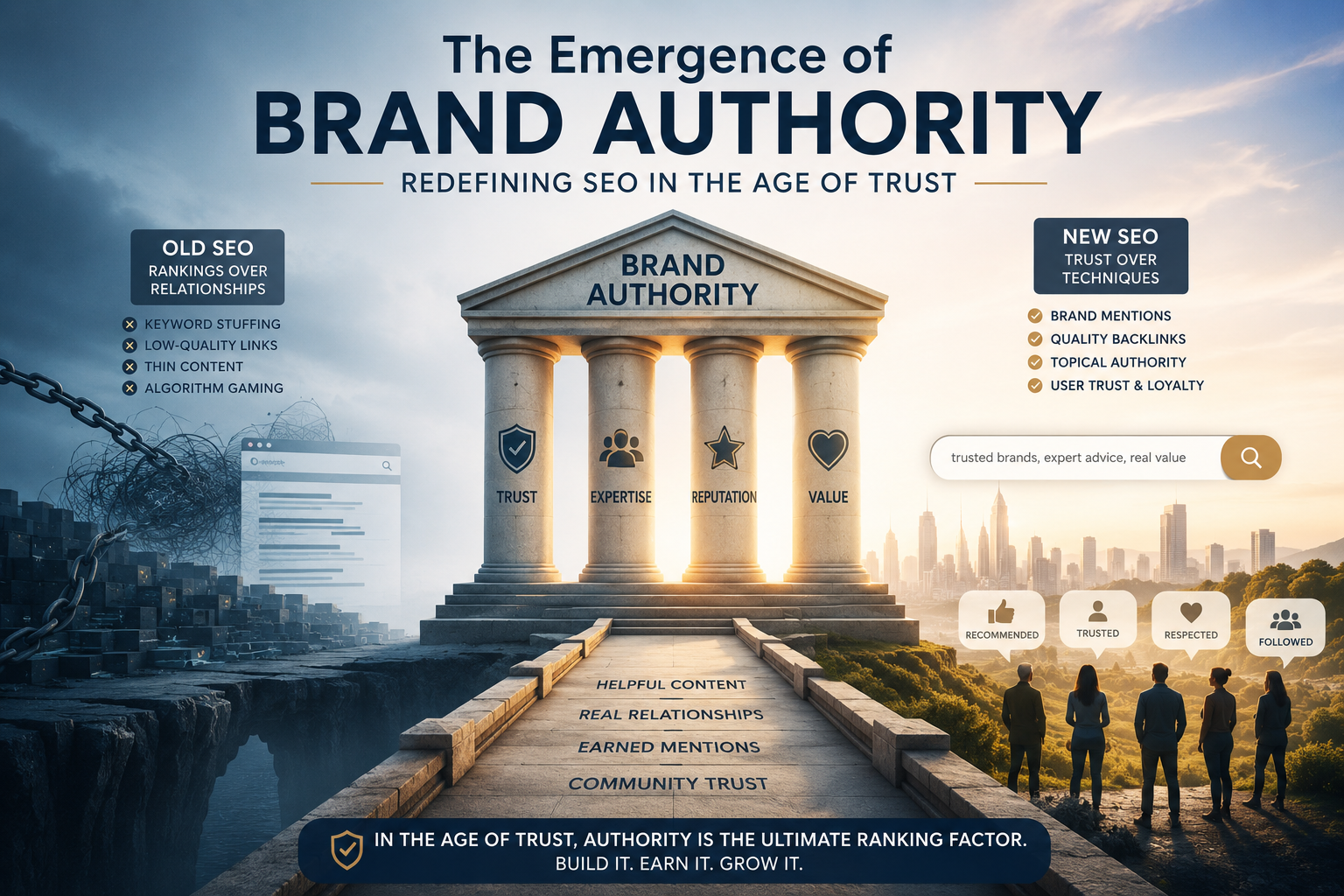
The mechanisms governing search rankings are undergoing a fundamental transformation. Google is placing more weight on brand authority. Learn why your brand identity is becoming a critical ranking factor beyond traditional backlinks. As algorithms evolve to better simulate human trust, they are shifting focus from simple link metrics to the holistic footprint that a brand leaves across the web, effectively prioritizing entities that offer verified reliability.
Why has brand authority surpassed traditional link building?
Brand authority has become a primary ranking factor because search engines now prioritize “entity recognition” over mere link quantity. In a landscape saturated with AI-generated content, backlinks alone are easily manipulated. Consequently, Google utilizes brand signals—such as direct search volume, brand mentions, and entity association—to confirm that a domain is a real, reputable organization rather than a temporary site optimized for spam.
The shift reflects a broader commitment to information quality. When a brand is mentioned consistently across diverse, authoritative platforms, Google’s Knowledge Graph builds a comprehensive profile of that entity. This profile acts as a trust anchor. While a backlink is an endorsement, brand authority is a demonstrated reputation. It signifies that the company is a known participant in its industry, making it a safer and more relevant choice for the algorithm to surface when users have high-intent inquiries.
How do you build brand authority that impacts rankings?
Building brand authority requires a multi-channel strategy that emphasizes consistency, high-level expertise, and active audience engagement. You must ensure that your brand name, core mission, and expert perspectives are represented uniformly across your website, social media, industry publications, and third-party news sources. This consistency enables the search algorithm to confidently link your domain to the specific professional entities you represent.
Furthermore, focus on becoming the “source” for your niche. When your experts are interviewed by reputable publications, your data is cited in white papers, or your company engages in community leadership, you generate non-link signals that Google interprets as proof of real-world impact. This strategy ensures that your presence is felt far beyond the confines of your own domain, creating a digital footprint that machines find impossible to ignore.
What role does E-E-A-T play in brand validation?
E-E-A-T—Experience, Expertise, Authoritativeness, and Trustworthiness—is the operational framework through which Google evaluates your brand’s credibility. For a brand to be recognized as authoritative, it must prove that it is not merely a content farm, but a destination for genuine human experience. This involves showcasing your team’s professional credentials, publishing original research, and maintaining a transparent editorial process that prioritizes accuracy and user utility over search volume.
Statistics regarding these shifts are significant. Forecasts suggest that brands prioritizing E-E-A-T-aligned identity markers see a 20-30% higher stability in search performance during major algorithm core updates. Because the algorithm views these brands as “low-risk, high-reward” results, they are less likely to be negatively impacted by volatility. When your content is inextricably linked to recognized human experts, the machine essentially “vets” your site before a user even clicks.
“A brand is not just what you say you are; it is what the internet says you are. When we look at ranking signals today, the collective, verified reputation of a brand is becoming more important than the individual authority of any single page.” — Strategic SEO Architect
How can you track the growth of your brand influence?
Tracking brand influence requires moving beyond keyword rankings to monitor metrics such as branded search volume, direct traffic, and share of voice within your specific industry topics. If your brand is gaining authority, you will observe a consistent increase in people searching for your company name directly, indicating that you have achieved top-of-mind status in your customer’s awareness journey.
Additionally, monitor how your brand is cited in AI-generated responses. If generative search tools frequently mention your brand when answering questions about your niche, it is a clear indicator that your brand entity has successfully registered as an authority in the Knowledge Graph. This is a critical metric for 2026 and beyond, as it confirms your presence in the future interface of search.
Are there risks in focusing too heavily on branded SEO?
The primary risk is neglecting the fundamental technical and content requirements that support your brand. Brand authority is meant to be a multiplier for, not a replacement for, high-quality content and a fast, user-friendly website. If you focus exclusively on “being a brand” without producing content that directly solves user problems, you will fail to convert the traffic your authority brings. A strong brand identity must be backed by a site that delivers the quality the brand promises.
Moreover, avoid artificial attempts to build brand status through paid PR campaigns that yield no real engagement. Google’s algorithms are increasingly adept at distinguishing between manufactured hype and organic authority. If your brand is being mentioned in hundreds of unrelated or low-quality news outlets, it may actually act as a signal of spam rather than a signal of authority. Authenticity remains the most critical component of a sustainable ranking strategy.
What is the strategic path forward for brand-driven visibility?
The strategy for the next several years is to evolve your domain into a “Knowledge Hub.” This involves documenting your brand’s internal expertise, contributing to industry discourse, and ensuring that every interaction a user has with your content reinforces your reputation. Your goal is to become the primary entity associated with your specific sector, so that when a user searches for an answer, the algorithm’s most logical conclusion is to present your brand.
We are moving away from an era of anonymous link-sharing and into an era of verifiable brand presence. Companies that treat SEO as a holistic extension of their public reputation will find themselves at a distinct competitive advantage. By aligning your digital footprint with real-world excellence, you build a foundation that is resistant to algorithm changes and uniquely positioned to thrive in the generative search landscape. The authority you build today is the search visibility you own tomorrow—not because you optimized a tag, but because you built a brand that the algorithm trusts.