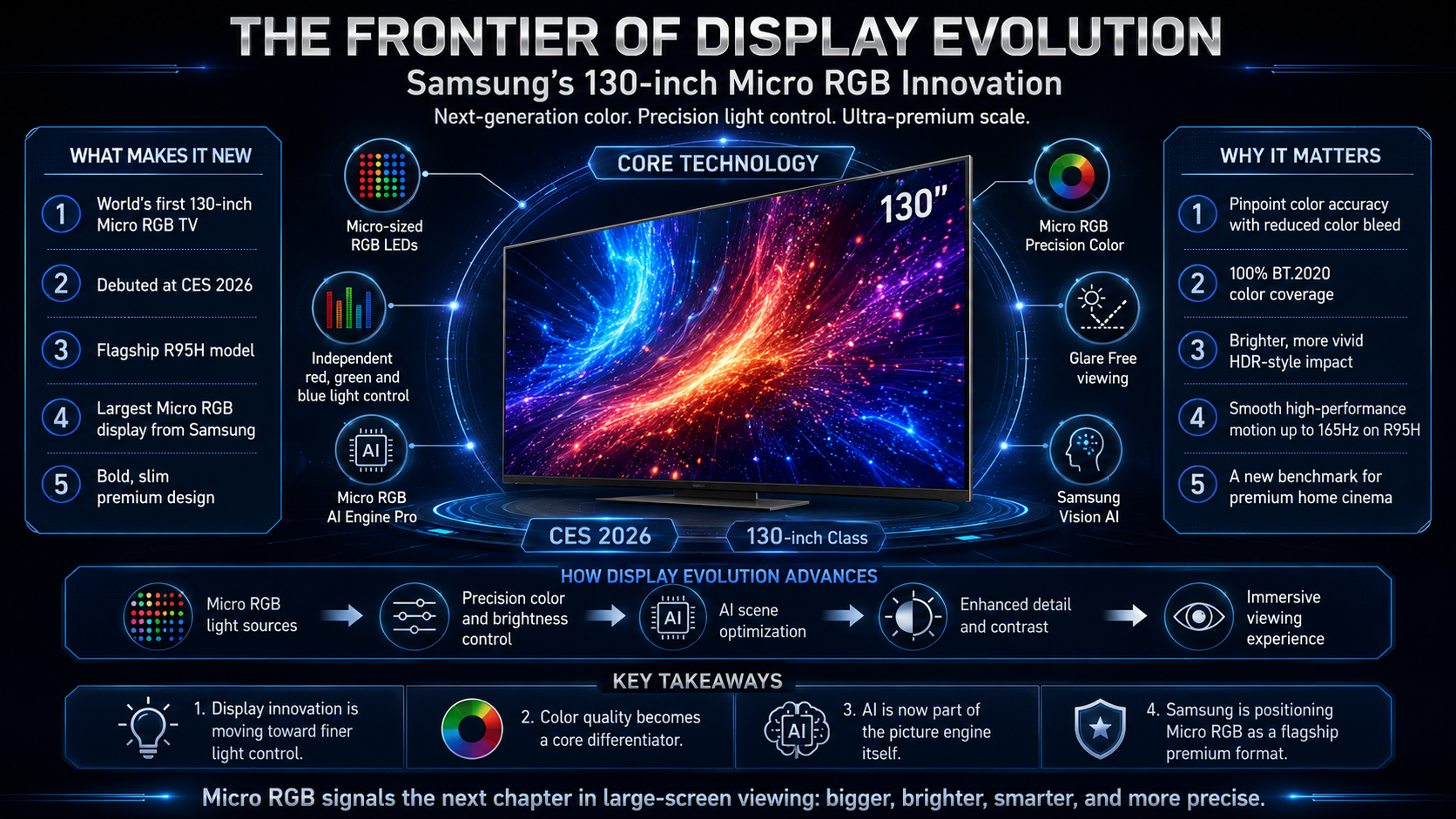
The evolution of home display technology has reached a definitive milestone, moving beyond traditional panel limitations into a realm of modular, self-emissive excellence. Samsung 130-inch Micro RGB TV: Rated as a technological pinnacle with its microscopic RGB diodes and Vision AI Companion, which transforms the screen into an interactive AI assistant. This device represents a fundamental shift in how domestic visual hardware interacts with the user, merging high-end display fidelity with proactive, intelligent orchestration.
Why does Micro RGB technology represent a shift in display performance?
Micro RGB technology utilizes individual, self-emissive microscopic diodes to construct images, eliminating the need for backlighting or color filters found in conventional LCD or OLED panels. This allows for absolute control over luminance and color at the pixel level, resulting in unprecedented contrast ratios, perfect blacks, and a color volume that accurately reflects the full breadth of the human visual spectrum.
By decoupling the display from the traditional panel structure, Samsung has essentially moved toward a modular architectural approach. Each individual RGB diode acts as its own light source, which effectively removes the common issues of “blooming” or “halos” seen in high-end LED displays. Furthermore, the sheer scale of a 130-inch display powered by this architecture ensures that the pixel density remains razor-sharp, regardless of the viewing distance. This is a technical triumph that bridges the gap between commercial cinema installations and residential environments. The microscopic nature of these diodes also contributes to extreme durability and longevity; unlike organic materials that may degrade over time, inorganic RGB diodes are designed to maintain their peak performance across tens of thousands of hours of operation. It is, by all technical accounts, a transition from “screen as a surface” to “screen as an integrated light environment,” providing a visual experience that is fundamentally more immersive and color-accurate than any preceding display generation.
What is the function of the Vision AI Companion?
The Vision AI Companion is an integrated intelligence layer that analyzes screen content in real-time to adjust settings, provide context, or assist with interactive tasks. It functions as a proactive assistant that utilizes advanced computer vision to understand the intent behind user requests, effectively turning the display into a central node for home productivity.
What are the projected market impacts of Micro RGB displays by 2029?
Industry analysts predict that the market for ultra-premium, large-format Micro RGB displays will expand at a compound annual growth rate of 18% through 2029. This growth is anticipated as luxury residential design increasingly integrates immersive display technology, coupled with a growing corporate demand for “smart displays” that can function as both high-end monitors and interactive AI hubs.
“We are witnessing the end of the traditional television era. The display is becoming an intelligent interface that does not just project information, but participates in the user’s workflow.” — Display Systems Architect
These projections highlight a critical shift: consumers are moving away from treating displays as passive devices. The statistical appetite for displays larger than 100 inches is reaching an all-time high, as homeowners look to replace projector setups with more vibrant, reliable, and intelligent alternatives. As the cost of manufacturing Micro RGB diodes continues to optimize, we can expect this technology to migrate from the ultra-luxury segment toward more accessible high-end tiers, standardizing the intelligent, AI-assisted interface.
How does the integration of AI change the way we interact with massive screens?
Integrating AI into a 130-inch display turns the screen into a collaborative workspace where the software manages environmental variables and task-oriented assistance. Through the Vision AI Companion, the display can recognize gestures, monitor workspace ergonomics, or automatically calibrate its image output based on the ambient lighting and the specific nature of the content being viewed.
Can such a large-scale display be effectively integrated into a living environment?
Effective integration of a 130-inch display requires a shift toward modular room design where the display is treated as a core architectural element rather than an peripheral accessory. The use of Micro RGB allows for significantly thinner profiles, enabling a seamless aesthetic integration that minimizes visual clutter and maximizes the impact of the content.
The challenge, however, is not just the physical installation but the “cognitive load” of a 130-inch intelligent surface. A screen of this size, when fully enabled by an AI assistant, can be overwhelming if not managed correctly. This is where the AI layer proves its worth: it intelligently zones the display. If the user is working, the AI organizes the screen into distinct, logical modules for productivity applications, video conferencing, and reference materials. If the user is relaxing, it pivots to a full-screen cinematic mode. This spatial intelligence is what separates the Samsung Micro RGB system from traditional displays. It is not just about the size of the glass; it is about the fluidity of the information density. By leveraging the Vision AI Companion to govern the screen real estate, the device becomes a “smart mirror” of sorts—a gateway that intelligently filters and displays the data that is most relevant to the user’s immediate context. This level of sophistication is the hallmark of the technological pinnacle, proving that the future of large-scale display technology lies in how well it manages the interaction between information volume and user intent.
What are the technical challenges of maintaining microscopic diode arrays?
Maintaining microscopic diode arrays involves rigorous quality control in the assembly phase, as the failure of a single diode in a 130-inch array can theoretically impact perceived image uniformity. Advanced self-healing algorithms and redundant pixel mapping are utilized to ensure that the image remains perfect, even if individual components reach their end-of-life early.
Conclusion: Orchestrating the Future of Visual Interfaces
The 130-inch Samsung Micro RGB TV, coupled with the Vision AI Companion, represents more than a luxury display; it is a preview of the intelligent visual interface that will define home and professional productivity in the coming decade. By moving to self-emissive, microscopic RGB diodes, Samsung has solved the inherent limitations of backlit displays, offering a visual fidelity that was once the domain of specialized industrial cinema.
The integration of the AI assistant ensures that this massive display is not merely a passive conduit for content, but a dynamic, useful partner in the user’s digital life. As the technology matures and becomes more prevalent, the standard for what we expect from a display will continue to rise. We are transitioning from an era of “watching” screens to an era of “interacting” with visual environments. Organizations and users who prioritize this level of high-fidelity, intelligent display technology will find themselves better positioned to manage the increasingly dense information landscape of the modern era. Samsung’s approach demonstrates that the future of the premium home screen is modular, intelligent, and uncompromisingly sharp. As we move forward, the screen will no longer just be a window into content; it will be an active engine of productivity and a central element of the modern architectural aesthetic. The technological pinnacle reached here suggests that we have only just begun to understand the possibilities of the intelligent, large-scale visual interface.