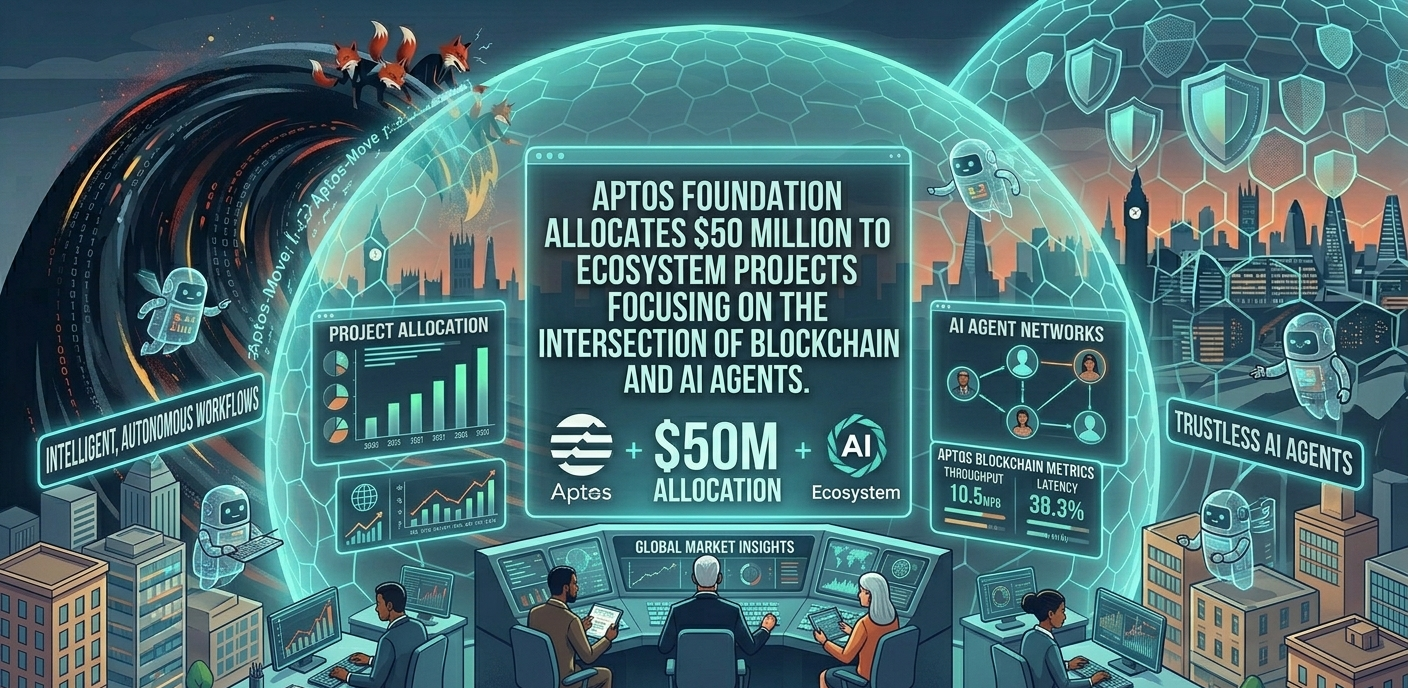
The landscape of decentralized technology is shifting from simple transactional ledgers to intelligent, autonomous ecosystems. As artificial intelligence (AI) begins to dominate every sector of the digital economy, the infrastructure supporting it must evolve to provide transparency, security, and scalability. Aptos, a Layer 1 blockchain known for its high throughput and safety-oriented Move programming language, is positioning itself as the primary base layer for this new era.
This strategic pivot is not merely a reaction to current market trends; it is a visionary bet on the future of autonomous digital labor. By integrating AI agents directly into the blockchain framework, the industry is moving toward a reality where software can perform complex financial and administrative tasks without human intervention, all while remaining verifiable on a public ledger.
How is Aptos supporting the integration of AI and blockchain?
Aptos is fostering this technological synergy through significant financial backing and infrastructure development tailored for autonomous software. Specifically, the Aptos Foundation has allocated $50 million to ecosystem projects focusing on the intersection of blockchain and AI agents. This capital is designed to accelerate the creation of decentralized intelligence tools that can leverage the speed and low latency of the Aptos network.
The initiative represents a proactive effort to solve the “black box” problem of modern AI. By running AI processes or their verification layers on a blockchain, developers can create a permanent record of an agent’s decisions. Mo Shaikh, CEO of Aptos Labs, has frequently emphasized that the combination of high-performance blockchain and AI will redefine user experiences: “We are building the foundation for a web that is not only decentralized but also intelligent enough to act on behalf of the user safely.”
This $50 million fund is targeted at developers building “AI agents”—autonomous programs that can navigate DeFi protocols, manage NFT portfolios, or execute cross-chain swaps based on predictive modeling. Unlike traditional bots, these agents are designed to “learn” and adapt within the constraints of smart contracts, ensuring that their actions remain within predefined security parameters.
The deployment of these funds is expected to drive a surge in “Agentic Workflows” on-chain. According to recent industry projections, the market for AI-driven decentralized applications (dApps) is expected to grow by over 300% by 2027. Aptos’s investment ensures that its ecosystem remains the competitive choice for developers who require the sub-second finality necessary for real-time AI decision-making.
What are AI agents and why do they need a blockchain like Aptos?
AI agents are autonomous entities capable of perceiving their environment, reasoning about tasks, and taking actions to achieve specific goals. In a financial context, they require a blockchain to provide a secure “bank account” and a transparent “logbook.” Aptos provides the necessary environment because its Move language was specifically designed to prevent the common exploits that plague other smart contract platforms.
For an AI agent to function effectively, it needs:
- Trustless Payments: The ability to pay for its own compute resources or settle transactions instantly.
- Verifiable Identity: A way to prove it is a specific authorized agent, not a malicious actor.
- Low Latency: AI agents move fast; they cannot wait for minutes for a block to confirm.
Aptos’s parallel execution engine allows it to process thousands of transactions simultaneously, which is critical when hundreds of AI agents are interacting with a single protocol at the same time. This technological synergy ensures that the “intelligence” of the AI is matched by the “efficiency” of the network.
Will AI agents change the way retail users interact with DeFi?
The integration of AI will likely abstract away the complexities of decentralized finance, turning manual processes into intent-based actions. Instead of a user manually bridging assets and providing liquidity to a pool, they will simply give a command to an AI agent: “Earn 5% yield on my USDC with the lowest possible risk.” The agent then executes the transaction on Aptos in milliseconds.
This shift toward “Intent-Centric” design is the primary goal of the recent funding. The Aptos Foundation has allocated $50 million to ecosystem projects focusing on the intersection of blockchain and AI agents to ensure that these user-friendly interfaces are built with institutional-grade security. This could lower the barrier to entry for millions of users who find current crypto wallets and bridges too intimidating to use.
What does the $50 million fund mean for the future of the Aptos ecosystem?
This investment acts as a massive “talent magnet” for the world’s most advanced software engineers. By providing the capital necessary for research and development, Aptos is ensuring that the most innovative use cases—such as decentralized LLM (Large Language Model) training and AI-governed DAOs—happen within its borders.
Statistically, ecosystems that invest heavily in emerging tech during early stages tend to capture the majority of the market share as that tech matures. By 2028, it is estimated that over 20% of all blockchain transactions will be initiated by AI agents rather than humans. By securing the infrastructure for these agents now, Aptos is positioning itself as the “Operating System” for the future of the internet.
This fund is not just about giving grants; it is about building a symbiotic relationship between machine learning and distributed ledgers. Projects receiving support are expected to contribute back to the Aptos codebase, creating a flywheel effect where the network becomes more optimized for AI with every new project that joins.
Can blockchain help solve the ethical concerns surrounding AI?
One of the most profound benefits of the Aptos-AI intersection is the ability to provide an immutable “Audit Trail” for AI behavior. As AI becomes more autonomous, the risk of “hallucinations” or biased decision-making increases. Blockchain acts as a neutral observer that records every input and output.
If an AI agent makes a mistake, developers can go back to the Aptos ledger to see exactly what data the agent was looking at when it made that decision. This level of accountability is impossible in centralized AI systems owned by big tech companies. This transparency is a core reason why the Aptos Foundation has allocated $50 million to ecosystem projects focusing on the intersection of blockchain and AI agents, as it seeks to promote “Ethical AI” that is both powerful and provable.
The Synergy of MOVE and Machine Learning
The future of Aptos is inextricably linked to the success of its AI initiatives. By providing a safe, fast, and now well-funded environment, Aptos is solving the most significant bottleneck in the digital asset space: usability. As AI agents begin to handle the “heavy lifting” of the blockchain world, the technology will finally achieve the mainstream adoption it has sought for over a decade.
We are entering an era where the blockchain is no longer a passive database, but an active, intelligent participant in the global economy. Investors and developers should view the $50 million allocation as a signal that the most important technological marriage of our time—AI and Blockchain—has found its most promising venue on the Aptos network.