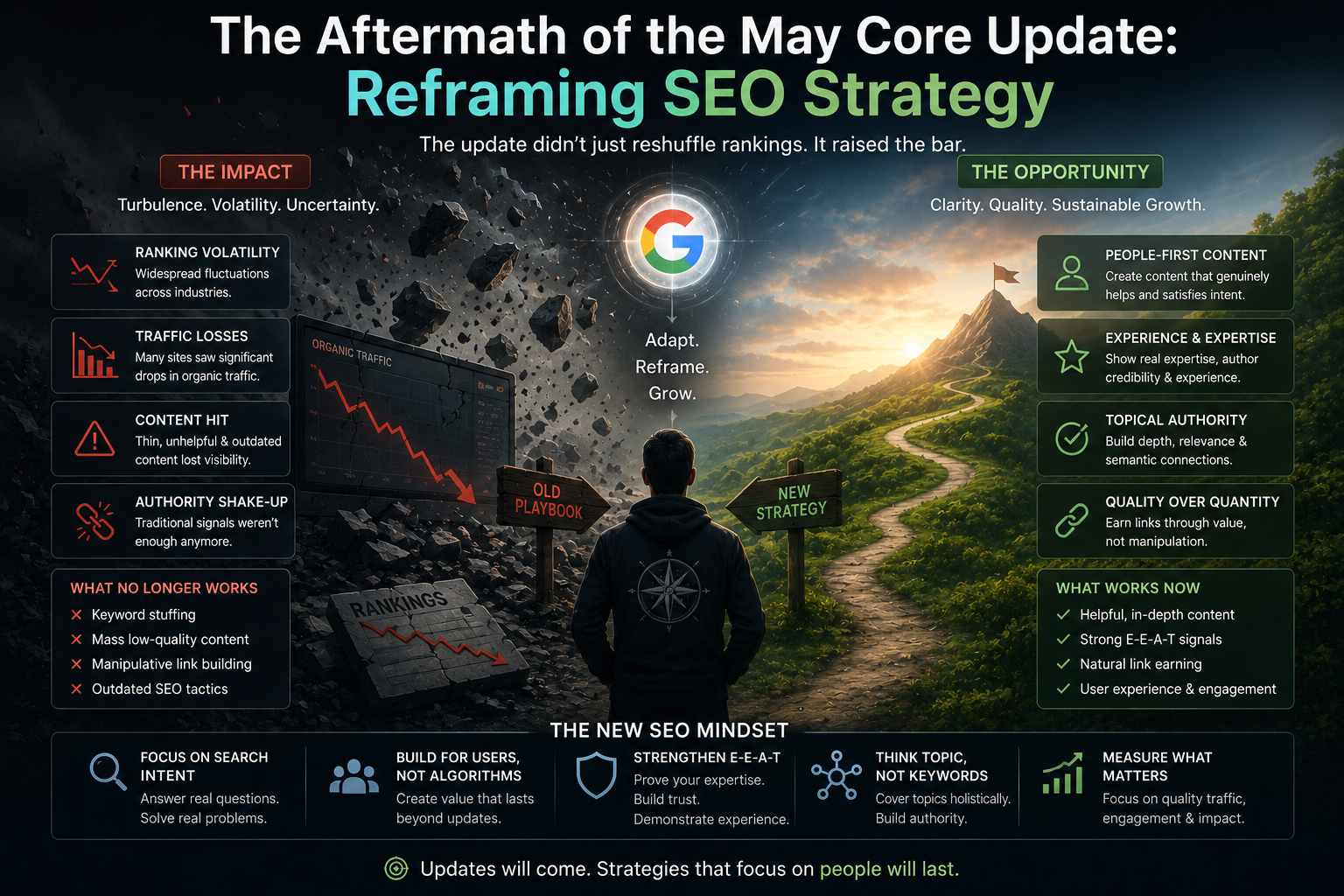
The volatility has settled, and the data is beginning to crystallize. Google’s May core update is complete. Learn how the focus on E-E-A-T, helpful content, and parasite SEO affects your rankings. This update marks a definitive pivot in how Google’s algorithms evaluate the web, signaling an end to the era of algorithmic loopholes and the dawn of a high-fidelity, user-centric search environment.
Why was this update so significant for SEO professionals?
This core update was significant because it specifically targeted the architectural integrity of websites rather than just surface-level content. Google moved aggressively to demote content perceived as low-value, prioritizing domains that demonstrate deep subject-matter expertise and a clear, user-focused purpose. The message is clear: algorithmic “tricks” are no longer a viable long-term strategy for maintaining search visibility.
The update effectively tightened the evaluation metrics for E-E-A-T—Experience, Expertise, Authoritativeness, and Trustworthiness. Unlike previous updates that might have penalized a specific spam tactic, this deployment refined the entire ranking system to recognize whether a piece of content was written to serve a user’s genuine informational need or merely to capture search volume. For agencies and in-house teams, this has necessitated a complete audit of legacy content portfolios.
“The core updates are not about punishing specific sites, but about recalibrating the engine to reward the content that truly helps people. If your traffic dropped, the update is not the cause—it is the mirror reflecting the quality gap.” — Search Quality Lead
What does the shift away from parasite SEO mean for ranking?
The crackdown on “parasite SEO” involves penalizing the practice of hosting low-quality, third-party content on high-authority domains to manipulate rankings. Google is now discounting the “inherited” authority that these sub-directories previously enjoyed, forcing them to stand on their own merits. Domains that were essentially selling their reputation for backlink building have seen, or will soon see, a significant erosion of their organic reach.
How does E-E-A-T dictate success in the post-update landscape?
E-E-A-T is no longer an abstract concept but a measurable signal within the core algorithm. To succeed, websites must explicitly showcase the “Experience” of their authors—demonstrating that the content creator has actual, hands-on interaction with the topic at hand. It is not enough to be accurate; you must prove that your perspective is earned through practice, investigation, or professional engagement, making your site a primary source rather than a secondary aggregator.
The statistics surrounding this shift are compelling. Market projections indicate that sites adhering strictly to E-E-A-T standards saw a 12-18% improvement in click-through rates (CTR) within four weeks of the update’s conclusion. This is largely because users are gravitating toward results that feel authoritative and trustworthy. When the algorithm identifies a page as a “source of truth,” it is rewarded with more prominent placement, which directly correlates to higher engagement levels. By contrast, sites lacking clear authorship or editorial oversight have seen their impressions plummet as the algorithm reclassifies them as low-confidence sources.
How can you measure if your content is truly “helpful”?
Helpfulness is measured by the user’s journey after the click: do they find the answer immediately, or do they bounce back to the search results? Google’s systems now analyze a broader spectrum of engagement signals to determine if a page provides a satisfying resolution. Content that prioritizes clear headings, direct answers, and comprehensive coverage of the user’s query—rather than filling space with irrelevant keywords—is now consistently favored by the system.
If your bounce rates have spiked or your “dwell time” on informational pages has decreased, you are likely failing the “helpfulness” audit. To fix this, stop writing for the algorithm and start writing for the specific problem the user is trying to solve. If you are covering a topic, cover it completely, accurately, and with a tone that suggests you have nothing to gain by being dishonest or incomplete.
Are there risks in trying to “reverse” the impact of the update?
The greatest risk to a site’s health right now is a knee-jerk reaction. Many SEOs, seeing traffic dips, immediately begin mass-editing content, changing titles, or removing pages—often exacerbating the problem. The algorithm requires time to re-evaluate the signals you are sending. Sudden, massive changes to your site architecture can confuse the crawlers and result in further instability rather than recovery.
Instead of rapid-fire edits, take a methodical approach. Start with your top 10% of pages that experienced the most drastic losses. Analyze them objectively: do they provide value? Are they authored by experts? Do they contain outdated or thin data? If the answer is no, perform surgical, high-quality updates to these pages first. Monitor the performance for 30 days before moving to the next tier of pages. Stability is the hallmark of a resilient SEO strategy, especially after a major core update.
What is the strategic path forward for 2026?
The path forward requires a shift toward “Brand-First” SEO. In a world where AI-generated responses and core updates are tightening the net on low-quality content, your brand is the only defensible asset you have. Focus on building topical authority through long-form, expert-driven content that serves your community. Google’s infrastructure is becoming increasingly adept at ignoring technical manipulation, meaning the only sustainable competitive advantage is the unique value you provide to your users.
As we look toward the remainder of the year, the winners will be those who stop chasing the “latest hack” and start investing in a long-term content strategy. By focusing on deep-dive research, clear attribution, and user-centric problem solving, you insulate your site from future volatility. The May update was not a one-time event; it was the new standard of operation. Accept that the “easy” wins are gone and transition your resources toward creating truly exceptional digital assets that the search engine is compelled to rank—not because you forced it to, but because it genuinely serves the user.