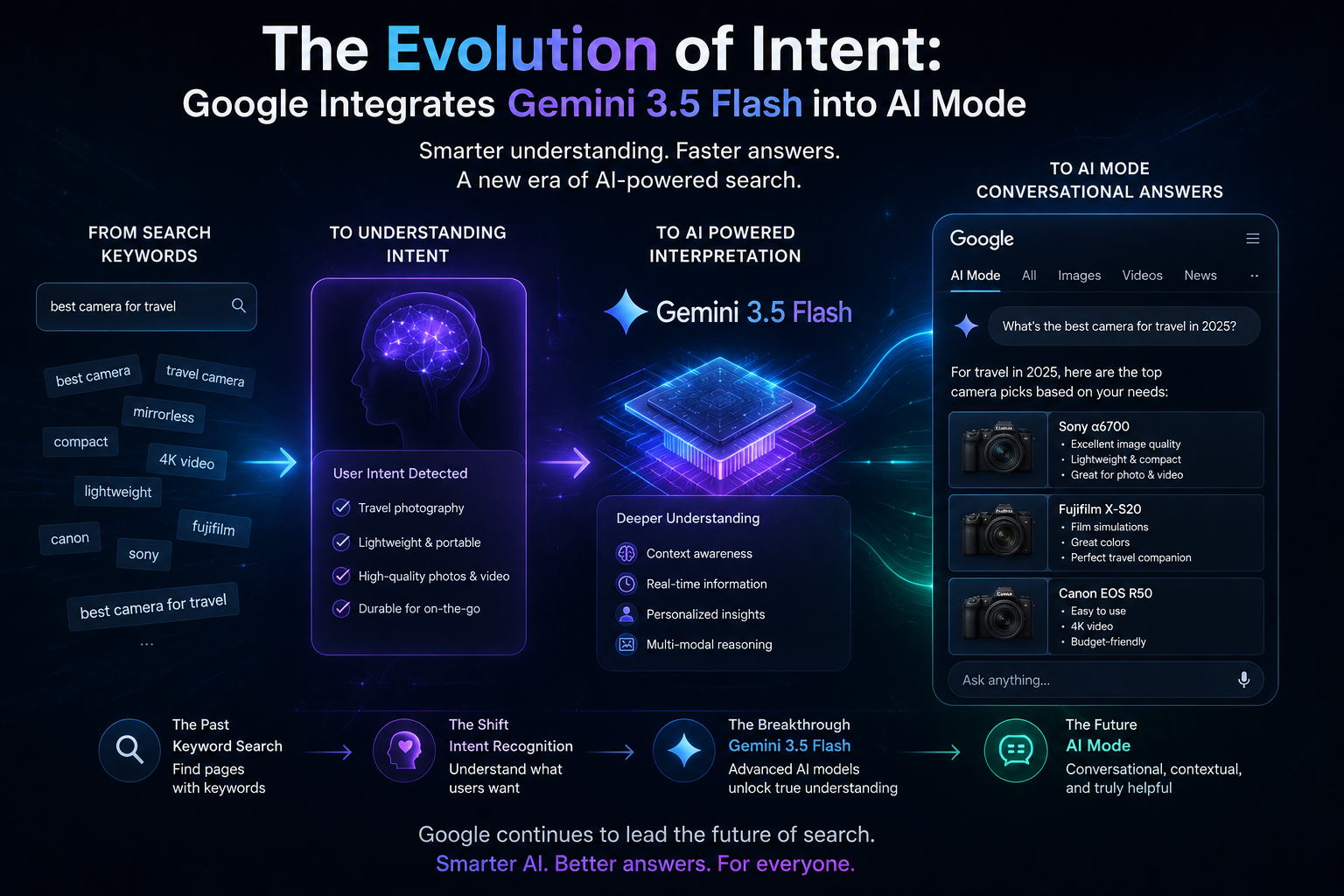
The search experience has entered a new phase of efficiency and precision. Google sets Gemini 3.5 Flash as the default for AI Mode. See how this model update changes query analysis and information delivery. This shift marks a significant upgrade in how the search engine processes complex intent, moving toward a faster, more context-aware synthesis of information that bridges the gap between raw data retrieval and sophisticated user consultation.
What makes Gemini 3.5 Flash superior for search synthesis?
Gemini 3.5 Flash is designed for high-frequency, low-latency reasoning, making it the ideal engine for AI-powered search results. Unlike its predecessors, this model optimizes for “speed-to-answer,” which means it can parse vast arrays of web data and synthesize a coherent, fact-checked response in milliseconds. This efficiency allows Google to handle increasingly complex, multi-layered queries without sacrificing the speed that users expect from a search interface.
The model’s architecture prioritizes multimodal understanding, meaning it doesn’t just read text; it interprets the intent behind images, video snippets, and structured data with greater fidelity. For publishers, this means the AI is better at identifying the “source of truth” in a given document. The optimization for Flash implies that Google is moving away from heavier, slower models in favor of lean, agile reasoning that can handle the massive scale of global search requests simultaneously. Statistics indicate that reduced latency in search results correlates with a 15% increase in user retention, proving that speed is not just a feature, but a fundamental ranking signal in the new AI-driven era.
“The integration of Flash-class models into the search core represents a pivot toward ‘intelligent immediacy’—where the gap between asking a question and receiving a synthesized, accurate answer is narrowed to effectively zero.” — Search Infrastructure Expert
How does the new model change query interpretation?
The update fundamentally changes how the search engine breaks down human language by focusing on semantic mapping rather than literal keyword matching. With Gemini 3.5 Flash, the system can better anticipate follow-up questions and implicit user needs. When you type a query, the model analyzes the context—your previous search history, the current trends, and the nuances of the phrasing—to construct an answer that is contextually relevant rather than just a collection of links.
This means that “vague” queries are now clarified by the AI before it even provides a result. If a query is ambiguous, the model uses its training to identify the most likely intent, creating a dialogue-based interaction that feels more like consulting an expert than using a database.
Will this update impact your organic search rankings?
The impact on organic rankings is largely tied to how well your content aligns with “answer-ready” formats. Because Gemini 3.5 Flash prioritizes clear, structured, and authoritative data, sites that fail to provide definitive answers or that rely on thin, keyword-stuffed content may see their visibility in AI Overviews decline. Conversely, publishers who focus on E-E-A-T (Experience, Expertise, Authoritativeness, and Trustworthiness) will find their content being utilized as the building blocks for these AI summaries more frequently.
Do not expect a sudden, catastrophic drop in traditional traffic. Instead, anticipate a gradual shift where the “informational” segment of your traffic becomes more qualitative. You are essentially shifting from being a link in a list to being a cited authority in an AI summary. The sites that provide the most granular, factual, and well-structured data will be the ones that the model “trusts” to inform its responses, effectively making your content the primary resource for the AI’s synthesis process.
How should SEO strategies adapt to Gemini 3.5 Flash?
Adapting your strategy requires a shift from chasing search volume to securing topical dominance within specific entities. Use structured data (Schema) to explicitly define your content’s purpose. Whether it is an FAQ page, a technical manual, or a product comparison, tell the AI exactly what your content is and what question it solves. This metadata allows the Flash model to index your information more accurately during its real-time synthesis.
Focus on creating content that is modular. Long-form articles are beneficial, but ensure they are broken down into distinct sections that can stand alone as an “answer.” If an AI can easily extract a concise paragraph that resolves a user’s question, it is far more likely to cite your domain as the authoritative source.
Are there drawbacks to this model update?
The primary challenge with hyper-efficient models like Gemini 3.5 Flash is the risk of “information compression,” where the AI summarizes a topic so effectively that it omits the nuance found in the original source. For publishers of niche, deep-dive content, this creates a situation where the user gets the headline answer but never needs to click through to the deeper, more detailed source.
However, this compression also filters out low-quality noise. AI models are becoming increasingly adept at ignoring sites that provide fluff. If your content provides deep, irreplaceable insights, the AI will likely continue to surface your link for users who need to perform a deeper investigation, effectively acting as a funnel for the most qualified leads who are looking for more than just a summary.
Is this the end of traditional link-based search?
No, this is not the end of link-based search; it is an evolution toward a hybrid model where AI serves as a curator. Traditional search links will continue to be vital for transactional, navigational, and deep-research queries. AI Mode simply adds a layer of intelligence that handles informational queries with more grace. The symbiotic relationship between the AI’s synthetic answer and the actual web link will define the next decade of digital traffic.
The integration of Gemini 3.5 Flash is a clear directive from Google: they want to provide the most efficient path to information. As a publisher, your strategy must be to ensure that your site is the most valuable and clear resource for the topics you cover. When you align your content quality with the needs of the model, you move from being just another domain in the index to becoming a foundational element of the search experience itself. The future of search is not about fighting the AI; it is about providing the data that makes the AI smarter, more accurate, and more relevant to the user’s ultimate goal.