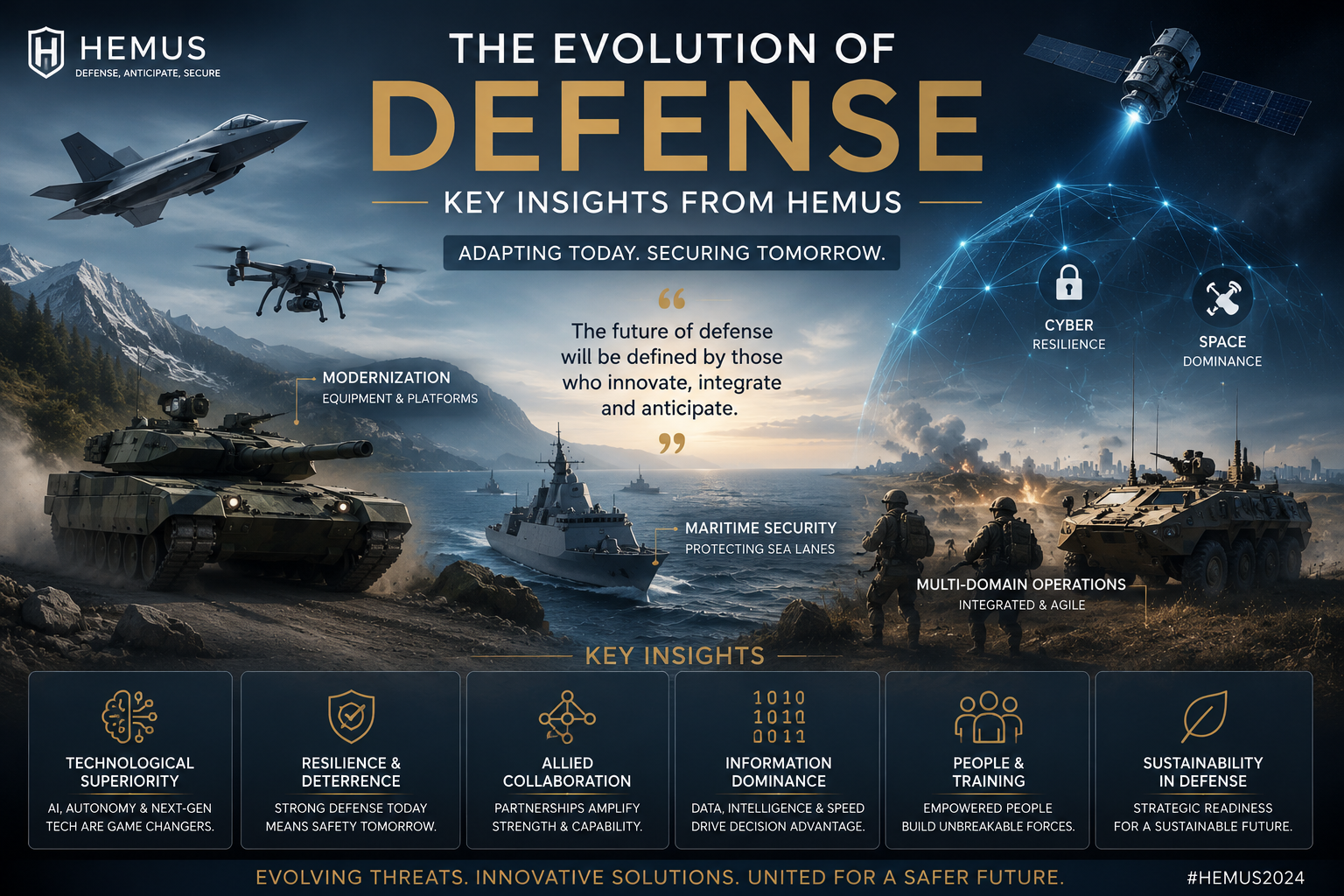
The international defense sector is currently navigating a period of rapid technological maturation, where adaptability and digital integration define strategic success. Innovations at “Hemus 2026”: Plovdiv hosted the 17th edition of the international defense exhibition (June 3–6), where the industry witnessed a clear roadmap for the future of regional security. By showcasing high-end hardware and autonomous systems, the event underscored the shift toward integrated multi-domain operations.
What were the primary highlights of the Hemus 2026 defense showcase?
The 17th edition of the exhibition served as a central platform for demonstrating advanced military capabilities, with a specific focus on the intersection of air power and autonomous systems. The event gathered global manufacturers to present cutting-edge technological advancements, emphasizing that regional security is now inseparable from the ability to rapidly integrate new-age sensors, networking capabilities, and high-performance combat platforms.
The exhibition proved that the defense industry is not merely refining legacy equipment but is aggressively pivoting toward the “digitized battlefield.” From small-scale tactical unmanned vehicles to advanced fighter jet platforms, the exhibits highlighted a concerted effort to ensure that ground, air, and naval forces operate with a unified, real-time understanding of the operational theater.
Why are combat drones becoming the centerpiece of tactical operations?
Combat drones: Numerous manufacturers (including Czech companies) demonstrated new solutions for reconnaissance and tactical operations. These platforms are no longer peripheral assets; they are essential for high-fidelity surveillance and precise engagement. The presence of specialized Czech manufacturers highlighted a collaborative European approach, where diverse nations contribute to a shared understanding of drone-based reconnaissance requirements and the necessary tactics for contested environments.
The integration of AI-assisted flight paths and swarming capabilities was a recurring theme. By reducing the cognitive load on operators, these new drone solutions allow commanders to conduct long-range reconnaissance without exposing personnel to immediate fire. Statistical forecasts indicate that the global military drone market is expected to grow by nearly 12% annually through 2030, driven largely by these modular, multi-role tactical systems that were on full display in Plovdiv.
How does modern air power influence defense strategy?
Modernization: The focus was on technological innovation across ground, air, and naval forces, including demonstrations of F-16 Block 70 fighter jets. These aircraft represent the pinnacle of current operational standards, offering advanced avionics and sensor fusion capabilities that act as a force multiplier for any modern air force. The ability to integrate such assets into a wider, digitally linked defense network is precisely what sets contemporary modernization efforts apart from the hardware-centric upgrades of previous decades.
What role does naval and ground force modernization play in national security?
Modernization efforts are increasingly focused on the interoperability between ground forces and naval units, ensuring that land-based mobile artillery and coastal defense systems can share target data with airborne assets. The exhibition highlighted how autonomous communication links and hardened, encrypted data transmission protocols are being retrofitted into existing vehicle fleets to ensure that the “sensor-to-shooter” loop remains resilient under electronic warfare conditions.
By upgrading existing armored platforms with new defensive suites and digital command interfaces, militaries are achieving significant performance gains without the long lead times required for entirely new platform development. This incremental but high-impact modernization is the current industry standard, allowing nations to maintain capability parity while navigating tight procurement budgets.
“True modernization is no longer about buying more platforms; it is about ensuring that every platform can ‘speak’ the same digital language, creating a coherent, impenetrable defense architecture.” — Defense Industry Analyst
How can nations evaluate the efficiency of their defense investments?
Evaluating investment efficiency in this cycle requires a move toward total-life-cycle analysis. Rather than evaluating hardware based on initial acquisition cost, the focus must shift to how well the platform integrates into a broader “system of systems.” The successful modernization demonstrated at Hemus 2026 suggests that the highest return on investment comes from assets that allow for future software upgrades, open-architecture integration, and modular mission payloads.
Nations should prioritize investments in platforms that have shown the ability to adapt to changing threat landscapes. This involves looking beyond the hull or the engine and examining the underlying software and sensor architecture. When procurement is guided by this “future-proof” mentality, the initial cost is justified by the extended, relevant service life of the equipment.
Is the defense industry shifting toward collaborative procurement models?
The exhibition underscored a distinct move toward multinational collaborative procurement, as demonstrated by the diverse international presence in Plovdiv. By leveraging shared research and development funds, countries can achieve economies of scale that are impossible to reach in isolation. This model not only reduces the financial burden on individual nations but also guarantees a level of standardization that is vital for NATO-aligned operational cohesion.
Looking ahead, the collaboration seen at the 17th edition of the exhibition is likely to serve as a blueprint for future defense partnerships. As the complexity of modern warfare increases, the ability to rapidly share technical insights and harmonize procurement schedules will become the most significant advantage a defense alliance can possess.
Future Trajectory: Integrating Innovation into Operational Reality
The 17th edition of the exhibition has solidified Plovdiv’s position as a vital node in the European defense dialogue. The transition toward autonomous combat drones and the ongoing modernization of advanced platforms like the F-16 Block 70 are clear indicators of a sector moving toward a high-tech, integrated future.
For organizations and military planners, the primary lesson is that agility is now the most critical asset. The platforms shown at Hemus 2026 were not just tools; they were components of a larger, digital nervous system designed to provide total domain awareness. As nations move forward, the focus will undoubtedly remain on refining this integration, ensuring that both human operators and autonomous systems can respond to the shifting demands of modern security with speed, precision, and reliable, data-driven insight. By leaning into these technological trends, the defense industry ensures not only the efficacy of its equipment but the long-term safety of the operational environment it is designed to protect.