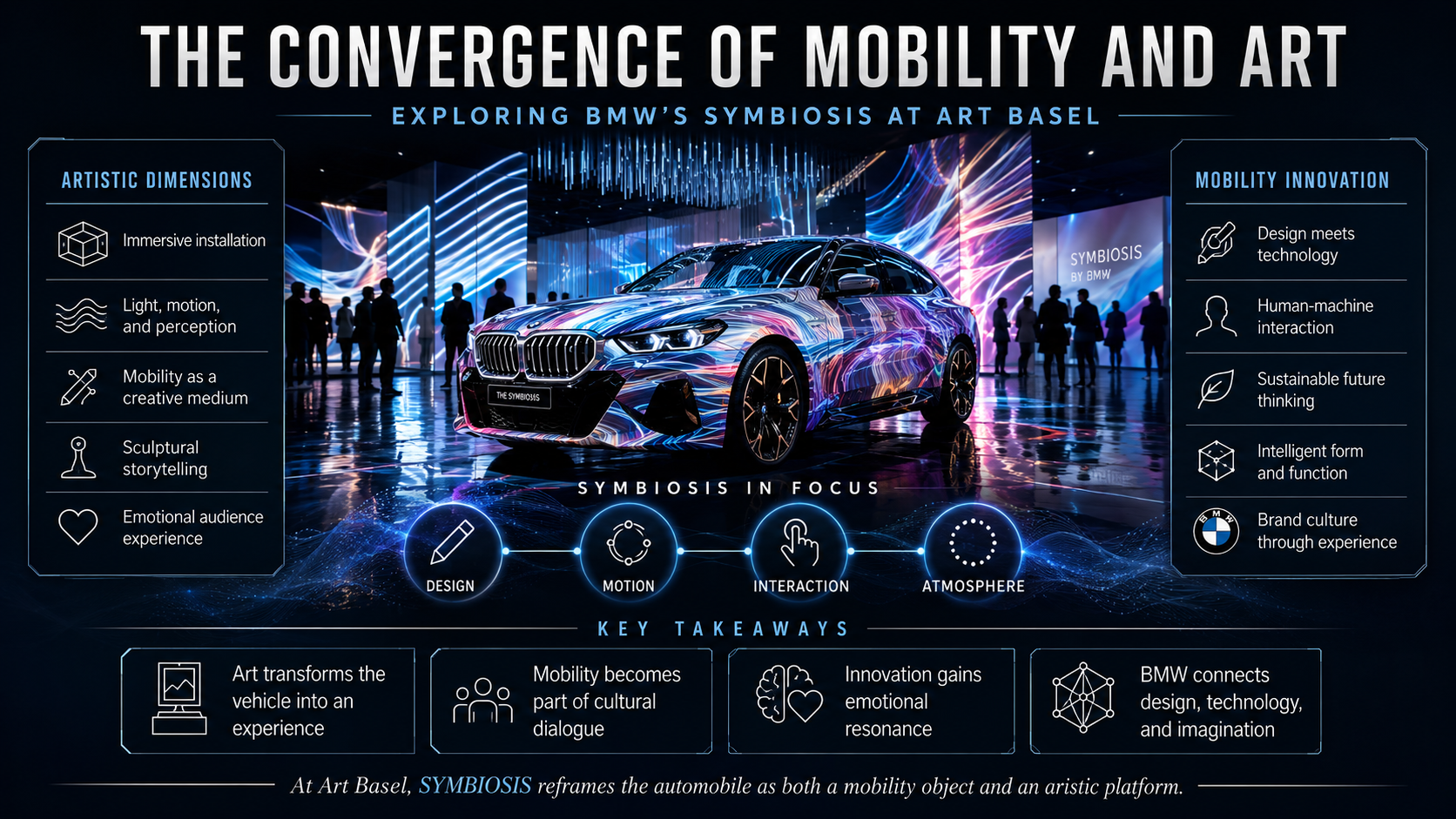
The intersection of automotive engineering and contemporary art serves as a catalyst for redefining how we perceive personal mobility in an increasingly sustainable era. At the upcoming Art Basel exhibition (June 15–21, 2026), BMW is presenting the installation “SYMBIOSIS.” This project conceptually translates the technology of the company’s future electric vehicles (Neue Klasse) into an abstract, immersive experience, exploring the connection between engineering structures and nature. By merging the technical precision of the Neue Klasse platform with the experiential design ethos of artist duo A.A.Murakami, the installation invites observers to rethink the mechanical nature of the electric vehicle.
What does the SYMBIOSIS installation reveal about the future of Neue Klasse?
The installation serves as a metaphorical bridge, illustrating that the technology behind the Neue Klasse platform is not merely a collection of hardware components, but an integrated ecosystem of circular, nature-inspired engineering. By abstracting these concepts, the project highlights how future mobility systems are designed to interact with the environment rather than simply traversing it, emphasizing efficiency, lightweight materials, and bio-inspired design motifs.
This artistic interpretation provides insight into BMW’s long-term vision, where the distinction between a machine and its surroundings begins to dissolve. For those tracking the evolution of electric mobility, this reveals a departure from traditional “industrial” aesthetics. Instead, the focus shifts toward fluid, adaptive, and ecologically attuned designs that mirror biological growth patterns, a core principle that BMW aims to embed in its upcoming generation of electric vehicles.
How does the partnership with A.A.Murakami challenge standard automotive design?
The collaboration with A.A.Murakami leverages their reputation for creating “ephemeral” works—installations that rely on sensory inputs like air, light, and water—to challenge the permanence and rigidity typically associated with automotive design. By translating engineering data into an immersive space, the artists compel viewers to engage with the Neue Klasse platform on an emotional and philosophical level.
This approach serves as a counter-narrative to the hyper-technical focus of the automotive sector, proving that complex engineering, when aligned with natural principles, can produce experiences that are both technologically advanced and human-centric.
Why is the connection between engineering structures and nature crucial for 2026?
The exploration of the connection between engineering structures and nature is crucial for 2026 as the automotive industry grapples with the transition to circular production models. With the European Union targeting a 55% reduction in greenhouse gas emissions by 2030, engineering must move beyond mere power efficiency. It must embrace material circularity and biomimicry to reduce the overall environmental footprint of the vehicle lifecycle.
Current industry data indicates that approximately 95% of vehicle materials can be recycled, yet the goal for the Neue Klasse era is to push this toward a truly closed-loop system. By framing the vehicle as an extension of a biological structure, BMW is signaling to investors and consumers that future mobility is not just about electrification, but about integrating the machine into a wider, regenerative planetary network.
What are the aesthetic and technical goals of this immersive project?
The project aims to create a shared space where mechanical precision meets organic chaos. Technically, it demonstrates the software-defined nature of the Neue Klasse platform, where the car’s intelligence acts as the “nervous system.” Aesthetically, it utilizes light-driven installations to mimic the energy flows of an electric drivetrain, transforming the abstract concept of software into a tangible, light-based environment.
This project serves as a testbed for experiential marketing, proving that complex technological platforms can be communicated effectively through non-traditional media. By distancing the vehicle from the showroom and placing it in an art context, BMW creates a unique value proposition that resonates with a highly sophisticated, design-conscious audience.
Is there a shift in how luxury brands communicate with their consumers?
Yes, there is a clear shift toward experiential storytelling that prioritizes “purpose-led” design over raw performance specs. In 2026, the premium consumer is less interested in horsepower and more intrigued by the “philosophy of the machine”—how it was made, its environmental impact, and its potential to enhance the user’s connection to the world around them.
The Art Basel installation marks a definitive move toward this narrative. By engaging with A.A.Murakami, the brand positions itself as a curator of human experiences rather than just a manufacturer of premium transportation. This strategy reflects a broader trend: luxury brands are increasingly becoming platforms for intellectual and sensory discourse, effectively moving the needle from material wealth to ideological and technological leadership.
Looking ahead: The long-term impact of BMW’s Neue Klasse vision
As we look beyond the 2026 exhibition, the impact of the Neue Klasse platform will be measured by its success in balancing radical technological innovation with environmental responsibility. The SYMBIOSIS project is a preview of a world where engineering is seen as a natural extension of environmental evolution.
By continuously exploring these philosophical and technical intersections, the brand secures its relevance in a market that is increasingly critical of traditional industrial practices. The collaboration illustrates that the future of the automotive industry lies not just in the battery or the electric motor, but in the seamless, intelligent integration of the machine into the natural world. This synergy between nature and engineering remains the ultimate frontier for mobility, and the upcoming installation is a poignant reflection of a company aiming to navigate that transition with visionary foresight and cultural relevance.