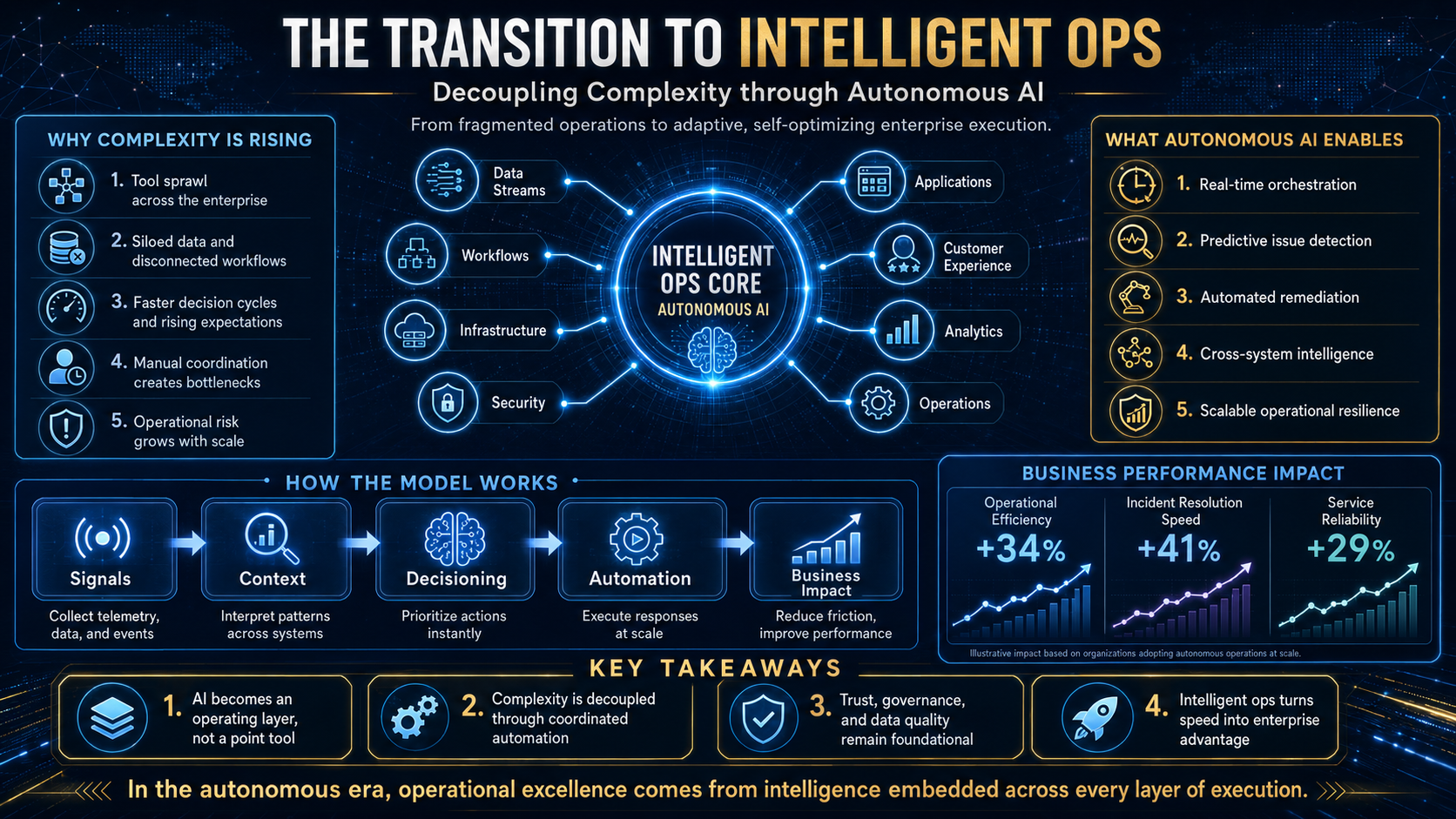
The architecture of modern corporate productivity is undergoing a profound shift, moving away from centralized, rigid frameworks toward agile, self-correcting networks. Monolithic systems are giving way to modular ecosystems of autonomous AI agents that learn in real-time and optimize business processes without the need for constant human intervention. This transition, known as Intelligent Ops, defines the current standard for operational excellence, where adaptability is baked into the technology stack rather than managed by manual oversight.
Why are modular ecosystems of AI agents replacing monolithic systems?
Modular ecosystems replace monolithic systems because they offer unparalleled scalability, fault tolerance, and the agility to update specific business functions without disrupting the entire operational core. By breaking down processes into autonomous units, enterprises can achieve a level of granular optimization that was mathematically impossible under older, centralized management architectures.
In the legacy era, a change to a single business process often required a system-wide overhaul—a process that was costly, slow, and prone to catastrophic failure. Today, Intelligent Ops utilizes independent agents that communicate through APIs, executing tasks, learning from performance metrics, and adjusting parameters autonomously. This modularity allows the system to evolve organically. If a logistics agent learns a more efficient routing path, it updates its own operational logic without needing a software developer to rewrite the entire backend. This decentralization effectively “future-proofs” the enterprise, as individual agents can be swapped, upgraded, or scaled independently as market conditions shift. The net result is an organization that feels more like an biological organism than a clockwork machine—capable of responding to environmental changes in real-time, maintaining high levels of efficiency even when parts of the system face unforeseen disruptions.
How do autonomous agents learn and optimize processes in real-time?
These agents leverage continuous feedback loops, consuming high-velocity data to refine their decision-making algorithms continuously. Rather than relying on static rules, they evaluate outcomes against performance objectives, identifying and implementing incremental improvements in millisecond-scale iterations that would escape human perception.
What are the projected statistical impacts of Intelligent Ops on operational productivity?
Industry research indicates that organizations adopting modular, autonomous AI architectures can expect a 35% to 50% improvement in process efficiency by the end of 2028. This significant gain is primarily attributed to the reduction of operational “latency,” where decisions are made by agents the moment the data is available, rather than waiting for human review cycles.
“The true measure of an intelligent enterprise is not the strength of its centralized control, but the agility of its distributed autonomy. Intelligent Ops is the infrastructure of that agility, turning every business process into a continuous loop of learning and execution.” — Chief Operations Architect
These projections suggest a massive reallocation of human talent. As operational maintenance becomes automated, the role of the workforce shifts from “process executor” to “agent strategist.” Professionals are increasingly tasked with defining the constraints, objectives, and ethical boundaries for these autonomous systems, ensuring that the machine’s drive for efficiency remains aligned with the broader strategic goals of the organization.
What are the architectural prerequisites for deploying Intelligent Ops?
To deploy Intelligent Ops, organizations must first adopt an API-first design philosophy, ensuring that data is interoperable across all systems. Without a unified data fabric, autonomous agents remain siloed, preventing the “cross-pollination” of insights that allows an ecosystem to optimize effectively across different business departments.
How does Intelligent Ops redefine the relationship between humans and technology?
Intelligent Ops transforms the human from an operator into an architect of objectives, creating a model of “supervision” rather than “execution.” Humans provide the value-based parameters—such as brand voice, legal compliance, and strategic long-term vision—while the agents manage the technical complexity of achieving those results at scale.
This model allows human teams to focus on the creative and relational aspects of the business, which remain beyond the capabilities of even the most sophisticated autonomous system. By automating the friction of daily operations, firms can direct human creativity toward high-value work: product innovation, strategic relationship building, and complex problem-solving. This is not about human obsolescence; it is about human empowerment. The modular nature of Intelligent Ops also means that human oversight can be integrated into the loop whenever the AI encounters an “edge case” it cannot solve. The system flags the issue, provides the necessary data, and waits for a human directive, maintaining a symbiotic relationship where technology handles the scale, and humans provide the context. This balance is critical, as it ensures that the enterprise never loses its capacity for nuanced judgment in its quest for machine-driven efficiency.
Can Intelligent Ops be implemented incrementally?
Incremental implementation is the recommended path, starting with specific, high-frequency, data-rich processes like supply chain logistics or customer ticket routing. By proving the efficacy of modular agents in these domains, companies can build the necessary internal infrastructure and cultural comfort required to expand into more complex, sensitive areas of business operation.
Conclusion: The New Standard for Enterprise Agility
The migration toward Intelligent Ops marks the end of an era defined by rigid, manual oversight and the beginning of a period characterized by autonomous, self-learning ecosystems. As monolithic systems collapse under the weight of their own complexity, the adoption of modular agents provides a clear, scalable path toward long-term efficiency. By allowing software to learn and optimize in real-time, organizations can achieve a level of resilience that was previously unattainable, ensuring they remain competitive in an increasingly unpredictable market.
Success in this new paradigm relies on the ability of leadership to design robust objectives and trust the modular ecosystems to execute them effectively. As we look toward the future, the integration of autonomous AI agents will be the primary differentiator between organizations that remain stagnant and those that continue to thrive. The transition to Intelligent Ops is not merely a technical upgrade; it is a fundamental shift in the definition of corporate health. Enterprises that master this autonomous model today will define the market standards for agility, responsiveness, and productivity for the coming decade. The future of operations is modular, autonomous, and intrinsically intelligent.