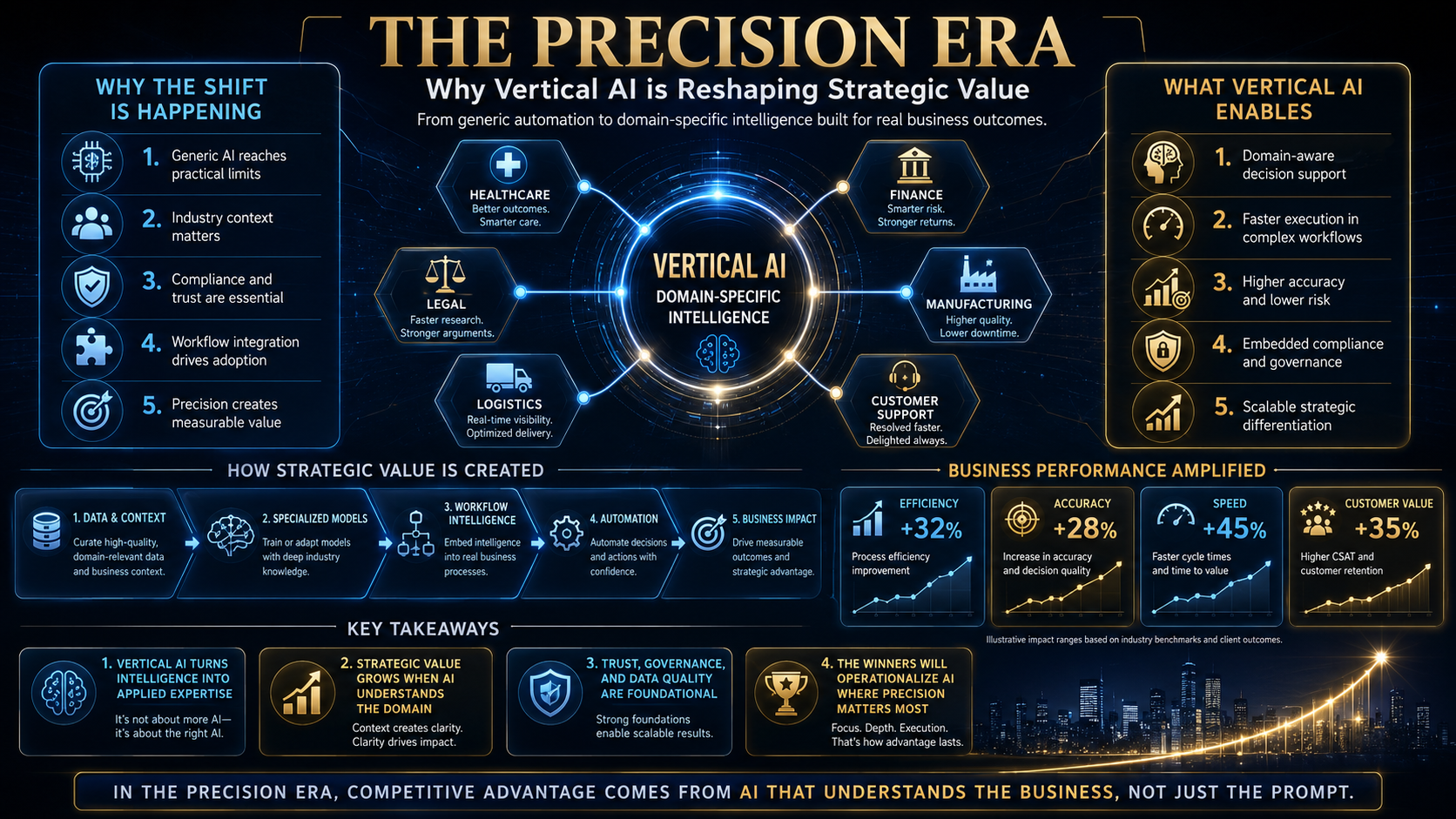
The era of undifferentiated AI utility is coming to a close as enterprises realize that general-purpose intelligence often lacks the contextual depth required for mission-critical operations. The competitive advantage no longer lies in large general-purpose models (such as GPT-5/6), but in highly specialized AI solutions that utilize a company’s proprietary data to solve specific industrial problems. This transition defines the rise of Vertical AI, a paradigm where deep domain expertise, rather than sheer parameter count, becomes the definitive measure of technological success.
Why has the strategic focus shifted from general models to Vertical AI?
The strategic focus has shifted because general models are designed for horizontal utility, which often results in superficial outputs that fail to meet the rigorous standards of specialized industries. By contrast, Vertical AI is purpose-built to navigate the unique regulatory, linguistic, and operational complexities inherent in sectors like legal, pharmaceutical, and high-precision manufacturing.
Enterprises are now recognizing that general-purpose tools provide a baseline, but they cannot provide a moat. If every competitor has access to the same foundational model, that model cannot be a source of sustainable competitive advantage. The true value is found in the synthesis of a company’s unique, non-public historical data with high-performance model architectures. By training systems on proprietary datasets—such as decades of specialized engineering logs, patient health records, or internal financial audit trails—companies create specialized agents that understand the nuances of their specific market. This is the difference between a tool that can “write a report” and an agent that can “audit a supply chain for regulatory compliance.” The former is a commodity; the latter is a specialized asset that contributes directly to the bottom line by reducing error rates, automating complex expert workflows, and uncovering insights that horizontal models would miss entirely due to their lack of domain context.
How does proprietary data become a competitive advantage in AI?
Proprietary data acts as the “intellectual fuel” for Vertical AI, creating a unique feedback loop where the model’s accuracy increases in direct proportion to the quality and exclusivity of the data ingested. While general models are trained on the public web, Vertical AI is trained on your specific reality, making it increasingly difficult for competitors to replicate.
What are the projected market impacts of Vertical AI adoption by 2028?
Economists and technology analysts project that by 2028, Vertical AI will account for over 70% of enterprise AI expenditure, significantly outstripping investments in general-purpose foundational models. This shift is driven by the realization that specialized outcomes yield a significantly higher return on investment (ROI) than the broad-spectrum efficiency gains promised by generic tools.
“General-purpose models are the foundation, but Vertical AI is the house. Competitive advantage in the next decade will be determined by how effectively a firm can apply its own unique data to tune those models to its specific reality.” — Enterprise Strategy Advisor
Statistical forecasts suggest that industries utilizing vertical solutions will see a 40% reduction in operational friction compared to those relying on generic AI. As companies move beyond the “experimental” phase of implementation, they are focusing on KPIs that reflect industry-specific value—such as improved diagnostic accuracy in healthcare or optimized yield in high-end manufacturing. The statistical trajectory is clear: capital is flowing away from “everything-to-everyone” platforms and toward deep-tier, expert-level infrastructure that delivers verifiable, high-value outcomes.
Is Vertical AI truly better than scaling larger general models?
Vertical AI is superior in performance metrics that matter most to enterprises: accuracy, reliability, and security. While GPT-5 and its successors push the boundaries of what is possible in general reasoning, they often suffer from “hallucinations” or logical vagueness that makes them unsuitable for complex, high-stakes tasks where precision is non-negotiable.
How can organizations begin building their own Vertical AI capabilities?
Building a Vertical AI capability is a process of architectural curation and data alignment. It starts with identifying the “high-value, high-complexity” tasks within the organization—areas where the cost of human expertise is high, and the availability of data is rich. The organization must then adopt a modular strategy, using foundational models as the “reasoning engine” while embedding the domain expertise through fine-tuning, retrieval-augmented generation (RAG), and specialized knowledge graphs.
This requires a cultural shift within the firm. Data scientists must collaborate directly with domain experts—the people who actually understand the nuances of the industrial process—to ensure that the model’s training reflects real-world operational reality. The process is not about “letting the AI learn” on its own; it is about “teaching the AI” the specific constraints and requirements of the business. By creating this internal knowledge structure, companies ensure that their AI remains an expert that they own, rather than a generic service that they rent. The objective is to build an intelligence that speaks the language of the company, understands its history, and is optimized for the specific challenges it faces on a daily basis. This is a deliberate, methodical approach that prioritizes long-term strategic utility over the short-term thrill of general-purpose innovation.
Conclusion: The New Standard for Enterprise Intelligence
The rise of Vertical AI signals the maturation of the artificial intelligence sector, moving from the excitement of broad-spectrum capability to the serious work of industrial application. The competitive advantage of the next decade will belong to those who understand that while general-purpose models provide a starting point, they do not constitute a destination. By leveraging proprietary data to build highly specialized solutions, organizations are moving from being passive users of technology to being the architects of their own intelligent futures.
As businesses continue to navigate the complexities of digital transformation, the distinction between “using AI” and “building Vertical AI” will become the primary differentiator in the market. Those who invest the time, capital, and cultural effort to integrate their unique domain expertise with modern machine learning architectures will define the leaders of their respective industries. The value is no longer in the breadth of the model, but in the depth of its application. In this new era, the most successful firms will be those that prioritize accuracy over breadth, and industrial relevance over general utility, ensuring that their AI assets are not just powerful, but perfectly tuned to the specific problems they are tasked to solve. The era of the “everything-model” is being superseded by the era of the “expert-model,” and for the enterprise, this is the most significant development in digital strategy of the decade.