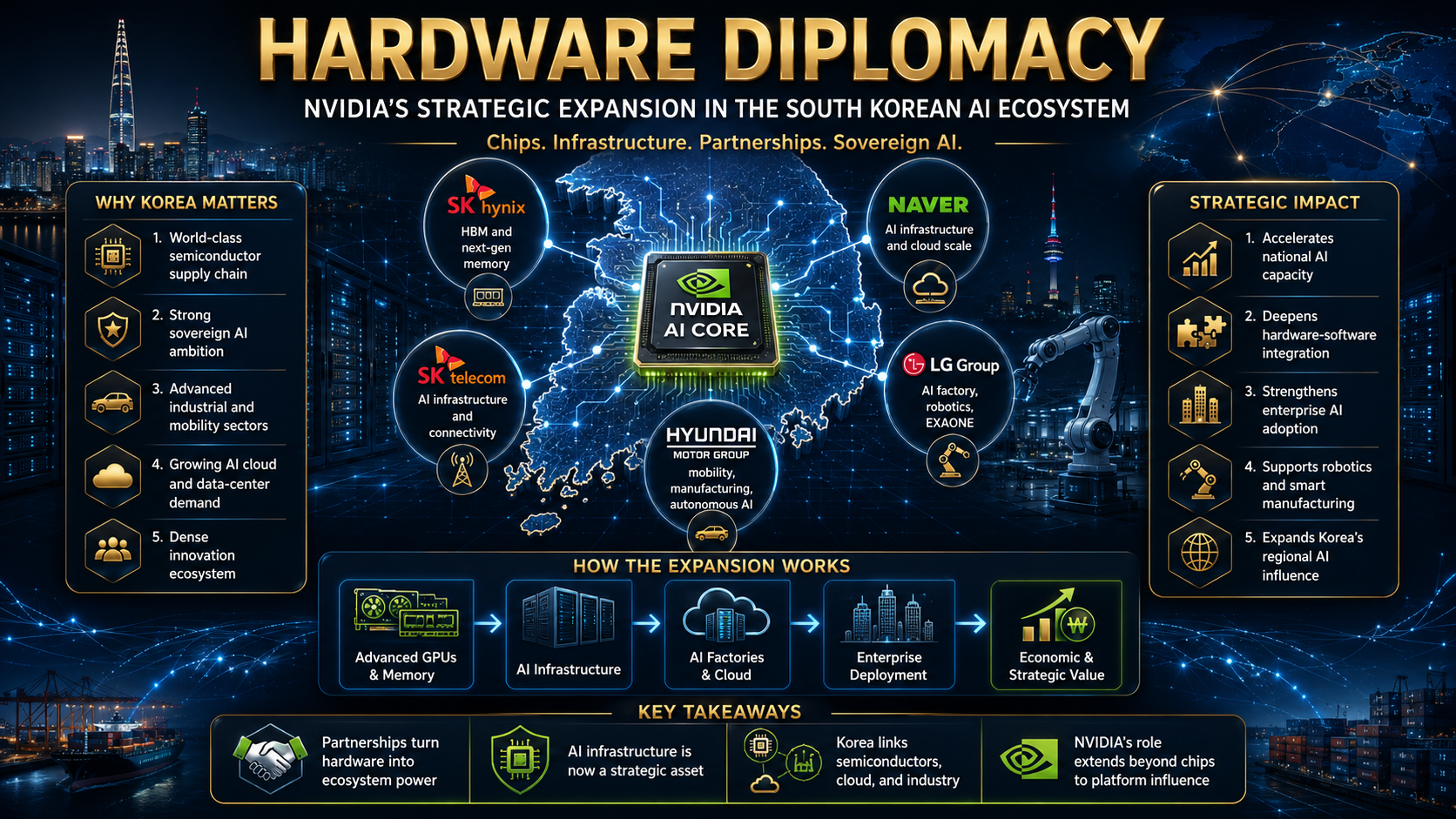
The landscape of global artificial intelligence is being fundamentally reshaped not just by software, but by the physical capacity of silicon infrastructure. Nvidia expands its presence: The tech giant has entered into a series of strategic corporate agreements for AI partnerships in South Korea, reinforcing its focus on hardware infrastructure for generative AI. This move serves as a critical indicator of how central high-performance computing has become to national and corporate technological sovereignty.
Why is South Korea a focal point for Nvidia’s infrastructure strategy?
South Korea represents a unique nexus of high-end memory manufacturing and sophisticated consumer electronics, making it an indispensable partner for Nvidia’s generative AI roadmap. By deepening its corporate footprint in the region, Nvidia secures a stable supply chain and collaborative ecosystem that is essential for producing the next generation of GPU-based architectures required for large-scale model training.
The decision to localize AI partnerships in South Korea is a calculated maneuver to align Nvidia’s hardware dominance with Korea’s advanced semiconductor prowess. South Korean firms are global leaders in HBM (High Bandwidth Memory), a component that is currently a bottleneck for AI performance. By forming deep-tier alliances, Nvidia is not just selling chips; it is participating in a co-development model that ensures their hardware remains the standard for enterprise-level generative AI. This strategy allows the company to integrate its software ecosystem, CUDA, directly into the local manufacturing stack, creating a seamless transition from raw silicon to functional AI data centers. Furthermore, these agreements foster localized development environments, which help Korean enterprises optimize their own AI models directly on Nvidia’s hardware, creating a virtuous cycle of localized innovation and hardware adoption that is difficult for competitors to disrupt.
How do strategic AI partnerships influence the global supply chain?
Strategic partnerships allow for the pre-emptive coordination of manufacturing capacity, ensuring that hardware availability keeps pace with the explosive global demand for AI compute. By co-investing in localized infrastructure, Nvidia minimizes geopolitical risk while maximizing the output efficiency of their complex, multi-layered semiconductor supply chain.
What are the statistical projections for generative AI hardware demand by 2030?
Current market analyses indicate that the demand for high-performance computing hardware, specifically tuned for generative AI, will sustain a compound annual growth rate of approximately 25-30% through 2030. This growth is driven by the transition of enterprise sectors from experimental AI pilots to permanent, infrastructure-heavy operational deployments.
“Infrastructure is the new battleground for generative AI. Partnerships that link compute power directly to regional memory manufacturing capacities are the most effective strategy for capturing the long-term value of the AI era.” — Semiconductor Market Strategist
These figures highlight that hardware is not a static requirement but a constantly evolving one. As models become more parameter-heavy, the demand for memory-dense, high-speed chips grows exponentially. South Korea’s unique capability to mass-produce this technology, combined with Nvidia’s architectural leadership, suggests that this specific regional partnership will be a primary engine of global AI progress for the remainder of the decade.
What role does localized hardware infrastructure play in generative AI deployment?
Localized hardware infrastructure significantly reduces data latency and increases sovereignty over training environments, allowing enterprises to develop and refine their own models without constant reliance on foreign, public cloud providers. This “sovereign compute” model is becoming a top priority for corporations that view their internal data as a strategic asset.
How does the partnership model mitigate technical risks for local enterprises?
For South Korean firms, these agreements provide a direct line to the latest hardware iterations and architectural best practices, significantly lowering the barrier to entry for building competitive AI products. By gaining early access to Nvidia’s software-hardware integrated stack, local companies can bypass years of R&D, focusing their resources on developing specific industry applications instead of debugging the underlying compute layer.
This access translates into faster go-to-market strategies and a higher degree of customization for enterprise AI tools. Because these partnerships involve collaborative development, local developers can provide feedback on hardware performance directly to Nvidia’s engineering teams, creating a continuous improvement cycle that benefits the entire ecosystem. This is a mutually reinforcing relationship: Nvidia gains deep market penetration in a highly advanced technical sector, and Korean enterprises gain the tools to lead in their respective vertical AI fields. It is a model of symbiotic evolution where the physical barrier to entry—access to top-tier compute—is effectively lowered for partners who can demonstrate deep integration with Nvidia’s broader vision. For the broader industry, this demonstrates that the AI era will not be won by silicon alone, but by the strength of the partnerships that manage the transition from raw hardware to applied intelligence.
Are these corporate agreements indicative of a broader trend?
The move in South Korea is part of a global trend where Nvidia is actively decentralizing its infrastructure influence to ensure its hardware is the foundational layer for regional generative AI developments. This approach reflects a transition from a product-selling model to an ecosystem-founding model, where Nvidia’s presence becomes a prerequisite for national and regional technological leadership.
Conclusion: Securing the Hardware Foundation for the Future
The expansion of Nvidia’s strategic presence in South Korea confirms that generative AI success is inextricably linked to the underlying hardware infrastructure. By forging deep corporate agreements, Nvidia is not only securing its supply chain but is actively embedding itself as the operational backbone for localized AI ecosystems. This strategy ensures that as AI moves from an academic concept to an industrial imperative, the firm remains the definitive leader of the underlying infrastructure that powers the intelligence of the modern economy.
Looking ahead, the success of these partnerships will likely serve as a blueprint for how global technology giants engage with advanced regional markets. As compute power becomes the primary constraint of corporate and national ambition, the ability to build, localize, and optimize hardware-integrated environments will be the ultimate competitive advantage. Nvidia’s trajectory in South Korea demonstrates a forward-thinking commitment to this reality, ensuring that their hardware remains the catalyst for innovation across every major industrial sector. For stakeholders and industry observers, this development signals that the foundation of the AI era is being laid right now, and that foundation is built on silicon, memory, and the strategic alliances that unify them into a cohesive, high-performance global network. The transition to generative AI is no longer a question of if, but how quickly the necessary infrastructure can be deployed; through these strategic partnerships, Nvidia is ensuring that the answer is “as quickly as possible.”