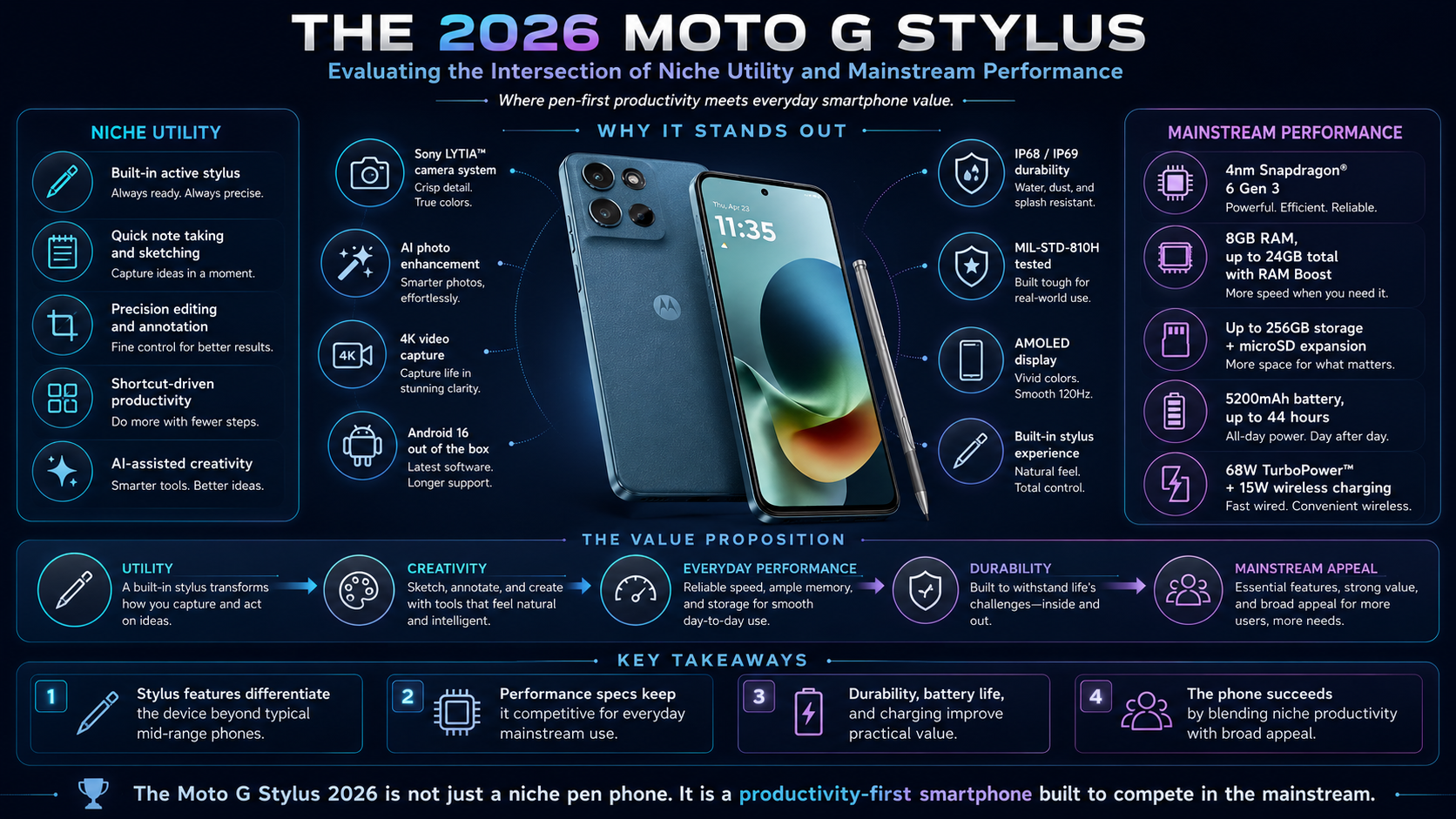
The smartphone market continues to evolve, yet some manufacturers persist in carving out specialized niches rather than competing solely on raw processing power. Current reviews describe it as a device with interesting features, yet focusing more on the stylus than on overall performance (“More Stylus Than Substance”). This positioning places the device in a unique category, catering to users who prioritize tactile input and creative annotation over the high-octane benchmarks typical of flagship competitors.
Why does the “More Stylus Than Substance” perception persist for the 2026 model?
The perception persists because the device’s hardware configuration prioritizes input-centric functionality at the expense of high-end processor overhead, leading to visible stuttering during intensive multitasking. While the stylus integration is remarkably refined for its price bracket, the underlying silicon struggles to match the fluid, instantaneous response times that users have come to expect from modern mid-range devices.
It is a common architectural trade-off. By allocating a significant portion of the bill-of-materials cost toward the digitizer, the stylus assembly, and the corresponding software integration, Motorola has inherently compromised the performance envelope of the core handset. For the casual user who requires a device for sketching, digital signing, or navigating complex spreadsheets, this trade-off is often acceptable. However, for those seeking a device that can handle gaming or complex video editing, the experience is underwhelming. The device essentially signals its intent: it is a tool for professional productivity on a budget, not a media consumption powerhouse. When benchmarks reveal frame rate drops during routine navigation, it reinforces the narrative that while the stylus is a sophisticated add-on, the device underneath remains firmly planted in the entry-to-mid-tier range. The challenge for Motorola is whether this specialized value proposition is enough to retain user loyalty in a market that is increasingly demanding seamless, high-performance integration across all functional layers.
How does the integrated stylus impact user productivity in daily workflows?
For specific professional applications, the integrated stylus significantly improves the precision of document editing and note-taking, effectively turning the device into a pocket-sized whiteboard. Its latency is surprisingly low, allowing for a natural hand-writing feel that capacitive pens simply cannot replicate on generic hardware.
What do current market projections suggest for niche input device adoption?
Market analysts project that while the broader smartphone market remains focused on AI-integrated cameras and foldable displays, a steady 8% annual growth in “productivity-niche” devices is expected through 2028. This growth is driven by a segment of users who explicitly seek alternatives to the increasingly expensive flagship tablets, preferring an all-in-one handheld device that facilitates creative workflows.
“A device that excels in a single specialized function often faces the paradox of being a perfect secondary tool and a disappointing primary one. The 2026 Moto G Stylus perfectly illustrates the trade-offs required to maintain price-point accessibility while innovating in input mechanics.” — Mobile Hardware Analyst
These projections highlight a strategic divergence in the smartphone market. While some brands pursue the “super-device” ideal—a handset that does everything with maximum speed—Motorola is capturing value by focusing on specific use cases that other manufacturers have largely ignored. This approach creates a strong emotional connection with a subset of users who feel underserved, even if the device fails to impress the benchmark-heavy tech community.
Does the software layer compensate for hardware limitations?
The software experience is surprisingly robust, featuring dedicated menus for stylus interaction, palm rejection technology, and cloud-syncing for notes. This layer acts as a critical interface bridge, ensuring that the device’s unique selling point feels cohesive rather than like an afterthought, which is the primary reason it remains relevant in a crowded landscape.
Is this device a viable replacement for high-end professional tablets?
It is not a replacement for high-end professional tablets, as it lacks the display resolution, color accuracy, and processing depth required for professional-grade design or high-definition content creation. Its purpose is strictly functional: it serves as a lightweight alternative for mobile editing and administrative work, where immediate access to note-taking is more critical than creative fidelity.
The device is most effective as a supplementary tool for users who carry a laptop for primary work but need a robust, stylus-equipped handset for impromptu interactions. Because the stylus is physically tucked inside the chassis, the device becomes a mobile office that is ready the moment an idea occurs. This is the “Substance” that reviewers might overlook—the utility of accessibility. In a professional setting, having a stylus that never needs to be paired via Bluetooth and never runs out of charge is a logistical advantage that outweighs minor performance lags. While the processor might not win any awards, the integration of the stylus into the operating system ensures that the barrier between thought and digital capture is lower than on almost any other non-flagship device. The value is not found in the chipset’s clock speed, but in the seamless workflow it enables for those who value handwriting over touch-typing.
What are the long-term reliability concerns for integrated stylus mechanisms?
Longevity concerns center on the internal spring mechanism and the stylus tip, which are susceptible to mechanical wear over time. While the stylus housing is durable, the frequent extraction and insertion inherent in its design require careful handling to avoid long-term degradation of the contact points that keep the stylus secure in the device frame.
Conclusion: Understanding the Value Proposition
The Motorola Moto G Stylus (2026) is a calculated study in trade-offs. It is a device that succeeds by ignoring the industry’s obsession with flagship-tier performance metrics and instead focusing on a singular, highly requested input feature. While it may be categorized by critics as “More Stylus Than Substance,” this label misses the point of the device’s existence. For the target demographic—professionals and creatives who prioritize tactile note-taking and document navigation—it offers a unique blend of functionality that simply does not exist in standard mid-range handsets.
Motorola has effectively identified a segment of the market that values practical utility over raw power. The success of this model is not measured in top-tier benchmark scores, but in how well it fits into the daily workflows of its users. If the device performs its primary task—providing a seamless, always-available stylus experience—without significant software failures, then it has achieved its design goals. Ultimately, the Moto G Stylus (2026) serves as a reminder that the “best” device is not always the fastest one, but the one that most precisely addresses the specific needs of its user. For those who can look past the performance limitations and appreciate the integrated digitizer for what it is, the device remains a compelling, if niche, addition to the mobile landscape. The market will continue to provide space for such devices, as long as they offer a functional advantage that cannot be replicated by generic, high-performance hardware.