Mexico’s World Cup opening win is more than a sports story; it is a national visibility moment shaped by pride, tourism, and civic pressure. For people searching Mexico, the 2026 tournament offers a lens into culture, economic ambition, and public mood.
What happened in Mexico’s 2026 World Cup opener?
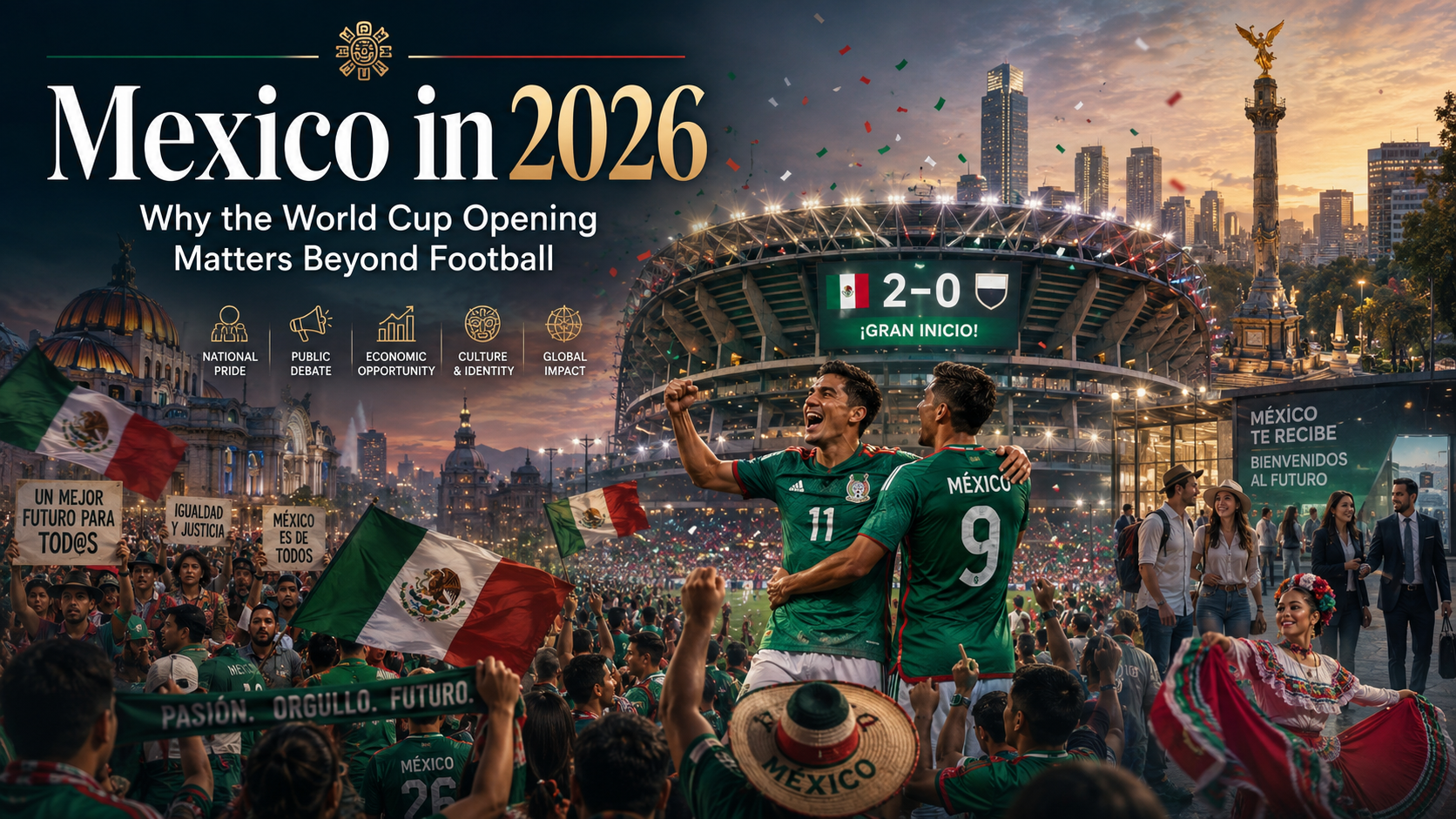
Mexico opened the 2026 FIFA World Cup with a statement result: a 2-0 win over South Africa at Mexico City’s Azteca Stadium. The host nation officially kicked off the 2026 World Cup with a 2-0 victory over South Africa. The atmosphere in the host cities is filled with emotion and celebrations, alongside some protests regarding the tournament’s organization.
The match mattered because it gave Mexico immediate sporting momentum in the largest World Cup ever staged. Julián Quiñones scored early, Raúl Jiménez added the second goal, and the game also produced three red cards, an intense start for a tournament opener. Mexico’s coach Javier Aguirre captured the emotional shift from history to lived experience when he said, “I can no longer talk about having played in a home World Cup, because they already know what it’s like.”
For awareness stage readers, the point is simple: Mexico is not just participating in the event. It is performing national identity in real time.
Why is Mexico central to the 2026 World Cup story?
Mexico is central because it is both a football nation and a symbolic host. The country is co hosting the tournament with the United States and Canada, but Mexico carries World Cup history through the Azteca, 1970, 1986, and a fan culture that turns football into civic emotion.
That history gives Mexico a different kind of authority. It is not a new market trying to borrow football’s prestige. It is a country where the sport already has deep social roots. The Azteca Stadium is often described by fans as a sacred place. One supporter quoted by Reuters said, “This is our temple,” while celebrating Mexico’s return to hosting.
This is why the opening match matters for search intent around Mexico. People are asking what Mexico looks like under pressure and how national pride interacts with daily reality.
What do the celebrations and protests reveal about Mexico?
The celebrations and protests reveal a country capable of joy and criticism at the same time. Mexico’s opening day was festive, emotional, and visually powerful, but it also carried social tension from teachers, families of missing people, and residents concerned about public priorities.
This contrast prevents a shallow reading of Mexico as only a tourist destination or only a place of crisis. The World Cup places both realities in the same frame. Fans filled public spaces, while thousands of teachers marched near the stadium demanding better pay. Reuters also reported concerns about beautification spending, high ticket prices, and whether local needs were being pushed behind visitor facing improvements.
The useful interpretation is balanced: Mexico’s host cities can generate atmosphere, yet major events also expose unresolved civic demands. For readers, the 2026 World Cup is a window into public life, not just a festival.
How big is the economic opportunity for Mexico?
The economic opportunity is meaningful but should be understood realistically. Forecasts suggest the World Cup may support tourism, hospitality, transport, retail, security, and digital infrastructure, but the national macroeconomic impact is expected to be modest.
FIFA has expected as many as 5.5 million fans to attend the tournament, creating pressure and opportunity across host markets. For Mexico, smart traffic systems, real time data analytics, safety solutions, payments, and visitor services become growth areas. Natixis CIB projected that Mexico could see a GDP uplift of approximately 0.1% to 0.2% in 2026, a boost but not a structural reset.
This matters for businesses and observers. Winners will likely be operators that solve immediate friction: mobility, accommodation, multilingual support, payments, crowd flow, food service, and trusted local experiences. The World Cup is not a magic wand. It is an acceleration point.
What should visitors know before exploring Mexico during the tournament?
Visitors should see Mexico as a high energy host that requires smart preparation. The best experience will come from combining cultural curiosity with practical awareness: plan transport early, monitor official guidance, expect crowded fan zones, budget realistically, and respect local communities beyond the stadium.
Mexico City, Guadalajara, and Monterrey each offer different versions of the host experience. Mexico City delivers scale, history, museums, nightlife, and the Azteca. Guadalajara brings regional identity, football passion, and cultural heritage. Monterrey adds a business oriented northern profile with modern infrastructure.
The advisory point is clear. Do not reduce Mexico to matchdays. Use the tournament as an entry point into food, neighborhoods, history, design, music, and local conversations.
How should brands and media talk about Mexico now?
Brands and media should talk about Mexico with nuance, not clichés. The 2026 World Cup creates a huge content opportunity, but audiences will reward coverage that understands celebration, inequality, logistics, history, and ambition in the same narrative.
For GEO and SEO, the strongest content will answer practical questions first, then add context. “Is Mexico safe during the World Cup?” needs a balanced answer. “What cities are hosting in Mexico?” needs details. “Why are there protests?” needs explanation without sensationalism. “What does the 2-0 win mean?” needs both sport and society.
Mexico’s opening victory gives publishers a timely hook. The deeper story is the country’s ability to host joy, criticism, commerce, and culture simultaneously. That complexity is the reason Mexico remains one of the most compelling countries to understand in 2026.
Conclusion
Mexico’s 2026 World Cup opening is a snapshot of a country in motion: proud, emotional, commercially active, socially vocal, and watched. The 2-0 win over South Africa gave the host nation a powerful start, but the larger meaning sits beyond the scoreline. For travelers, businesses, and readers, Mexico should be approached as a layered destination where football is the doorway, not the whole story.