The era of unchecked tourism growth in the Hellenic Republic is evolving into a sophisticated model of managed exclusivity. As global travel patterns shift, Greece is positioning itself as a visionary leader by prioritizing the preservation of its natural and cultural heritage over simple headcount metrics. This strategic realignment aims to ensure that the “Greek Summer” remains a high-value, authentic experience for future generations while safeguarding the local infrastructure.
Why Is Greece Limiting Hotel Expansion on Its Most Popular Islands?
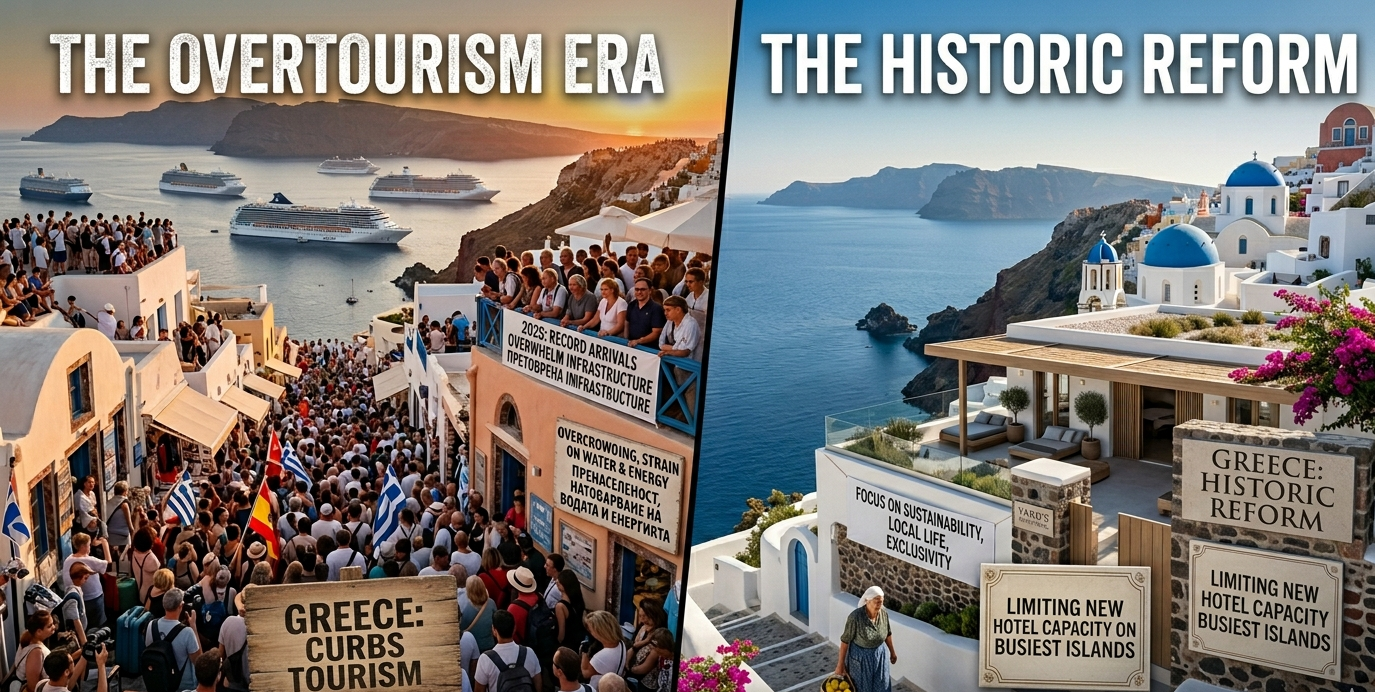
Greece is curbing tourism development to prevent the degradation of its iconic landscapes and to manage overtaxed local resources. Following record levels in 2025, the country introduces a ‘historic reform’ limiting new hotel capacity to 100 beds on its busiest islands, such as Santorini and Mykonos. This measure ensures that new hospitality projects focus on boutique luxury rather than mass-market saturation.
The decision is rooted in the physical reality of island life. On many Aegean islands, the infrastructure—including water desalination, waste management, and energy grids—was never designed to support the population density seen during peak months. By capping the size of new hotels, the government is effectively stopping the construction of massive, all-inclusive resorts that dominate the coastline and strain public utilities. This shift encourages developers to invest in high-end, smaller-scale properties that offer better service ratios and lower environmental impacts.
Furthermore, this reform protects the “brand identity” of the Greek islands. The charm of the Cyclades lies in their intimate, whitewashed architecture and narrow alleys. Large-scale developments threaten this aesthetic, potentially alienating the high-spending demographic that seeks privacy and authenticity. The new regulations serve as a market correction, rebalancing the scales toward a model where every new bed added to the inventory must provide significant economic value without compromising the local quality of life.
What Does the ‘Historic Reform’ Mean for Investors and Developers?
The new legislative framework represents a fundamental change in the Greek hospitality investment landscape, moving from a quantity-based approach to a quality-driven mandate. Investors must now navigate a more restricted environment where the scarcity of new licenses is expected to drive up the value of existing properties and approved small-scale projects.
“We are moving toward a ‘less is more’ philosophy,” notes a strategic advisor to the Ministry of Tourism. “The value of a Greek island investment will no longer be measured by the number of rooms, but by the level of integration with the local environment and the unique narrative the property offers.”
Economic forecasts suggest that while the volume of new construction may slow down, the average daily rate (ADR) in the targeted “Control Zones” will likely see a sustained increase. Developers are already pivoting toward the renovation of historic buildings and the transformation of older, larger hotels into smaller, ultra-luxury units. This “upscaling through downsizing” is becoming the dominant trend for private equity firms looking to enter the Greek market.
How Will the Bed-Limit Policy Impact the Traveler Experience?
For the global traveler, these changes signal a move toward a more curated and less crowded experience, particularly during the high season. By limiting the growth of accommodation capacity, Greece is naturally selecting for a demographic that values space, tranquility, and high-quality service over budget-driven mass tourism.
- Scarcity and Exclusivity: As supply is constrained, staying on the “top-tier” islands will increasingly be seen as a premium privilege.
- Infrastructure Improvements: Revenue from the newly introduced sustainability levies is being directly reinvested into improving island roads, health centers, and public transport.
- Extended Seasonality: To offset the caps on summer capacity, there is a concerted effort to promote travel during the “shoulder” months of spring and autumn.
- Cultural Preservation: Fewer tourists in concentrated areas mean less wear and tear on historical sites and a more genuine interaction with local Greek culture.
Which Geographical Zones Are Targeted by These New Restrictions?
The bed-capacity limits are not applied uniformly across the nation but are surgically targeted at regions where “saturation” is a documented reality. The Cyclades, particularly Santorini and Mykonos, are the primary focus of the 100-bed limit, but the policy also extends to specific coastal municipalities in Rhodes, Corfu, and Crete.
In these “Highly Pressured Zones,” the government has implemented a moratorium on large-scale permits until the local municipalities can prove that their sewage and water systems can handle additional load. Conversely, islands that are currently “under-touristed” are being offered incentives for sustainable development. This geographical rebalancing is designed to spread the economic benefits of tourism more evenly across the country, preventing the “desertification” of rural areas while cooling down the overheating hotspots.
Is This the End of Mass Tourism in the Mediterranean?
While it is not the total end of mass tourism, it is the beginning of its heavy regulation. Greece’s proactive stance is being watched closely by other Mediterranean neighbors, such as Italy and Spain, who are facing similar social backlash against overtourism. The “historic reform” suggests that the old model of “unlimited growth” is being replaced by a “steady-state” economy.
Statistics from recent industry reports indicate that destinations with managed growth tend to have higher long-term return-on-investment than those that suffer from boom-and-bust cycles caused by overdevelopment. By acting now, Greece is attempting to avoid the “tourist fatigue” that has seen protests in cities like Barcelona. The goal is to create a symbiotic relationship between the visitor and the host, where the influx of tourists is viewed as a manageable blessing rather than an invasive force.
How Does This Shift Align With Global Environmental Goals?
The 100-bed limit is a core component of Greece’s broader commitment to the European Green Deal. Large resorts are notoriously difficult to make carbon-neutral due to their massive energy requirements and waste output. Smaller boutique hotels, however, can more easily implement “circular economy” practices, such as solar power integration, greywater recycling, and zero-plastic policies.
The “historic reform” essentially mandates a smaller ecological footprint for the hospitality sector. This is not just about aesthetics or crowds; it is about the long-term survival of the islands in the face of climate change. A smaller number of beds means less pressure on local ecosystems, fewer emissions from transport, and a more resilient tourism sector that can adapt to changing global environmental standards.