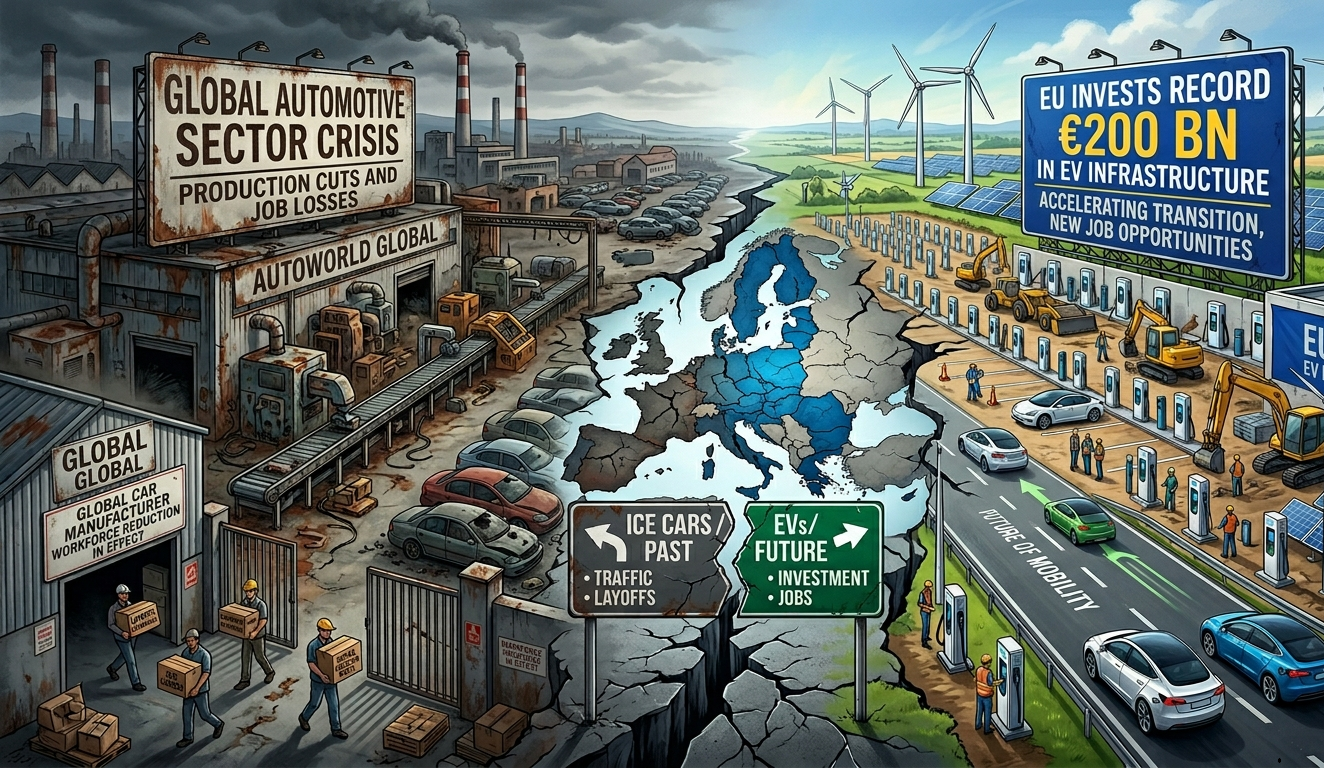
The global automotive landscape is currently undergoing its most radical transformation since the invention of the assembly line. We are witnessing a paradoxical “double-speed” economy: legacy manufacturers are aggressive downsizing to survive, while regional governments pour unprecedented capital into the electric future. This is not a standard cyclical downturn, but a structural rebirth.
Why Is the Automotive Industry Facing a Dual-Ended Crisis?
The current crisis stems from a widening gap between declining internal combustion engine (ICE) profitability and the massive capital expenditures required for electrification. Nissan to cut 10% of its European workforce as EU reports record €200bn investment in EV infrastructure illustrates this perfectly—traditional players are shedding weight while the continent builds the stage for a new era of mobility.
This friction is creating a “valley of death” for manufacturers who failed to pivot early. On one hand, high interest rates and fluctuating energy costs have dampened consumer demand for high-end vehicles. On the other, the regulatory pressure to meet zero-emission targets by 2035 is non-negotiable. Manufacturers are forced to maintain two separate supply chains—one for the dying petrol market and one for the surging, yet low-margin, EV market.
Industry analysts suggest that the “old guard” is currently paying a “legacy tax.” This tax includes pension liabilities for thousands of assembly workers whose skills do not translate to battery chemistry or software engineering. Consequently, strategic layoffs are becoming the primary tool for fiscal survival. The goal is to reach a “lean state” where digital-first production can finally match the efficiency of newer competitors from the East.
How Significant is the European Investment in Infrastructure?
Europe is doubling down on its green mandate to ensure it doesn’t lose its status as a global automotive hub. The EU reports record €200bn investment in EV infrastructure, a figure aimed at solving “range anxiety” once and for all by installing ultra-fast charging stations every 60 kilometers on major trans-European networks.
This financial commitment is unprecedented. It covers everything from high-capacity power grids to localized hydrogen refueling for heavy-duty trucking. As European Commission spokespeople have noted, “The transition is no longer a choice; it is an industrial necessity to keep European brands competitive against subsidised external players.”
However, there is a disconnect between infrastructure and the vehicles themselves. While the roads are being prepared for a 300% increase in electric traffic, the average price of a European-made EV remains roughly 20% higher than its ICE counterpart. This gap is the primary reason why market penetration has hit a temporary plateau, causing the very layoffs we see at firms like Nissan. The infrastructure is coming, but the affordable vehicle has yet to arrive in mass quantities.
Why Is Nissan Restructuring Its European Operations Now?
The decision for Nissan to cut 10% of its European workforce as EU reports record €200bn investment in EV infrastructure is a tactical move to realign its manufacturing footprint with a “software-defined vehicle” (SDV) strategy. Nissan is prioritizing higher-margin crossover models and fully electric platforms over traditional hatchbacks that once dominated the European market.
“The industry is moving from hardware-centric to service-centric models,” says Marcus Hoffmann, a leading automotive consultant. “Nissan’s restructuring is a painful but necessary recalibration of their human capital toward digital competencies.”
The 10% reduction specifically targets administrative and legacy assembly roles. By thinning these ranks, the company aims to divert roughly €450 million annually into its “Ambition 2030” project, which focuses on solid-state battery technology. This is a clear signal: the company would rather be smaller and technologically advanced than large and stuck in the fossil-fuel past.
What Role Does Geopolitics Play in This Automotive Crisis?
The crisis is deeply intertwined with global trade tensions and the race for raw material sovereignty. As the EU reports record €200bn investment in EV infrastructure, it is also implementing stricter “Rules of Origin” to protect local manufacturers from low-cost imports. This creates a protectionist wall that forces global brands like Nissan to either build locally with local parts or face crippling tariffs.
Currently, 75% of EV battery components are processed in Asia. For Europe to justify its massive infrastructure spending, it must establish a localized “Battery Alliance.” This geopolitical tug-of-war adds another layer of cost to an already stressed sector. Companies are no longer just building cars; they are negotiating international trade agreements and securing mining rights in Africa and South America.
Is the €200bn Investment Enough to Save the Sector?
While the EU reports record €200bn investment in EV infrastructure, many experts argue that money alone cannot solve the “skills gap.” The automotive sector currently faces a shortage of approximately 500,000 workers trained in power electronics and AI-integrated systems. Investment in cables and chargers is useless if the workforce cannot maintain the high-tech vehicles using them.
- Public investment focuses on the “seen” (chargers, roads).
- Private crisis focuses on the “unseen” (R&D debt, workforce retraining).
- Market projection: A 15% increase in total automotive sales is expected by 2028, but only for brands that survive the 2026-2027 “culling period.”
Statistical forecasts suggest that by 2030, 1 in 3 cars sold in Europe will be a brand that didn’t exist twenty years ago. This reality is what keeps legacy CEOs awake at night, leading to the drastic measures seen in the current headlines.
How Can Consumers and Investors Interpret This Turmoil?
For the “Awareness” stage seeker, this turmoil represents a massive buying and investment opportunity rather than a sign of industry death. The Nissan to cut 10% of its European workforce as EU reports record €200bn investment in EV infrastructure news should be viewed as a “correction.” The industry is shedding the inefficiencies of the 20th century to make room for a 21st-century digital mobility model.
Investors should look at companies that are aggressively cutting legacy costs while simultaneously partnering with the EU on infrastructure projects. Consumers, meanwhile, can expect a surge in more affordable, “infrastructure-ready” vehicles by late 2027, as the current investments in charging networks reach maturity and battery prices continue their downward trend toward the $100/kWh parity mark.