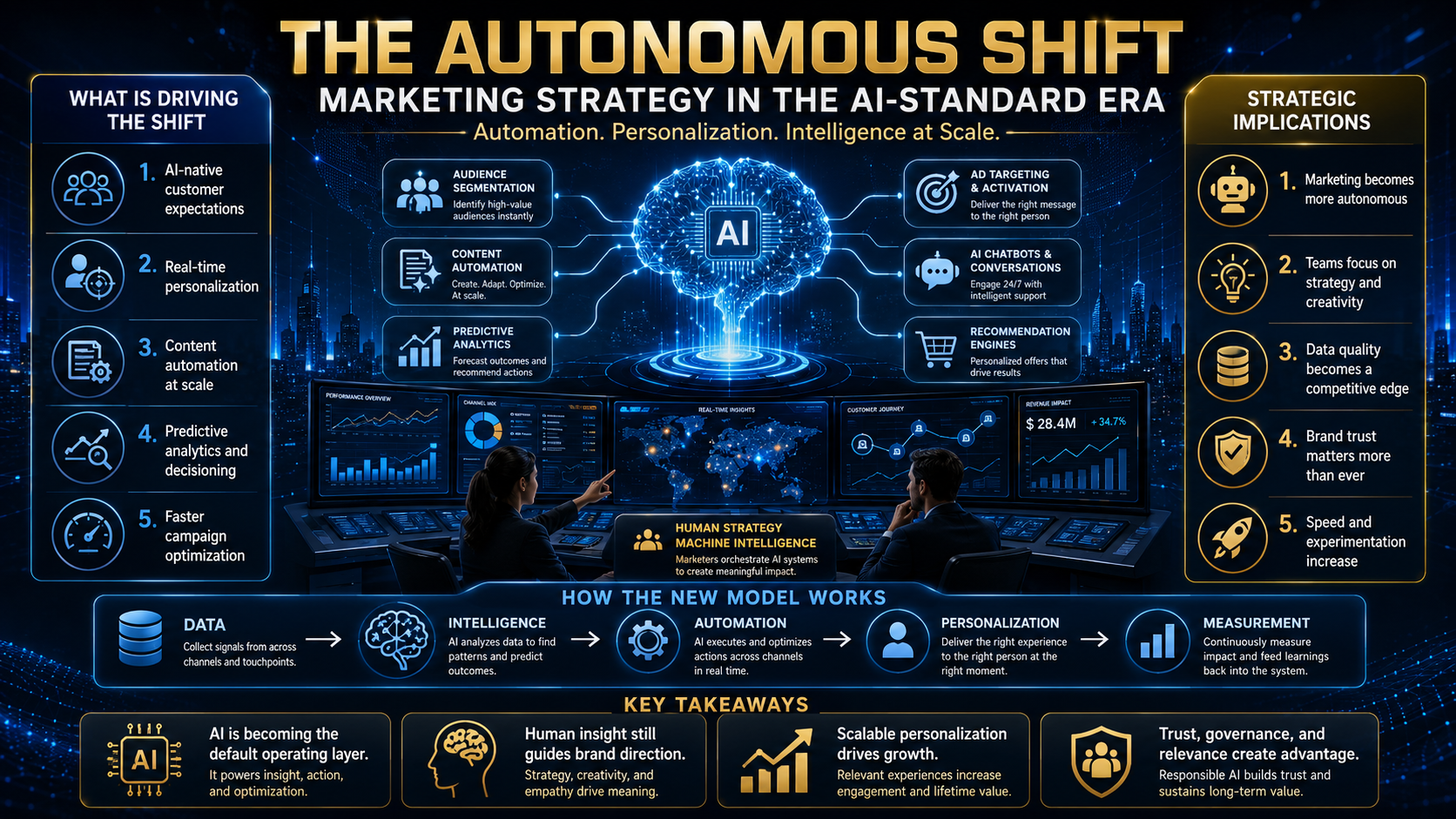
The fundamental mechanics of brand-consumer engagement have fundamentally altered, moving away from manual campaign management toward autonomous, data-driven systems. We are no longer speaking of AI as an “assistant,” but as a primary driver. Marketing strategies in 2026 are fully integrated with artificial intelligence for hyper-personalization of messaging and real-time consumer behavior prediction. This integration is not merely an operational upgrade; it is the current industry baseline for any organization seeking to maintain relevance in a hyper-competitive digital ecosystem.
Why has artificial intelligence transitioned from a supportive tool to a core strategic driver?
The transition occurred because traditional, manual segmentation methods lack the computational capacity to process the sheer volume of behavioral data generated by modern users. By delegating decision-making to AI, marketers can orchestrate complex, multi-channel journeys that adapt instantaneously to user actions, achieving a level of efficiency and precision that human teams could never sustain alone.
This shift has effectively removed the bottleneck of human intervention in the middle and lower stages of the marketing funnel. Modern systems now handle millions of micro-decisions per second—adjusting bids, refining ad creative, and modifying email subject lines—without waiting for periodic performance reports. This autonomy allows marketing leadership to pivot from tactical execution toward high-level vision, focusing on the strategic alignment of brand values with the algorithmic outcomes produced by their AI-integrated platforms.
How does hyper-personalization change the effectiveness of modern messaging?
Hyper-personalization uses predictive models to deliver unique content experiences at the individual level, rather than relying on broad demographic segments. By mapping user intent against historical interactions, AI curates messaging that resonates with the specific psychological drivers and immediate needs of each recipient.
What are the projected impacts of real-time behavioral prediction on ROI?
Industry analysts forecast that firms utilizing real-time behavior prediction will outperform their competitors by a factor of three in terms of conversion efficiency by late 2027. Predictive modeling allows brands to anticipate a user’s purchase intent before the user has even explicitly searched for a product, effectively shortening the sales cycle.
“The true power of the AI-integrated marketing stack lies not in what it produces, but in what it eliminates: the massive inefficiency of targeting the wrong audience at the wrong time.” — Digital Transformation Strategist
By proactively managing the customer experience, companies are seeing a reduction in customer acquisition costs by up to 40%. The ability to predict abandonment and provide an automated intervention—such as an adjusted offer or a specific educational resource—ensures that the brand remains present at the precise moment a user is prepared to commit.
How does the integration of AI redefine the role of the creative professional?
The creative professional now functions as a “director of algorithmic output” rather than a manual content generator. They provide the brand’s ethical and aesthetic framework, while the AI iterates on variations of that framework to maximize engagement based on performance feedback.
What are the structural prerequisites for successfully adopting an AI-driven strategy?
To transition to an AI-driven model, organizations must prioritize data hygiene, unified architecture, and cross-departmental integration. Without high-quality, normalized data flowing into the AI engine, the output remains inaccurate or biased, nullifying the strategic advantages of the technology.
- Unified Data Infrastructure: Siloed information is the primary enemy of AI effectiveness. Ensuring that customer relationship management, sales, and marketing data are accessible within a single architecture is a foundational requirement.
- Algorithmic Transparency: Leaders must understand the bias inherent in their chosen models to ensure that the AI-driven messaging aligns with the core identity of the brand.
- Agile Talent Management: Marketing teams require new skill sets, focusing on prompt engineering, data analytics, and the management of autonomous systems rather than administrative campaign maintenance.
Organizations that lack this infrastructure often find themselves struggling to gain the promised efficiencies, as the AI system fails to integrate with legacy operational workflows. It is essential to view this transition as a complete overhaul of the marketing department’s operating system.
Is there a ceiling to AI-driven performance in the coming years?
While the potential for optimization is immense, we are approaching a saturation point where the performance gap between competitors may shrink, leading to a “competitive parity” where the winning variable returns to brand differentiation and emotional resonance—areas where the human element remains vital.
Conclusion: The New Baseline of Competitiveness
The maturation of AI into a standard marketing component marks the end of the experimental phase and the beginning of the performance-efficiency era. Organizations that have successfully integrated artificial intelligence as their primary driver are now realizing the full benefits of hyper-personalization and predictive analytics. This evolution has redefined the standard for professionalism in the industry, where strategic success is measured by the ability to oversee, refine, and provide ethical constraints to high-velocity autonomous systems.
As we look beyond 2026, the focus will inevitably shift toward how companies use these tools to create deeper, more authentic human connections. The technology provides the scale and the insight, but the brand’s ability to use that information to build lasting trust remains the ultimate competitive advantage. By moving beyond the view of AI as a helper and accepting its role as a core engine, companies are not just improving their results—they are redesigning the future of their relationship with their customers. Those who master this integration today will define the market standards for years to come.