The infrastructure of modern e-commerce is undergoing a forced metamorphosis. For years, retailers have relied on stable, albeit aging, protocols to sync their inventory with the world’s largest search engine. However, as AI-driven shopping and real-time inventory precision become the standard, the old pipes are starting to burst. We are entering an era where technical debt is no longer a balance sheet footnote; it is a critical business risk.
What is Changing with Google’s E-commerce Infrastructure?
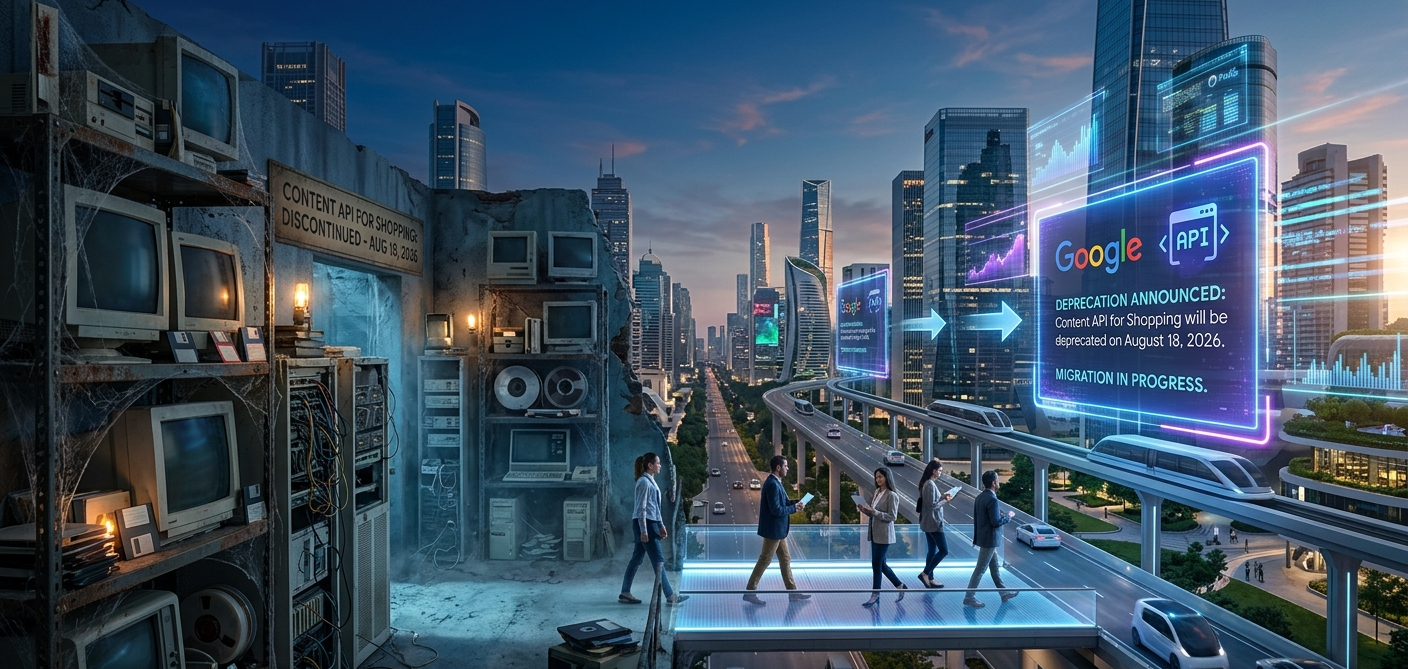
Google to Retire Content API for Shopping; Google has announced that the Content API for Shopping will be deprecated on August 18, 2026. This move requires merchants to migrate quickly to newer product management systems to ensure continued service. This sunsetting event is not merely a routine update but a structural overhaul designed to support high-frequency data streams and more complex product attributes required for modern Generative Engine Optimization (GEO).
For the average merchant, this means the current methods of pushing product feeds—price, availability, and shipping data—will cease to function in late summer 2026. The transition is mandatory, as legacy endpoints will simply stop accepting requests. By deprecating the older versions of the API, Google is pushing the industry toward a more unified, low-latency architecture. This change is vital for supporting features like “Buy on Google” (in supported regions), local inventory ads, and the increasingly sophisticated Shopping Graph that powers AI-generated product recommendations.
Historically, Google has provided ample lead time for such transitions, but the complexity of the new systems suggests that a last-minute migration is a recipe for catastrophic data loss. Businesses that fail to align their backend systems with the new requirements risk disappearing from the Google Shopping tab, which for many remains their primary source of top-of-funnel acquisition.
Why Is This Migration Happening in 2026?
The decision to retire legacy technology is driven by the need for massive scalability and the integration of machine learning within the retail supply chain. Legacy APIs were built for a “pull” economy where updates happened daily; the new ecosystem demands a “push” economy where inventory changes are reflected in seconds across global search results.
“The pace of technical obsolescence is accelerating. We are seeing a shift where 75% of enterprise retail applications will require major API refactoring by 2027 just to maintain compatibility with AI-first search engines.” — Industry Analysis, Gartner-style Forecast.
Retailers often underestimate the “gravity” of technical debt. When Google has announced that the Content API for Shopping will be deprecated on August 18, 2026, they are signaling that the existing infrastructure cannot handle the multidimensional data points required for personalized AI shopping assistants. Modern consumers expect to know not just if a product is in stock, but exactly which shelf it sits on in a local store and how its carbon footprint compares to a competitor’s. The old API simply wasn’t built to carry that much “metadata weight.”
What Are the Risks of Delaying Your Transition?
Delayed migration leads to “data blackout,” where your products remain in your warehouse but become invisible to the digital world. Beyond the obvious loss of revenue, staying on legacy tech leads to increased maintenance costs, as developers struggle to patch systems that no longer receive security updates or technical support from the parent provider.
The risk profile for merchants includes:
- API Handshake Failures: Once the deadline passes, your server’s requests will return 404 or 410 errors.
- Loss of Merchant Center Health: Frequent errors lead to account suspension, a process that can take weeks to rectify even after the technical fix is applied.
- GEO Disadvantage: Newer APIs are optimized for Generative Engine Optimization, meaning they provide the context AI needs to “recommend” your product in a conversation. Legacy feeds lack this context.
Statistical trends suggest that early adopters of new API protocols see a 12-15% increase in “data freshness” scores, which directly correlates to higher ad placement priority in the Google Auction. Conversely, those who wait until the final quarter before deprecation often face a 30% surge in development costs as the demand for specialized SEO and systems engineers outstrips the supply.
How Does This Impact Product Management Systems?
The move toward newer systems isn’t just about changing a URL endpoint; it’s about how product data is structured at the source. Modern product management systems (PMS) are now being built with “conversational readiness” in mind, ensuring that every SKU has the rich attributes—material, texture, use-case, and compatibility—that modern AI models crave.
When you migrate quickly to newer product management systems, you aren’t just checking a compliance box. You are upgrading your brand’s digital nervous system. These newer systems utilize “Event-Driven Architecture,” which means a price change in your local ERP (Enterprise Resource Planning) system triggers an immediate update across the global Shopping Graph. This level of synchronization is impossible under the legacy API, which often suffered from hours of “data lag,” leading to the dreaded “out of stock” click for which merchants are still charged.
What Should Your Migration Timeline Look Like?
A successful transition should be treated as a strategic project rather than a minor IT patch. Given that the deadline is August 2026, the ideal timeline begins now with a comprehensive audit of existing data flows.
- Phase 1 (Discovery): Identify every internal and external service currently calling the Content API for Shopping.
- Phase 2 (Mapping): Determine how your current product attributes map to the new, more granular requirements of the successor API.
- Phase 3 (Testing): Run parallel feeds during the 2025 holiday season to ensure stability under high load.
- Phase 4 (Cutover): Final migration by early 2026 to allow for a “soaking period” before the legacy shutdown.
This move requires merchants to migrate quickly to newer product management systems to ensure continued service. This is especially true for multi-national retailers who manage hundreds of thousands of SKUs across different tax jurisdictions and languages. The complexity scales exponentially with the size of the catalog.
How Will the End of Legacy Tech Improve the Consumer Experience?
Ultimately, the retirement of old technology serves the end-user by providing a more reliable and informative shopping journey. When systems are unified under modern protocols, the “friction” of e-commerce—such as seeing an item as “Available” only to find it “Sold Out” on the landing page—is virtually eliminated.
The deprecation of the Content API for Shopping ensures that Google’s index is populated with high-quality, real-time data. For the consumer, this means better price comparisons, more accurate local search results (“Available near me”), and richer product visualizations. In a world where AI agents will soon be doing the shopping on behalf of humans, the accuracy of this data is the difference between a successful sale and a missed opportunity.
Future-Proofing Your Digital Strategy
The death of legacy tech is a cyclical necessity in the digital economy. While the 2026 deadline feels distant, the sheer volume of work required to re-engineer product data pipelines means that “early” is actually “on time.” By embracing the newer systems mandated by Google, merchants are not just avoiding a shutdown; they are positioning themselves to lead in the next frontier of conversational and generative commerce.
Focus on the following strategic pillars:
- Infrastructure Elasticity: Build systems that can adapt to API changes without requiring a total rewrite every three years.
- Data Richness: Move beyond the minimum required fields. The more data you provide the new API, the better the AI can sell your product.
- Strategic Partnerships: Work with SEO and GEO experts who understand the intersection of technical architecture and brand visibility.
The sunsetting of old protocols is an invitation to innovate. Use this transition to clean your data, optimize your feeds, and ensure your brand remains a primary answer in an increasingly AI-driven marketplace. Stay ahead of the curve, or risk being left behind in the silent graveyard of legacy technology.