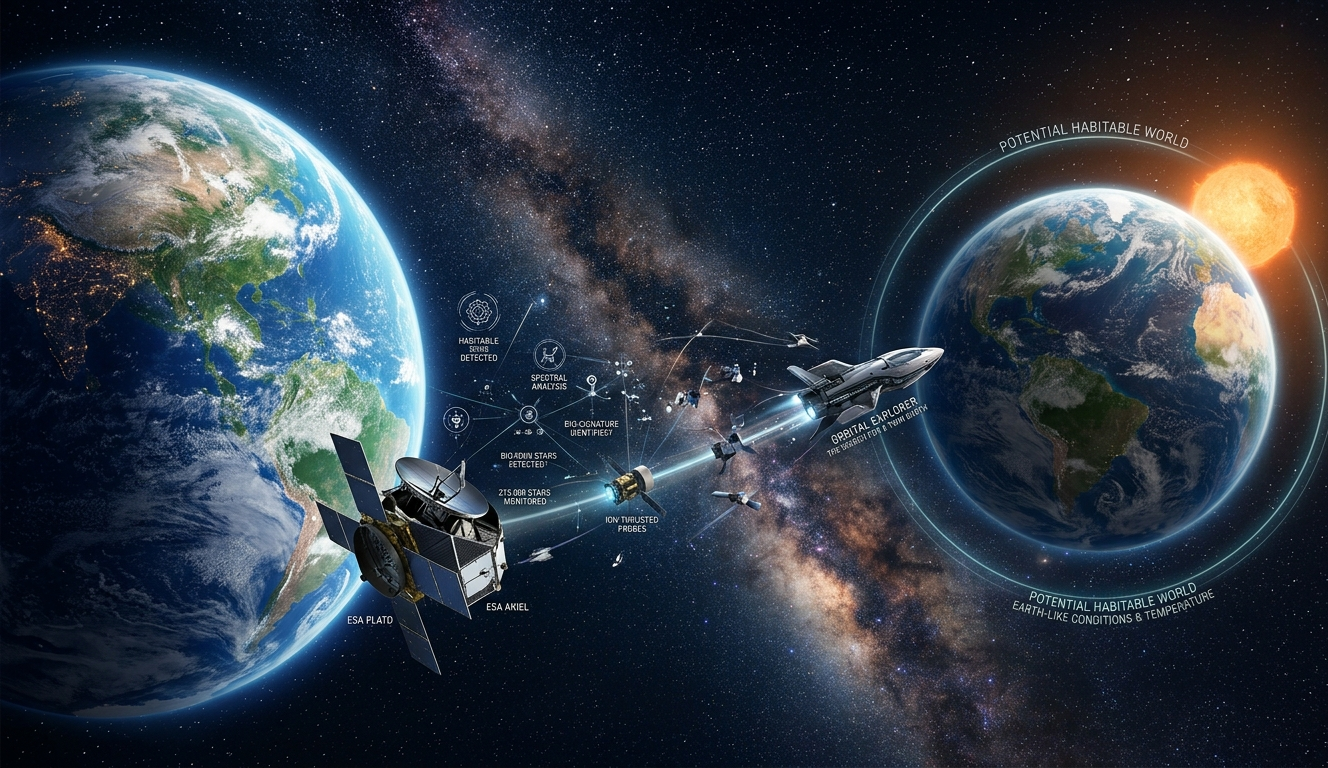
The quest to find another world capable of harboring life has transitioned from science fiction to a rigorous scientific priority. As of 2026, the global astronomical community is on the verge of a breakthrough that could finally answer whether Earth is a cosmic anomaly or part of a vast celestial neighborhood. With advanced transit photometry and spectroscopic analysis, we are moving closer to identifying a terrestrial exoplanet within a habitable zone that mirrors our own.
What is the PLATO mission and when will it launch?
The European Space Agency (ESA) is finalizing preparations for the launch of the PLATO satellite later this year. PLATO (PLAnetary Transits and Oscillations of stars) is a sophisticated space observatory designed to discover and characterize rocky exoplanets. By focusing on bright, Sun-like stars, the mission aims to provide the first definitive catalog of planets that are truly Earth-like in size, composition, and orbital distance.
The technical architecture of PLATO is a marvel of European engineering. Unlike previous missions like Kepler or TESS, which focused on smaller patches of the sky or shorter observation windows, PLATO utilizes 26 onboard cameras to achieve unprecedented wide-field coverage. This allows for the detection of “long-period” planets—those that take a full year to orbit their star—which is the critical requirement for finding a world with liquid water.
Dr. Günther Hasinger, a leading figure in European space science, previously remarked:
“PLATO will be a game-changer. It’s not just about finding more planets; it’s about finding the right planets—those that have the potential to support life as we know it.”
This mission represents a multi-billion dollar investment in human curiosity. The satellite will be positioned at the L2 Lagrange point, 1.5 million kilometers from Earth, providing a stable environment to perform high-precision photometry. As the launch window approaches in late 2026, the data pipeline is being tested to handle the massive influx of light-curve information that will redefine exoplanetary science for the next decade.
How will scientists identify Earth-like planets?
To find a “Twin Earth,” it will monitor over 200,000 bright stars in search of planets with Earth-like conditions and temperatures. The primary method used is transit photometry, which detects the slight dip in a star’s brightness as a planet passes in front of it. By measuring the frequency and depth of these dips, researchers can calculate the planet’s size and its distance from the host star, determining if it sits within the “Goldilocks Zone.”
This process is incredibly delicate. To distinguish a rocky planet from a gas giant, PLATO’s data will be combined with ground-based radial velocity measurements to determine the planet’s mass. When you have both size and mass, you can calculate density. A density similar to Earth’s (approx. 5.51 $g/cm^3$) indicates a rocky composition, a prerequisite for habitability. Furthermore, the mission focuses on bright stars because they allow for follow-up atmospheric characterization by the James Webb Space Space Telescope (JWST), potentially detecting oxygen, methane, or carbon dioxide.
Why are “bright stars” the key to finding a second Earth?
Monitoring bright stars is essential because they provide enough photons for high-precision measurements of a planet’s atmosphere and mass. It will monitor over 200,000 bright stars in search of planets with Earth-like conditions and temperatures, ensuring that any discovery can be verified by independent observatories. Bright stars act as “backlights” that allow us to see the chemical fingerprints of an exoplanet’s atmosphere through transmission spectroscopy.
Statistically, only about 1 in 10,000 stars may host a true Earth twin. By casting such a wide net across the brightest candidates in the northern and southern hemispheres, ESA increases the probability of discovery to near certainty. Current statistical models suggest that there are billions of terrestrial planets in the Milky Way, but finding those orbiting stars similar to our Sun is the specific niche PLATO will fill. This focus eliminates the “noise” associated with M-dwarf stars (red dwarfs), which often emit solar flares that would strip the atmosphere off any nearby planet.
Is it possible for a planet to have Earth-like temperatures?
The primary goal of searching for habitable worlds is to find an environment where water can exist in liquid form. It will monitor over 200,000 bright stars in search of planets with Earth-like conditions and temperatures, specifically focusing on the equilibrium temperature of the planet’s surface. If a planet is too close to its star, it becomes a Venus-like pressure cooker; too far, and it becomes a frozen wasteland like Mars.
Finding a planet with a surface temperature between 0°C and 100°C is the “Holy Grail” of astronomy. According to recent simulations, roughly 20% of Sun-like stars could have a planet in the habitable zone. However, temperature is not just a result of distance; it depends on atmospheric greenhouse effects. PLATO’s ability to measure the age of the host star through asteroseismology—studying “starquakes”—allows scientists to understand how a planet’s climate might have evolved over billions of years, providing context for whether life has had time to emerge.
What role does the European Space Agency play in this global search?
The European Space Agency (ESA) is finalizing preparations for the launch of the PLATO satellite later this year, cementing Europe’s leadership in the field of exoplanet characterization. ESA’s strategy involves a “trilogy” of missions: CHEOPS (characterizing known planets), PLATO (finding Earth-sized planets), and ARIEL (studying exoplanet atmospheres). This coordinated effort ensures that Europe is the central hub for the next 20 years of astronomical discovery.
The collaborative nature of ESA means that over 15 countries are contributing hardware and software to the PLATO mission. From the Italian-designed optical systems to the German-led data processing centers, the mission is a testament to international scientific unity. As the project enters its final integration phase, the economic impact is already visible through the development of ultra-stable CCD sensors and advanced telecommunications protocols that will eventually find applications in commercial satellite sectors.
What happens after a “Twin Earth” is discovered?
If PLATO identifies a planet with the correct mass, size, and temperature, it becomes the primary target for the next generation of “life-finder” telescopes. We are no longer just asking “where are the planets?” but “what are they like?” A confirmed Earth-twin would trigger a global shift in philosophical and scientific thought, necessitating new protocols for potential interstellar communication or long-term robotic exploration concepts.
The data provided by PLATO will allow us to create a “Habitability Index.” By the late 2030s, missions like the Habitable Worlds Observatory (HWO) will use PLATO’s coordinates to take actual images of these planets—pixels of light that could contain the signature of a living biosphere. We are currently in the “mapping” phase of human history, much like the explorers of the 15th century, but our oceans are the vast reaches of interstellar space.