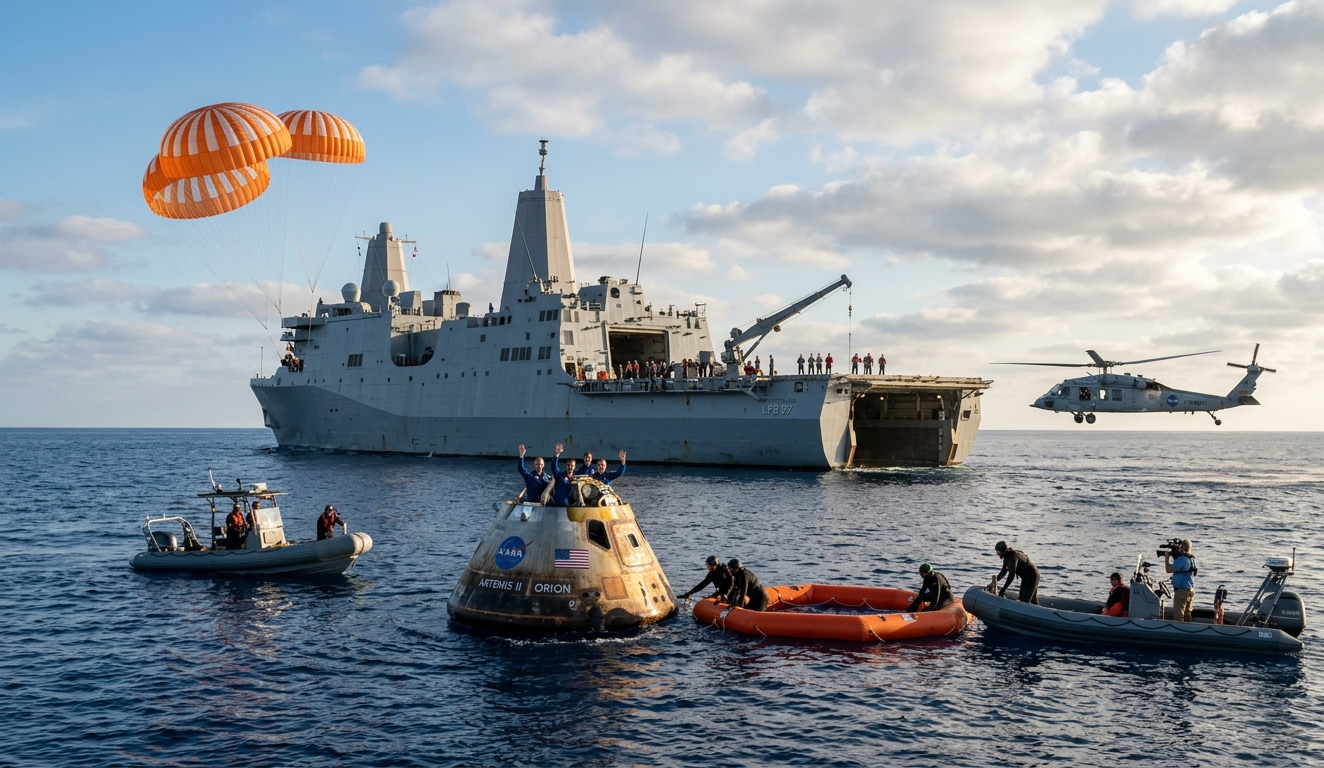
On April 10, 2026, humanity witnessed a historic milestone as NASA’s Artemis II mission concluded with a flawless splashdown in the Pacific Ocean. This mission, featuring a crew of four courageous astronauts, represents the first time humans have journeyed to the lunar vicinity in over half a century. Its success paves the definitive path for Artemis III and the eventual establishment of a sustainable human presence on the Moon.
When did the Artemis II mission end and was it successful?
NASA’s Artemis II mission concluded successfully on April 10, 2026, when the Orion spacecraft safely entered Earth’s atmosphere and splashed down under a canopy of parachutes. Every primary objective—from the high-altitude elliptical orbit maneuvers to the trans-lunar injection—was met with precision. This validates the safety and performance of the Space Launch System (SLS) and the Orion capsule for crewed deep-space operations.
The return marks a shift from theoretical testing to operational reality. Bill Nelson, NASA Administrator, noted during the post-landing briefing:
“Today, we aren’t just celebrating a splashdown; we are celebrating the proof that humanity has the resolve and the technology to return to the stars. Artemis II has shown that our systems are ready for the next giant leap.”
The mission’s success is not merely a technical achievement but a geopolitical and scientific triumph. By completing this approximately 10-day journey, NASA has confirmed that the heat shield can withstand temperatures of nearly 2,760°C (5,000°F) while protecting a human crew. This data is vital for the upcoming Artemis III mission, which aims to land the first woman and first person of color on the lunar surface. The precision of the landing within the designated recovery zone also highlighted the expertise of the U.S. Navy and NASA recovery teams, ensuring that the four-member crew was extracted within the planned “golden hour” for post-flight medical evaluation.
Who were the crew members of Artemis II and what was their role?
The mission was historic for its diversity and expertise, featuring a crew of four high-caliber professionals: Commander Reid Wiseman, Pilot Victor Glover, Mission Specialist Christina Koch from NASA, and Mission Specialist Jeremy Hansen from the Canadian Space Agency (CSA). Their roles involved testing the Orion’s life support systems, manual handling qualities, and communication arrays in the deep space environment beyond Low Earth Orbit (LEO).
The Human Element of Deep Space
Each member brought a specific set of skills to this flight. Victor Glover, acting as the pilot, was instrumental in performing the “proximity operations” demonstration, where Orion maneuvered near the spent ICPS (Interim Cryogenic Propulsion Stage) to test manual piloting. Christina Koch and Jeremy Hansen focused on scientific yields and system monitoring, ensuring that the radiation shielding performed as expected during the passage through the Van Allen belts. This mission was the ultimate test of human-machine integration, proving that a crew can maintain high-level cognitive performance during the stresses of trans-lunar flight.
How does the Artemis II success impact future lunar landings?
The successful conclusion of Artemis II on April 10, 2026, serves as the final “green light” for the Artemis III lunar landing mission. By proving that the Orion life support systems can sustain a crew of four for the duration of a lunar flyby, NASA has mitigated the highest risks associated with life-critical hardware. This success directly accelerates the procurement and testing cycles for the Human Landing System (HLS) and the Gateway station.
- Validation of the Heat Shield: The most critical data point was the skip-entry maneuver, which reduced G-forces on the crew.
- Deep Space Communications: The mission utilized the Deep Space Network (DSN) to maintain high-bandwidth video feeds, a first for a crewed lunar mission.
- International Collaboration: Jeremy Hansen’s participation cements the role of international partners in the Artemis Accords, ensuring the Moon remains a zone of peaceful cooperation.
With Artemis II complete, NASA’s roadmap now focuses on the South Pole of the Moon. Statistics from NASA’s budget projections suggest that for every $1 invested in the Artemis program, there is a multi-fold return in technological spin-offs, from water purification systems to advanced battery storage. The “Moon-to-Mars” strategy is no longer a vision—it is a scheduled reality.
What technical challenges were overcome during the flight?
During NASA’s Artemis II mission, the spacecraft had to navigate the intense radiation of the Van Allen belts twice and maintain thermal equilibrium while exposed to the vacuum of space. The Orion’s European Service Module (ESM) performed flawlessly, executing several orbital adjustments to ensure the free-return trajectory was precise. This mission proved that the integration between Boeing’s SLS and Lockheed Martin’s Orion is robust enough for long-duration missions.
While the mission appeared seamless to the public, the crew managed several minor system anomalies, including a communication lag during the far-side lunar flyby. These “lessons learned” are exactly why Artemis II was designed as a flight test. By resolving these issues in real-time, the crew provided invaluable data that automated systems could not have captured. The thermal protection system (TPS) was examined post-flight, showing less ablation than predicted, which suggests the Orion may have even higher safety margins than originally engineered.
Why is the date April 10, 2026, significant for space history?
The date concluded successfully on April 10, 2026, will be remembered as the day the “Apollo era” was officially surpassed by the “Artemis generation.” While Apollo was about reaching the Moon, Artemis II was about staying there. This date marks the transition from exploration to habitation, as the data collected will inform the construction of the Lunar Gateway.
“We are no longer just visiting; we are preparing to move in,” said a senior flight director at Johnson Space Center.
This return to Earth also demonstrated the efficiency of modern recovery operations. Unlike the 1960s, the 2026 recovery utilized real-time drone surveillance and advanced sea-state forecasting, ensuring that the crew of four was out of the water in record time. This efficiency is crucial for future missions where crews may return after months in space, requiring immediate medical attention.
What is the next step after the Artemis II return?
Following the successful splashdown, the focus shifts immediately to the integration of the Artemis III hardware. The data from NASA’s Artemis II mission will be fed into the training simulators for the next crew, who will attempt to land on the lunar surface. The goal is to establish the Artemis Base Camp by the end of the decade, a feat that would have been impossible without the technical benchmarks set this April.
The upcoming milestones include:
- Orion Refurbishment Analysis: Studying the capsule to improve future manufacturing.
- HLS Integration: Finalizing the Starship HLS docking software based on Orion’s flight telemetry.
- Crew Selection for Artemis III: Utilizing the biological data from the Artemis II crew to select the most resilient team for the surface mission.