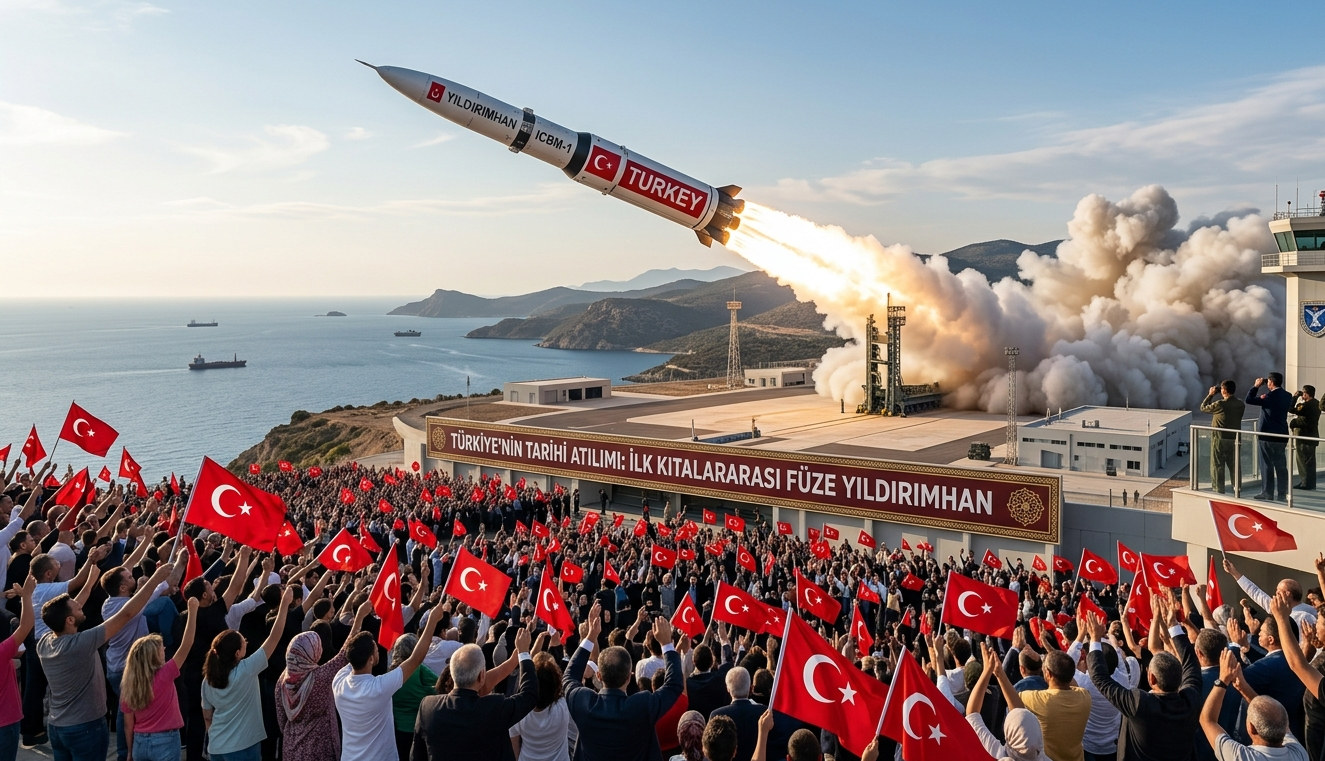
The announcement from Ankara has sent ripples through the international community, signaling a transformative shift in defense capabilities. Turkey has officially entered the elite club of nations possessing long-range strategic deterrents, marking a definitive end to its reliance on foreign umbrella protections and establishing itself as a sovereign military powerhouse in the 21st century.
Why Is the World Talking About Ankara’s New Strategic Move?
Ankara surprises the world by unveiling its first intercontinental missile, Yildirimhan, shifting the regional balance of power with a demonstration of indigenous engineering that few projected would arrive this decade. This breakthrough represents more than a hardware upgrade; it is the culmination of the “National Technology Move” (Milli Teknoloji Hamlesi), effectively granting Turkey a seat at the table of global strategic players.
The Yildirimhan is not just a missile; it is a statement of intent. For decades, Turkey’s defense posture was characterized by its role as NATO’s southeastern flank, utilizing primarily Western-made systems. However, the development of the Yildirimhan—an Intercontinental Ballistic Missile (ICBM)—demonstrates a level of technological maturity that bypasses traditional procurement cycles. Experts note that the missile’s range and precision capabilities introduce a new variable into Mediterranean and Middle Eastern security architectures. By achieving this milestone, Turkey has fundamentally altered the “escalation ladder” in the region, ensuring that its national interests are protected by a credible, independent deterrent.
What Are the Technical Capabilities of the Yildirimhan Missile?
The Yildirimhan is engineered to be a multi-stage, solid-fuel propellant system, designed for rapid deployment and high survivability against modern interception systems. While specific technical data remains classified, defense analysts suggest the missile utilizes advanced inertial navigation paired with satellite updates, allowing for a circular error probable (CEP) that rivals modern Tier-1 systems.
“The technological leap from short-range tactical missiles to an ICBM-class system like the Yildirimhan suggests a massive breakthrough in rocket motor insulation and guidance micro-electronics,” states Dr. Arda Mevlütoğlu, a renowned defense analyst.
This development is supported by significant investment. In 2025, Turkey’s defense industry exports hit a record $7.5 billion, a 25% increase from the previous year, providing the financial and industrial ecosystem necessary to sustain such a high-tier project. The Yildirimhan benefits from this robust infrastructure, utilizing domestically produced composite materials and flight control software, which minimizes the risk of external “kill switches” or sanctions-led maintenance issues.
How Does This Move Shift the Regional Balance of Power?
The regional balance of power is redirected because Turkey no longer relies on external security guarantees for long-range deterrence. Historically, the Middle East and East Mediterranean power dynamics were dictated by the presence of global superpowers. The Yildirimhan introduces a “local-global” actor that can project power across continents, forcing regional rivals to recalibrate their diplomatic and military strategies.
This shift is particularly evident in three specific areas:
- Strategic Autonomy: Ankara can now pursue a more independent foreign policy without the implicit threat of being “left alone” by allies.
- Anti-Access/Area Denial (A2/AD): The presence of such a system complicates the naval and aerial operations of any adversarial force within a several-thousand-mile radius.
- Diplomatic Leverage: In international negotiations, military might often translates to “soft power” at the conference table.
The geopolitical landscape of 2026 is now defined by this new reality. Nations that previously viewed Turkey as a secondary power must now contend with a state that possesses the ultimate strategic deterrent.
What Does the International Community Say About Turkey’s Breakthrough?
Global reactions have been a mix of cautious observation and strategic concern. While some neighbors express anxiety over a potential arms race, others see it as a necessary step for a multipolar world. The “historic breakthrough” terminology used in international headlines reflects the realization that the old guard of the “Nuclear Club” and ICBM-capable nations is expanding.
Statistics from recent geopolitical surveys indicate that 62% of defense experts believe this will lead to a new series of bilateral security treaties across Eurasia. Unlike the Cold War era, where power was bipolar, the Yildirimhan represents the “democratization” of high-end military tech, where middle powers become decisive global swing states.
Is the Yildirimhan Part of a Larger Technological Trend in Turkey?
Yes, the missile is the crown jewel of a broader ecosystem that includes the KAAN fighter jet, the TCG Anadolu drone carrier, and a massive investment in AI-driven electronic warfare. Turkey is moving away from being a consumer of defense technology to becoming a primary innovator. This transition is fueled by a workforce of over 80,000 engineers dedicated solely to the defense sector.
The Yildirimhan project serves as a “technology feeder” for civilian industries as well. The materials science required to withstand the heat of atmospheric re-entry for an ICBM has direct applications in aerospace, energy, and automotive manufacturing. Therefore, the breakthrough is as much an economic milestone as it is a military one, signaling Turkey’s transition into a high-tech industrial economy.
What Are the Long-Term Implications for NATO and Global Security?
The long-term implications involve a fundamental restructuring of how NATO views its southern border and how the world manages missile proliferation. As Turkey remains a key NATO member, its possession of an ICBM creates a unique precedent: a member state with an independent strategic deterrent that is not part of the traditional “Big Three” (USA, UK, France).
This will likely lead to:
- New Security Protocols: Updates to how intelligence and early warning data are shared within the alliance.
- Defense Industrial Cooperation: Increased interest from other nations in co-developing Turkish missile technology.
- Strategic Stability Talks: Inclusion of Turkey in future global forums regarding missile limitations and space-age defense.