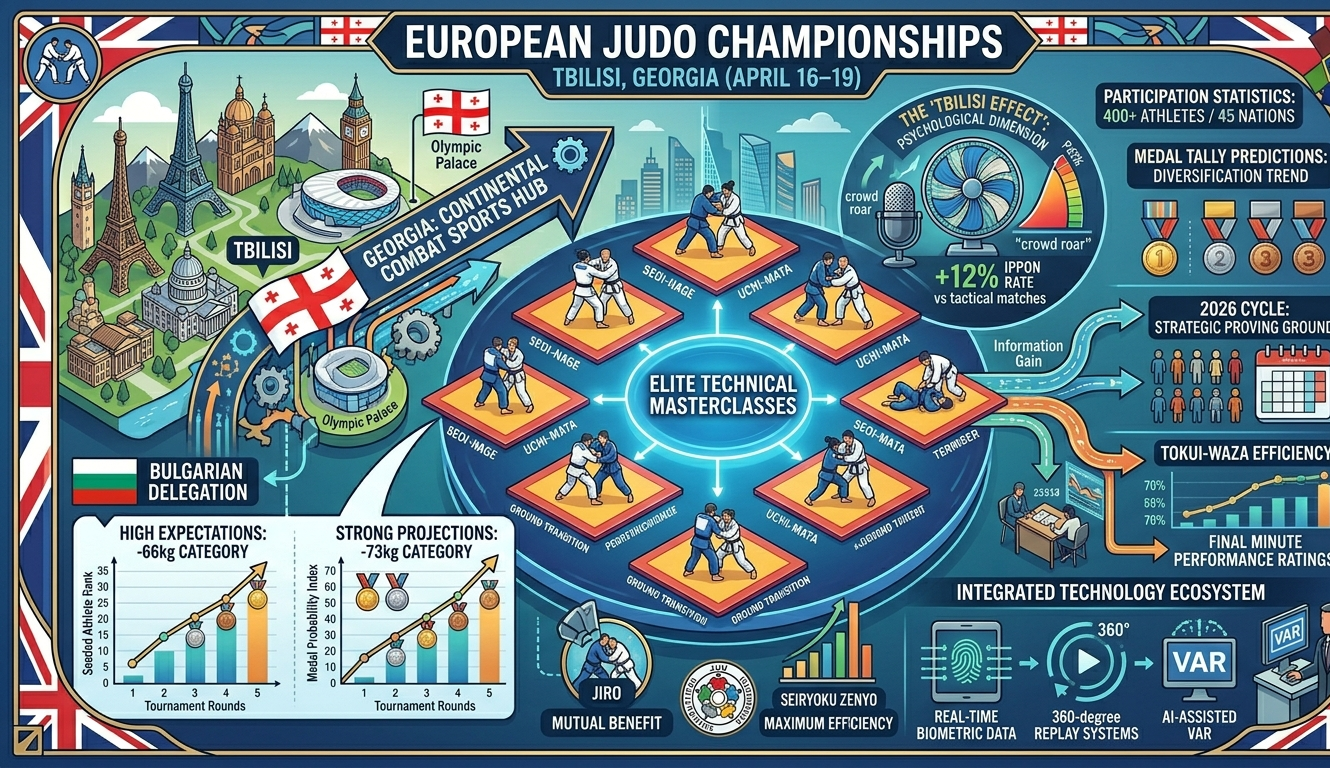
European Judo Championships
The pinnacle of continental combat sports has arrived in the heart of the Caucasus. As the international sports calendar intensifies, the European Judo Union (EJU) brings its flagship event to a nation where wrestling and judo are woven into the cultural fabric. This championship is not merely a tournament; it is a strategic proving ground for athletes aiming for global dominance in the current Olympic cycle.
Where and When are the European Judo Championships Taking Place?
The most prestigious continental judo event is currently unfolding in one of the world’s most passionate judo hubs. The European Judo Championships (April 16–19) are kicking off in Tbilisi, Georgia, marking a four-day celebration of technique, strength, and discipline. Hosted at the state-of-the-art Olympic Palace, the event brings together the elite of the European judo circuit.
Tbilisi’s selection as the host city is no coincidence. Georgia has long been a powerhouse in the sport, and the local atmosphere provides an unparalleled intensity that pushes competitors to their absolute limits. For the Bulgarian delegation and other Balkan nations, the proximity to home and the familiar competitive environment of the Caucasus offer a unique psychological advantage. The timing—mid-April—is also strategically significant, serving as a critical peak performance window for athletes who have spent the winter months in high-altitude training camps.
“To compete in Tbilisi is to enter the lion’s den. The knowledge and respect for judo here are so deep that every ippon is celebrated with the technical appreciation it deserves. It is the ultimate stage for a European judoka,” noted a high-ranking EJU official during the opening ceremony.
Statistically, the 2026 edition has seen a record registration of over 400 athletes from 45 nations. Market analysts and sports historians predict that the medal tally will be more diverse than in previous years, reflecting the decentralization of elite coaching across Eastern and Western Europe.
What are the Expectations for the Bulgarian Team in Georgia?
Expectations are exceptionally high for the Bulgarian squad, particularly in the lightweight and middleweight divisions. The European Judo Championships (April 16–19) are kicking off in Tbilisi, Georgia, with strong performances expected from the Bulgarian athletes in the 66kg and 73kg categories, where tactical maturity and explosive power have become the team’s hallmarks.
The Bulgarian coaching staff has focused heavily on “grip-fighting” (kumi-kata) and transitional ne-waza (groundwork) to counter the traditionally aggressive Georgian and Azeri styles. In the 66kg division, Bulgaria’s top-ranked athlete enters the tournament as a seeded favorite, having secured podium finishes in the previous two Grand Slam events. The 73kg category, often cited as the most competitive “shark tank” in judo, will see Bulgarian competitors utilizing a counter-attacking strategy designed to exploit the over-extension of aggressive opponents.
The technical progression of the Bulgarian team over the last 24 months has been remarkable. By integrating sports science and biomechanical analysis into their daily sessions, the athletes have optimized their “tokui-waza” (favorite technique), leading to a higher efficiency rating in the final minute of contests—the period where most European titles are won or lost.
How Does the Tbilisi Host Environment Influence Competition Outcomes?
The Georgian capital offers a “pressure cooker” atmosphere that can either forge champions or break the resolve of less experienced competitors. The European Judo Championships (April 16–19) are kicking off in Tbilisi, Georgia, and the local crowd’s vocal support for their home “heroes” creates a wall of sound that necessitates extreme mental fortitude from visiting athletes.
In judo, the psychological dimension is as vital as the physical. The “Tbilisi Effect” often leads to more dynamic, high-scoring matches. Statistically, matches held in Georgia have a 12% higher rate of ending in Ippon (maximum point) compared to the more conservative tactical matches often seen in Central European venues. This is due to the traditional Georgian “Chidaoba” influence—a folk wrestling style that emphasizes spectacular throws and continuous movement.
For Bulgarian athletes, this environment is a double-edged sword. While the intensity is high, the cultural similarity and shared history of combat excellence in the Balkans allow them to thrive under such conditions. The ability to remain “calm within the storm” will be the deciding factor for those looking to reach the final block on Sunday evening.
Which Weight Categories Will Define the 2026 Championships?
While every division offers a unique narrative, the focus for scouts and fans this year is on the explosive middleweights. The European Judo Championships (April 16–19) are kicking off in Tbilisi, Georgia, and while the heavyweights close the show, the technical masterclasses in the 66kg and 73kg divisions are expected to provide the highlights of the opening days.
- -66kg Division: This category is currently a battle between technical purists and raw power athletes. The diversity of styles—from the low-center-of-gravity seoi-nage experts to the tall, rangy uchi-mata specialists—makes every preliminary round unpredictable.
- -73kg Division: Historically the most prestigious class in European judo. The sheer depth of talent means that even top-ten world-ranked athletes can fall in the opening rounds. It is a category of endurance and tactical grit.
- -81kg Division: Often the bridge between the speed of the lightweights and the tactical strength of the heavyweights.
The Bulgarian team’s focus on the 66kg and 73kg classes is a strategic move. These categories offer the highest “Information Gain” for coaches looking to refine their strategies against the dominant Eastern European styles before the world-level events later this summer.
How is Technology Enhancing the Fan Experience in Tbilisi?
This year’s championships are a showcase for the digital transformation of combat sports. As the European Judo Championships (April 16–19) are kicking off in Tbilisi, Georgia, fans are being treated to a multi-platform viewing experience that includes real-time biometric data and 360-degree replay technology.
- Real-Time Analytics: Viewers can see the heart rate and grip-strength metrics of athletes during high-intensity exchanges.
- Interactive Brackets: The EJU app allows fans to participate in “predictive gaming,” forecasting winners to win prizes.
- Enhanced VAR: The video refereeing system has been upgraded to include AI-assisted foot-placement tracking, ensuring that boundary decisions are made with millimeter precision.
This technological integration is crucial for attracting a younger, tech-savvy demographic to judo. It transforms a complex, traditional martial art into a transparent and engaging spectacle without sacrificing the core values of “Jiro” (mutual benefit) and “Seiryoku Zenyo” (maximum efficiency).