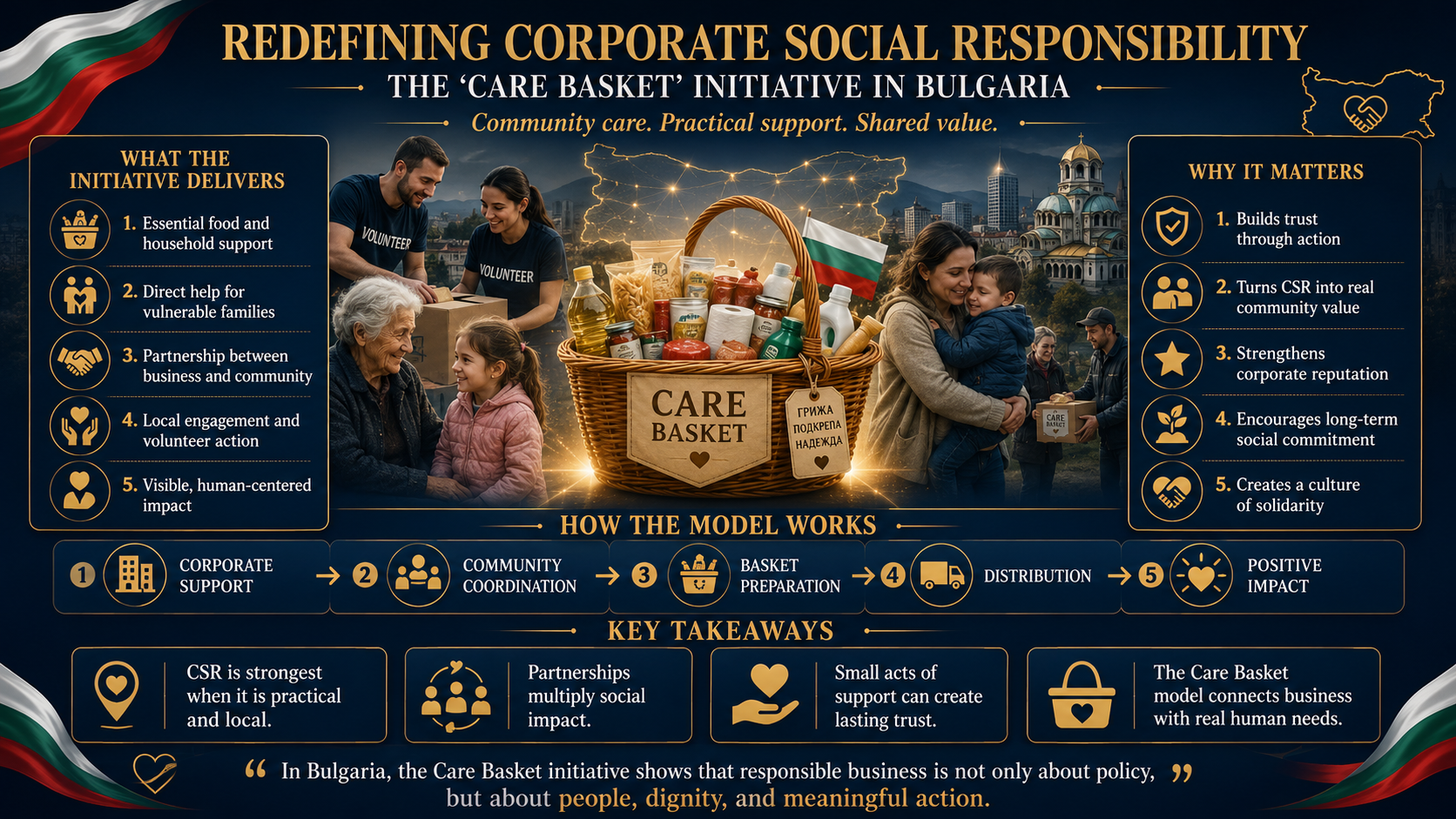
The evolution of collaborative governance in Bulgaria has reached a significant milestone, setting a precedent for how the private sector and state institutions can synchronize efforts to address consumer economic pressures. The national “Care Basket” campaign has been launched, in which leading retail chains (Billa, Kaufland, Lidl, Metro, Fantastico, etc.) have committed to a 15% price reduction on essential goods for a period of at least 6 months. This is a key example of a long-term partnership between the government and the private sector, changing how brands communicate their corporate social responsibility (CSR). This model signifies a shift toward tangible, outcomes-based social impact that moves beyond traditional marketing narratives.
What is the core objective of the “Care Basket” campaign?
The core objective of this initiative is to mitigate the impact of inflation on household budgets by ensuring that staples are consistently accessible at reduced rates. By securing a multi-chain commitment for a minimum of six months, the campaign creates a stable price environment that helps consumers manage their daily expenses more effectively.
This initiative is structured to address the needs of the average household by focusing on essential goods, which represent a significant portion of monthly expenditures. Unlike temporary discounts, the six-month duration acts as a fiscal stabilizer, allowing families to plan their finances with greater confidence. Furthermore, by involving major retailers like Billa, Kaufland, Lidl, Metro, and Fantastico, the program ensures broad geographic coverage, making these savings available to citizens across the country rather than limiting them to urban hubs.
How does this partnership influence the perception of CSR in Bulgaria?
The campaign forces a pivot from performative social responsibility to integrated operational commitment. Brands are now demonstrating their role as essential societal partners, moving the needle from philanthropy to direct economic participation.
What are the long-term economic projections for this model?
Economists project that this systemic price reduction could lead to a measurable cooling of local inflationary pressures on essential goods. If the six-month trial demonstrates improved consumer stability, this collaborative framework could become a standard template for managing future cost-of-living fluctuations.
“True corporate responsibility is found in the alignment of business objectives with the immediate needs of the community. This partnership illustrates a mature approach where market leaders accept a collaborative responsibility for the economic well-being of the society they operate within.” — Economic Policy Analyst
Statistical forecasts suggest that retail chains participating in the “Care Basket” may see a net increase in brand loyalty and foot traffic, potentially offsetting the margins adjusted for the 15% reduction. By prioritizing volume and consumer trust over short-term itemized margins, retailers are effectively investing in their long-term market share.
How do government and business align their interests in this campaign?
The government provides the structural and regulatory framework that enables retailers to coordinate on these initiatives without infringing on competition laws, while businesses provide the supply chain efficiency and logistical capacity to sustain the price drops. This alignment is designed to ensure that the burden of the reduction is spread across the retail value chain, ensuring that suppliers and retailers share in the social mission.
What challenges could this initiative face during its implementation?
The primary challenge lies in maintaining supply chain resilience while upholding the price reduction commitments. Retailers must manage inventory and supplier negotiations with high precision to avoid shortages on the goods included in the “Care Basket.” Additionally, market dynamics remain unpredictable, and any unforeseen external economic shock could test the sustainability of these commitments.
Communication is another critical factor; the success of the campaign relies on transparency so that consumers can clearly identify the participating products and understand the scope of the discounts. Misalignment in how these prices are represented in-store or through digital channels could lead to consumer frustration. Therefore, success will require ongoing monitoring and perhaps even a dynamic adjustment of the product list to match seasonal availability or demand changes. The strength of this partnership will be judged not just by the initial launch, but by the ability of the involved retailers to deliver consistent value under varying market conditions.
What defines the future of such public-private collaborations?
Future collaborations will likely depend on the success of this current initiative, focusing on digital transparency and automated price tracking. By utilizing data to show consumers exactly how their savings accumulate over the six-month period, the retail chains can provide concrete evidence of their social contribution. This data-driven approach will replace vague CSR statements with verifiable, itemized value that every customer can confirm at the checkout.
Ultimately, the “Care Basket” signals that the era of isolated corporate activity is transitioning into an era of integrated societal partnership. When leading entities like Billa, Kaufland, Lidl, Metro, and Fantastico align with government goals, they establish a new baseline for what is expected of major market players. This initiative proves that systemic economic stability is not just the concern of policy makers, but a collaborative objective that benefits the entire value chain—from the supplier and the retailer to the final consumer. As businesses move toward 2027, the success of this model will likely serve as the definitive case study for balancing commercial success with fundamental social responsibility, ensuring that brand value is inextricably linked to the prosperity of the public they serve. The commitment to such a long-term partnership shows a mature understanding of market health, proving that corporate longevity is secured by active, tangible engagement in national stability.