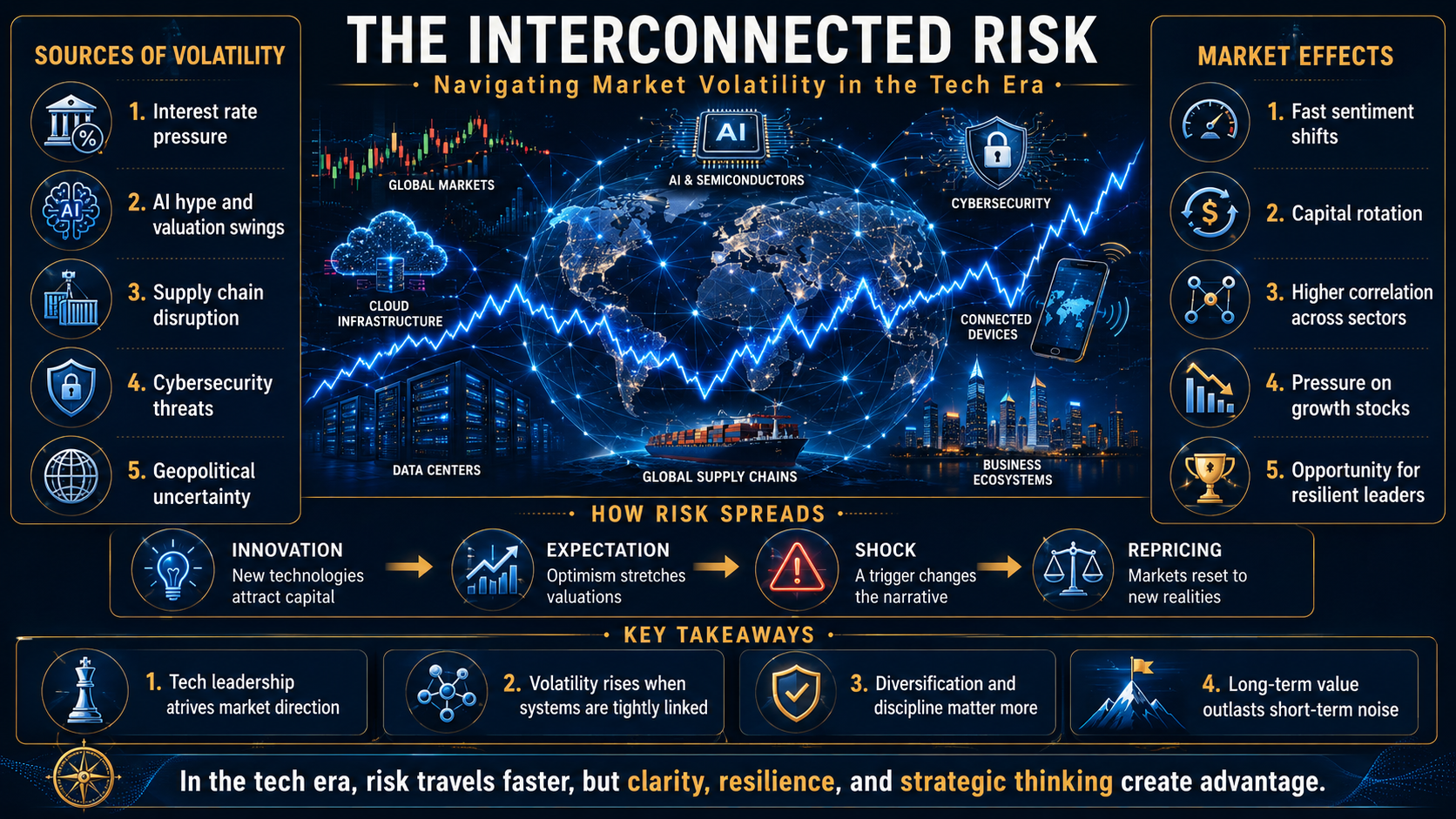
Global financial markets are experiencing a period of heightened sensitivity, where even minor adjustments in specific sector forecasts can trigger widespread volatility. Markets and Technology: Asian indices closed in the red due to disappointing AI chip sales forecasts from Broadcom. In the US, the technology sector (Nasdaq) declined amid concerns that higher interest rates will weigh on the growth of tech companies. This synchronized movement underscores the profound reliance of contemporary equity markets on the continuous, hyper-growth narrative of artificial intelligence.
Why are AI chip sales forecasts acting as a catalyst for market volatility?
The reliance on artificial intelligence as the primary engine for global market growth makes even modest deviations in component demand forecasts a major liability. When a cornerstone player like Broadcom provides outlooks that fail to meet investor expectations, it triggers a cascade of selling, as market participants reassess the valuation premiums assigned to the entire semiconductor supply chain.
This sensitivity exists because the current AI investment cycle is heavily leveraged on expectations of exponential, rather than incremental, growth. When these expectations are challenged, investors immediately look to reduce exposure to hardware manufacturers, fearing that the anticipated “super-cycle” in AI infrastructure may be encountering early resistance. For Asian markets, where the supply chain for these components is heavily concentrated, such news acts as an immediate deflationary shock to equity indices, illustrating the fragility of growth narratives in a high-expectation environment.
How do elevated interest rates fundamentally change the valuation of tech equities?
Technology companies, particularly those in the growth stage, rely on future cash flows that must be discounted back to the present. As interest rates rise, the discount rate applied to these future earnings increases, which mathematically reduces the present-day value of the company, causing valuations to contract regardless of underlying innovation.
What are the long-term implications for the Nasdaq index under restrictive monetary policy?
The Nasdaq, with its concentration of capital-intensive and research-heavy firms, faces a dual challenge: higher borrowing costs and the potential for reduced capital expenditure from corporate clients. As the cost of servicing debt climbs, firms that previously relied on cheap credit to fund aggressive R&D must now pivot toward profitability or face valuation compression.
Statistical projections from investment banks suggest that tech valuations could see a further adjustment of 5-8% if the current “higher-for-longer” interest rate environment persists through the end of 2026. This environment forces investors to discriminate between “true-value” tech firms with strong balance sheets and those whose viability is predicated solely on rapid, debt-funded expansion.
“The market is currently undergoing a painful transition where the promise of AI-driven productivity is being weighed against the harsh reality of capital costs. This is not a shift in the technology, but a shift in the economics of innovation.” — Macro-Economic Tech Strategist
Is the current semiconductor dip an anomaly or a cyclical shift?
While some analysts argue that the current dip is merely a market correction, others see it as a structural pause. Semiconductor demand is notoriously cyclical, and the rush to build AI data centers may be hitting a localized saturation point, leading to a temporary inventory buildup that analysts are beginning to factor into future earnings guidance.
What role does global investor sentiment play in market corrections?
Global investor sentiment in 2026 is driven by algorithmic reaction speeds, which amplify price swings based on incoming data. The immediate “red” close across Asian markets following Broadcom’s guidance shows that sentiment is now more tightly correlated across borders than at any previous point in history. Investors are no longer waiting for quarterly reports to rebalance; they are responding to every headline, creating a “reflexive market” where news flow dictates valuation.
This reflexivity increases the risk of “overshoot,” where indices drop further than justified by fundamental data. However, for the discerning investor, this volatility often masks opportunities. During periods where the tech sector declines based on rate-hike concerns, high-quality companies that have decoupled their revenue from purely speculative AI spending often see their price-to-earnings multiples return to historically attractive levels.
Conclusion: Balancing Innovation with Financial Reality
The recent market turbulence serves as a necessary reminder that technological advancement does not happen in a vacuum, detached from macroeconomic conditions. As the AI sector matures, investors must move beyond the hype and apply rigorous financial scrutiny to the hardware and software companies driving the innovation.
Moving forward, the primary factor for tech company resilience will be the ability to generate free cash flow in an environment where capital is no longer free. The decline in the Nasdaq and the cooling of sentiment in Asian indices are not signals to abandon the technology sector, but rather indicators that the market is entering a phase of professionalization. Investors who prioritize companies with sustainable business models and diversified revenue streams will be better positioned to navigate the risks posed by interest rate cycles and demand fluctuations. By maintaining a focus on fundamental indicators—such as margin stability, debt management, and real-world application of AI rather than just chip volume—market participants can look past the daily volatility. The path forward is not just about the velocity of chip sales, but about the long-term endurance of the companies that build the foundation of our digital future. Success will be defined by identifying those firms capable of turning raw technological potential into consistent, interest-rate-resistant profit.